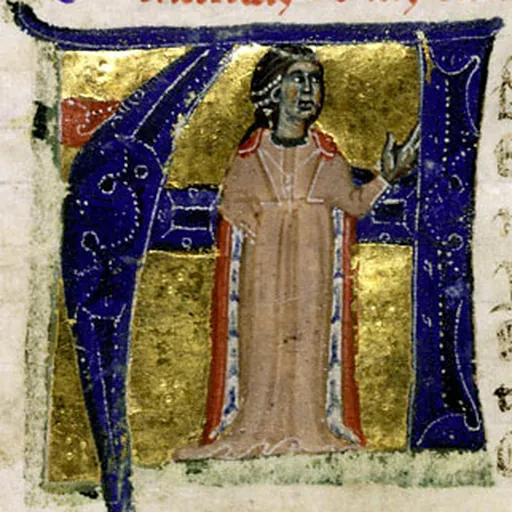
About Comtesse de Die
Lived 980 – 1200. Comtesse de Die was a French trobairitz, poet, writer and composer.
The Comtessa de Dia (Countess of Die), possibly named Beatritz or Isoarda (fl. c. 1175 or c. 1212), was a trobairitz (female troubadour).
She is only known as the comtessa de Dia in contemporary documents, but was most likely the daughter of Count Isoard II of Diá (a town northeast of Montelimar now known as Die in southern France). According to her vida, she was married to William of Poitiers, but was in love with and sang about Raimbaut of Orange (1146-1173). Bruckner, Shepard, and White cite Angela Rieger's analysis of the songs, which associates them, through intertextual evidence, with the circle of poets composed of Raimbaut d'Aurenga, Bernart de Ventadorn, and Azalais de Porcairagues. If her songs are addressed to Raimbaut d'Aurenga's nephew Raimbaut IV, the Comtessa de Dia may have been urging the latter to support Raymond V of Toulouse.
Five of the Comtessa's works survive, including 4 cansos and 1 tenson. Scholars have debated whether or not the Comtessa authored , a tenso typically attributed to Raimbaut d'Aurenga. One reason for this is the similarities between this composition and her own . A second reason references the words in her vida, ("And she fell in love with Sir Raimbaut d'Aurenga, and made about him many good cansos").
A tenso between Giraut de Bornelh and Alamanda de Castelnau closely matches the structure of ("I must sing a song I'd rather not"). The phrase in it, ("dressed nor nude") echoes ("in bed and when I am dressed") in ("I dwell in sorrow"). The tenso may have been composed as a response to these songs.
Her song in the Occitan language is the only canso by a trobairitz to survive with its music intact. The music to A chantar is found only in Le Manuscript du roi (f. 204r-v), a collection of songs copied around 1270 for Charles of Anjou, the brother of Louis IX.
Her extant poems are: In writing style, Comtessa uses a process known as in , repeating the same rhyme scheme in each strophe, but changing the a rhyme each strophe. , on the other hand, uses , changing the rhyme sounds every two strophes, with a rhyme scheme of ab' ab' b' aab'.
Don’t just read it —
keep it.
Full-length biographies made to live with: read them, listen on the way to work, watch them tonight.
- E-book
- Audio
- Video
Instant download · yours to keep · every purchase keeps this site free
Important facts
People in Comtesse de Die's life
Named in this biography and alive at the same time

Related people
Same field, nearest in time




Contemporaries
People whose lives overlapped Comtesse de Die's





Frequently asked questions
Who was Comtesse de Die?
female troubadour (fl. c. 1175 or c. 1212)
When was Comtesse de Die born?
Comtesse de Die was born in 980 in Montélimar.
When did Comtesse de Die die?
Comtesse de Die died in 1200 in Provence.
What was Comtesse de Die's occupation?
Comtesse de Die was a trobairitz, poet, writer and composer.
What nationality was Comtesse de Die?
Comtesse de Die was French.
Sources & further reading
Cite this page
APA: Biography.guide. (2026). Comtesse de Die. https://biography.guide/comtesse-de-die/
MLA: "Comtesse de Die." Biography.guide, https://biography.guide/comtesse-de-die/.
Chicago: "Comtesse de Die." Biography.guide. https://biography.guide/comtesse-de-die/.
Data last updated: 2026-09-20 · Spot an error? Report a correction.
Portrait: Wikimedia Commons · author & licence
Page generated 2026-09-27 05:12 UTC