
About Colin Egar
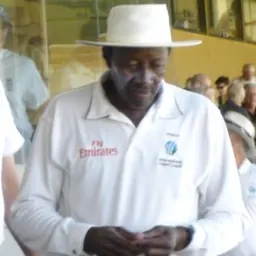
Lived 1928 – 2008 (aged 80). Colin Egar was an Australian cricket umpire and cricketer.
Colin John "Col" Egar (30 March 1928 – 4 September 2008) was an Australian Test cricket umpire.
Born in Malvern, South Australia, Egar umpired in 29 Test matches between 1960 and 1969.
First-class debut Egar started his career as an umpire of Australian rules football and quickly gained a reputation for being a forthright arbiter. He became an umpire in district cricket, and gained a reputation for his willingness to no-ball suspicious bowlers for throwing. In his district career, he called bowlers on eight occasions, not counting multiple no-ball calls against a bowler in the same match.
Egar made his first-class umpiring debut during the 1956–57 season when he stood in South Australia's home Sheffield Shield match against Queensland at the Adelaide Oval. This was Egar's only appointment for the season. At the time, there were no neutral umpires, and the host association provided the officials, so Egar's Sheffield fixtures all took place at the Adelaide Oval.
The following season, Egar became more of a regular, standing in three of the four matches at Adelaide Oval. In 1958–59, Egar stood in all but one of South Australia's three home Shield matches, and officiated a game involving an international team for the first time. He oversaw two matches between South Australia and the touring England cricket team of Peter May,
At the end of this season, the veteran Australian Test umpire Mel McInnes retired after a controversial season and a series of questionable decisions that prompted May and English manager Freddie Brown to call for his standing down. This left a vacancy for an Australian Test umpire. During the 1959–60 Australian summer, there were no home Tests as the national team was in the Indian subcontinent. the fact that Egar made called the bowler for throwing only became apparent to most in the newspapers the next day.
Due to his Test commitments, Egar stood in only two Shield matches for the season. However, Brooks played in a further 16 matches for South Australia over the following three years without incident. During the Tests in 1960–61, as well as in other first-class matches, Egar officiated over Meckiff's bowling, and deemed his bowling legitimate. The bowler noted that the umpire had told him that there was little point in changing his action.
Meckiff was not selected in Tests after some poor performances in 1960–61. In 1962–63, Meckiff was again under the spotlight. He topped the bowling averages for the Australian first-class season with 58 wickets at 19.86 from ten matches, as Victoria won the Sheffield Shield. Meckiff was hoping to regain his Test place, but was not selected despite his success. Problems arose when he was no-balled in separate matches, by Jack Kierse in a match hosted by South Australia, and another hosted by Queensland. In both matches he continued bowling without further incident.
Meckiff's performances as the leading wicket-taker during the 1962–63 season meant that he could not be justifiably denied national selection on grounds of productivity,
At the start of the season, the Australian Board of Control had issued a directive calling on the umpires to "get tough" in enforcing the laws of cricket, and asked the state associations to "back the umpires to the fullest extent". In the lead-up to the Test, Meckiff was the centre of media attention, and one report described him as cricket's "bogey man". Reaction in England was also hostile, ahead of Australia's forthcoming tour in the English summer of 1964. They unequivocally called Meckiff a thrower.
The Brisbane Test was dubbed "Meckiff's Test" by the Australian media; speculation abounded that the bowler was being chosen so that he could be no-balled as a public relations effort to promote Australia's anti-throwing credentials. As a close friend of the fast bowler, umpire Egar was in a difficult situation; the duo had won a pairs lawn bowling competition just a few months earlier. On the second day, South Africa began to bat just after the luncheon interval. Graham McKenzie conceded 13 runs from the first over. At the same time, the South African manager Ken Viljoen set up a camera and began filming the left-armer's bowling action. Egar ruled the second, third, fifth and ninth balls to be throws, and therefore illegitimate. Meckiff had previously been passed in five countries, having played Tests in four of these nations. Egar had cleared his bowling on five previous occasions, in three Shield matches and two Tests; the Victorian had bowled 119.1 overs in these games without incident. Egar later said "My only judgement was what I saw at the time". Benaud removed his paceman from the attack and Meckiff did not bowl again in the match.
Barry Gibbs, the secretary of the Queensland Cricket Association and the manager of the Australian team, said that the "humiliation" of Meckiff was "without a doubt the most dramatic and emotion-charged" sporting moment he had witnessed. Egar's actions also ignited "one of the most emotional crowd displays in Test history", Half an hour before the close of the day's play, proceedings were suspended for two minutes as the crowd repeatedly chanted "We want Meckiff". After this incident, the Queensland Police escorted the umpire to and from the match venue.
Reaction During a rest day after the second day's play the media dissected the events of the previous afternoon. The South African Charles Fortune wrote that Meckiff's action was "not according to the laws of cricket" although he would not call the Australian bowler a "chucker". Egar said that he was "the second most upset person in the world", and later added that he thought Meckiff's first ball was suspect. He said that he could have called more deliveries, but was worried that the over would never end. Retired Test umpires Hoy and Les Townsend were watching at the ground when Meckiff was called. The day after the incident, both asserted that they would not have no-balled the paceman, claiming that Meckiff's action, though unusual, was legitimate.
Meckiff later agreed to a series of ghost-written articles about the no-ball incident. He said that Egar's calls "hit him like a dagger in the back", A dinner hosted by board member Don Bradman in January 1963 for visiting state captains was later cited to suggest that Meckiff may have been a sacrificial offering. At the dinner, Bradman had shown film of Meckiff among others, which purportedly depicted incriminating actions. This indicated Bradman's doubts over Meckiff's legitimacy, yet Bradman was one of the selectors who oversaw Meckiff's inclusion.
Many members of the Australian media alleged a conspiracy against Meckiff, using words such as "the whole affair smacks of a set-up", Several called for Bradman and his colleagues to resign. Gibbs later claimed that the selection of an extra bowler for the match hinted at fears that Meckiff would not be able to bowl. Alan Connolly remained adamant that his teammate's action was legitimate and implied a conspiracy, saying "I wasn't amazed [by Egar's call]...There was a good reason for that which I can't disclose and won't disclose." Tom Veivers, who made his Test debut for Australia in Meckiff's last match, hinted at the same. He recalled that Rowan had said "It's going to be a very interesting game" at the pre-match function.
Egar stood in all five Tests as well as four of South Australia's home matches during 1963–64. Despite taking a total of 7/71 on debut, Illingworth was overlooked for further state selection for over two years. Illingworth's best performance in a Sheffield Shield match was against South Australia at the Adelaide Oval in November 1964, the same match in which he was called.
Illingworth took 4/92 in South Australia's first innings but was no-balled a total of three times by Egar and his partner Jack Ryan, both standing at square leg. He was called twice by Egar on the second and fourth deliveries of his eleventh over, and once by Ryan on the sixth ball of his fourteenth over. In the same fourteenth over, Illingworth had dismissed former Pakistani Test batsman Duncan Sharpe and Australian Test wicket-keeper Barry Jarman from the first and fourth deliveries respectively. Victorian captain Bill Lawry chose not to remove Illingworth and continued to bowl him.
In 1965–66, Egar had the busiest season of his career. He stood in all five Anglo-Australian Tests, two matches between South Australia and England, and three of his state's home Shield matches.
The following season, the Test team were in India and South Africa, and Egar stood in all four of South Australia's home Shield fixtures.
Criticism of throwing Egar remained outspoken about bowling actions that he considered to be dubious in his later life. He was strongly critical of the action of the Sri Lankan world record-breaking spinner Muttiah Muralitharan. In 2002, he criticised Wisden for ranking Muralitharan the best bowler in Test history, citing his bowling action. After Muralitharan broke the world record for career Test dismissals, Egar said "As far as I am concerned they should have a separate record for bowlers with illegal actions...I've got a photo at home of Murali's arm bending at 48 degrees." Egar criticised laboratory tests on Muralitharan at the University of Western Australia as "rubbish...The only tests that matter are those conducted under match conditions...The administrators of the game have got to take the blame for letting his action go."
Don’t just read it —
keep it.
Full-length biographies made to live with: read them, listen on the way to work, watch them tonight.
- E-book
- Audio
- Video
Instant download · yours to keep · every purchase keeps this site free
Important facts
People in Colin Egar's life
Named in this biography and alive at the same time




Related people
Same field, nearest in time





Contemporaries
People whose lives overlapped Colin Egar's





Frequently asked questions
Who was Colin Egar?
Australian cricket umpire (1928-2008)
When was Colin Egar born?
Colin Egar was born on 30 March 1928 in Malvern.
When did Colin Egar die?
Colin Egar died on 4 September 2008 in Adelaide.
What was Colin Egar's occupation?
Colin Egar was a cricket umpire and cricketer.
What nationality was Colin Egar?
Colin Egar was Australian.
Sources & further reading
Cite this page
APA: Biography.guide. (2026). Colin Egar. https://biography.guide/colin-egar/
MLA: "Colin Egar." Biography.guide, https://biography.guide/colin-egar/.
Chicago: "Colin Egar." Biography.guide. https://biography.guide/colin-egar/.
Data last updated: 2026-09-20 · Spot an error? Report a correction.
Page generated 2026-09-27 05:07 UTC