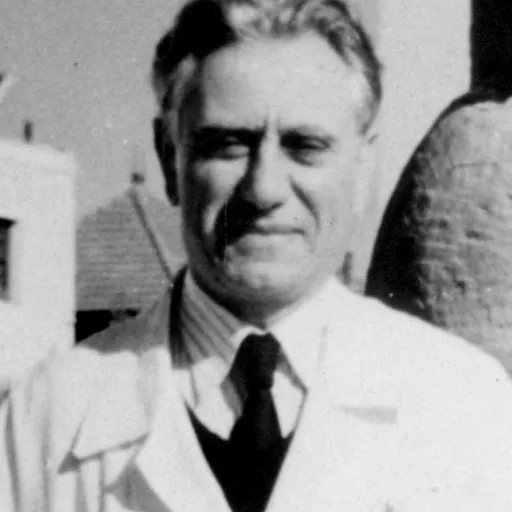
About Clemente Estable
Lived 1894 – 1976 (aged 82). Clemente Estable was an Uruguayan biologist, teacher, essayist, esperantist and pedagogue.
Clemente Estable (23 May 1894 – 27 October 1976) was a Uruguayan biologist, researcher, and professor, best known for his work in cellular biology and neurobiology research.
In collaboration with Eduardo De Robertis and Magdalena Reissig, Estable authored a study providing definitive proof for neuron theory using the first electron microscope in South America. Estable's work showed that the nervous system was not a continuous network, but rather made up of individual neurons separated by gaps called synapses.
The , which he founded in 1927, is named in his honor.
Early life Estable was born on 23 May 1894 in a rural area of Canelones, now known as Santa Lucía. He was born ninth of the fourteen children of Giuseppe Stabile and Giuseppa Fallabella, Italian immigrants from San Rufo who immigrated to Uruguay in 1865.
Estable was also an autodidact of biology, psychology, and microscopy.
Career After graduating in 1914, he taught at public schools in Montevideo: Primary School #38, the Artigas School, and the España Vocational School. He also returned to teach at the Normal Institutes, where he became the chair of natural history.
In 1925, he returned to Montevideo and founded the Laboratory of Biology and Cinematography. A year later, awarded him a posting as Chief of Histological Research at the Neurological Institute.
By 1930, Estable developed The Plan Estable, which called for teaching the scientific method as a learning tool in primary school. Through Estable's plan, the scientific method was adopted into the curricula of Natural and Applied Sciences. That same year, Estable presided over the First International Congress of Biologists in Montevideo, as president of The Uruguayan Society of Biologists.
In the 1930s, Estable was appointed professor of biology at schools of law and medicine. He also received an honorary degree from the University of Santiago, Chile.
In 1948, he presided over the first Latin American Scientists Congress, organized by UNESCO and WHO. In 1959, he was given the title of Honorary Professor of Universidad de Montevideo. In 1962, he was awarded the Legion of Honour, the highest French order of merit. In the same year, Italy awarded him an honorary position as a member of The Medical Academy of Rome.
According to Estable, scientific research, artistic creation, or philosophical reflections should offer the possibility of living with dignity in civil society. Further, he proposed that the scientist, the artist, and the philosopher all fulfill essential societal and national functions. Therefore, it is the responsibility of the elected public officials to promote these professions and create adequate conditions for them to execute their work.
Personal life During Estable's posting at the Neurological Institute, he met Isabel Puig, also a teacher. They eventually married and had three children.
Death and legacy On 27 October 1976, Estable died at the age of 82. Due to his contributions to the cultural, pedagogic, political, and scientific arenas, Estable was buried with a full ceremony reserved for Ministers of State.
In 1994, Uruguay released a stamp in his honor on the 100th anniversary of his birth. That same year, the legislature passed Law No. 16.572, which designated 15 elementary schools to be named in his honor.
Don’t just read it —
keep it.
Full-length biographies made to live with: read them, listen on the way to work, watch them tonight.
- E-book
- Audio
- Video
Instant download · yours to keep · every purchase keeps this site free
Important facts
People in Clemente Estable's life
Named in this biography and alive at the same time

Related people
Same field, nearest in time




Contemporaries
People whose lives overlapped Clemente Estable's


Frequently asked questions
Who was Clemente Estable?
Uruguayan researcher (1894–1976)
When was Clemente Estable born?
Clemente Estable was born on 23 May 1894 in Santa Lucía, Canelones Department.
When did Clemente Estable die?
Clemente Estable died on 27 October 1976 in Montevideo.
What was Clemente Estable's occupation?
Clemente Estable was a biologist, teacher, essayist, esperantist and pedagogue.
What nationality was Clemente Estable?
Clemente Estable was Uruguayan.
Sources & further reading
Cite this page
APA: Biography.guide. (2026). Clemente Estable. https://biography.guide/clemente-estable/
MLA: "Clemente Estable." Biography.guide, https://biography.guide/clemente-estable/.
Chicago: "Clemente Estable." Biography.guide. https://biography.guide/clemente-estable/.
Data last updated: 2026-09-23 · Spot an error? Report a correction.
Portrait: Wikimedia Commons · author & licence
Page generated 2026-09-27 05:07 UTC