About Clement
Clement was a Roman theologian and catholic priest.
Clement of Rome (; ; died ), also known as Pope Clement I, was the Bishop of Rome in the late first century. He is considered to be the first of the Apostolic Fathers of the Church.
Little is known about Clement's life. Tertullian claimed that Clement was ordained by Saint Peter. Early church lists place him as the second or third In Against Heresies, Irenaeus described Clement as the successor to Anacletus, who was the third bishop of Rome, and as a personal acquaintance of the Apostles. According to the Annuario Pontificio, Clement was the fourth bishop of Rome, holding office at the very end of the 1st century. (The 2008 Annuario pontificio gives the dates as either 92–99 or 68–76.) However, the 2012 edition settles for 92 as the beginning date, following Eusebius and Jerome. The date of 68–76 is given by the later Catalogus Liberianus and Liber Pontificalis, which are not trustworthy for the chronology of the first popes. All four sources give Peter an episcopate of 25 years in Rome, and the Liber Pontificalis even records that Peter died 38 years after Jesus' death, that is, 67–68. However, the Catalogus and Liber counted Peter's episcopate from 30 and thus arrived to 55, as Pope Linus is said to have succeeded in 56. The author thus "gives two incompatible traditions." The year of Clement's death is disputed, it was 99 according to Jerome and 100 according to Eusebius (and the Liber Pontificalis, despite previously stating that his tenure ended in 76). The Liber Pontificalis states that Clement died in Greece in the third year of Trajan's reign, or 100.
The only known genuine extant writing of Clement is his letter to the church at Corinth (1 Clement) in response to a dispute in which certain presbyters of the Corinthian church had been deposed. He asserted the authority of the presbyters as rulers of the church because they had been appointed by the Apostles.
Life
The Liber Pontificalis presents a list that makes Linus the second in the line of bishops of Rome, with Peter as first; but at the same time it states that Peter ordained two bishops, Linus and Anacletus, for the priestly service of the community, devoting himself instead to prayer and preaching, and that it was to Clement that he entrusted the Church as a whole, appointing him as his successor. Tertullian considered Clement to be the immediate successor of Peter. In one of his works, Jerome listed Clement as "the fourth bishop of Rome after Peter, if indeed the second was Linus and the third Anacletus, although most of the Latins think that Clement was second after the apostle." Clement is put after Linus and Cletus/Anacletus in the earliest (c. 180) account, that of Irenaeus, who is followed by Eusebius of Caesarea.
Early succession lists name Clement as the first, second, or third Some believe there were presbyter-bishops as early as the 1st century, A tradition that began in the 3rd and 4th century, The Liber Pontificalis, which documents the reigns of popes, states that Clement had known Peter.
Clement is known for his epistle to the church in Corinth (c. 96), in which he asserts the apostolic authority of the bishops/presbyters as rulers of the church. about an ancient veneration of the relics in Chersonesus and the translation of the head to Kyiv. Other relics of Clement, including his head, are claimed by the Kyiv Monastery of the Caves in Ukraine.
Writings The Liber Pontificalis states that Clement wrote two letters (though the second letter, 2 Clement, is no longer ascribed to him by many modern scholars). It is considered the earliest authentic Christian document outside the New Testament.
Clement writes to the troubled congregation in Corinth, where certain "presbyters" or "bishops" have been deposed (the class of clergy above that of deacons is argued by certain historians to be designated indifferently by the two terms). But by the middle of the second century all the leading Christian centres had bishops.
Clement's letter also contains historical references, it mentions persecutions of Christians, records the martyrdom of the Apostle Peter and suggests that the apostle Paul traveled to Spain. The Protestant scholar Tom Schreiner argued that Clement of Rome believed in a grace oriented justification by faith, which will cause the believer to do works as a result, Philip Schaff also said that Clement probably taught a faith alone doctrine while Catholic Encyclopedia wrote that Clement believed works to be part of justification. And so we, having been called through His will in Christ Jesus, are not justified through ourselves or through our own wisdom or understanding or piety or works which we wrought in holiness of heart, but through faith, whereby the Almighty God justified all men that have been from the beginning; to whom be the glory for ever and ever. Amen. (1 Clement 32:4) but most scholars see the epistle as more fraternal than authoritative, and Orthodox scholar John Meyendorff sees it as connected with the Roman church's awareness of its "priority" (rather than "primacy") among local churches. It has also been argued by Dave Armstrong, that Clement supported Papal Infallibility in Letter to the Corinthians 1, 63. Because of him speaking of the Corinthians to "being obedient" to the things he has "written through the Holy Spirit" in order to correct and "root out the wicked passion of jealousy".
It has also been argued that the epistle may contain early evidence for belief in universal salvation.
According to Catholic Encyclopedia, the letter of Clement has Trinitarian theology and Christ is frequently called as the high priest by him. Doubts about the authorship were already expressed in antiquity by Eusebius and Jerome.
Epistles on Virginity Two "Epistles on Virginity" were traditionally attributed to Clement, but now there exists almost universal consensus that Clement was not the author of those two epistles.
False Decretals
A 9th-century collection of church legislation known as the False Decretals, which was once attributed to Isidore of Seville, is largely composed of forgeries. All of what it presents as letters of pre-Nicene popes, beginning with Clement, are forgeries, as are some of the documents that it attributes to councils; and more than forty falsifications are found in the decretals that it gives as those of post-Nicene popes from Sylvester I (314–335) to Gregory II (715–731). The False Decretals were part of a series of falsifications of past legislation by a party in the Carolingian Empire whose principal aim was to free the church and the bishops from interference by the state and the metropolitan archbishops respectively.
Clement is included among other early Christian popes as authors of the Pseudo-Isidoran (or False) Decretals, a 9th-century forgery. These decrees and letters portray even the early popes as claiming absolute and universal authority. Clement is the earliest pope to whom a Pseudo-Isidoran text is attributed.
Clementine literature
Clement is also the hero of an early Christian romance or novel that has survived in at least two different versions, known as the Clementine literature, where he is identified with Emperor Domitian's cousin Titus Flavius Clemens. Clementine literature portrays Clement as the Apostles' means of disseminating their teachings to the Church.
The St Clement's Church in Moscow is renowned for its glittering Baroque interior and iconostasis, as well as a set of gilded 18th-century railings. The parish was disbanded in 1934 and the original free-standing gate was demolished. The Lenin State Library stored its books in the building throughout the Soviet period. It was not until 2008 that the building reverted to the Russian Orthodox Church.
Clement of Rome is commemorated in the Synaxarium of the Coptic Orthodox Church of Alexandria on the 29th of the month of Hatour [25 November (Julian) – equivalent to 8 December (Gregorian) due to the current 13-day Julian–Gregorian Calendar offset]. According to the Coptic Church Synaxarium, he suffered martyrdom in 100 during the reign of Emperor Trajan (98–117). He was martyred by tying his neck to an anchor and casting him into the sea. The record of the 29th of the Coptic month of Hatour states that this saint was born in Rome to an honorable father whose name was Fostinus and also states that he was a member of the Roman senate and that his father educated him and taught him Greek literature.
Relics Besides relics venerated in Rome and Kyiv (see above), in the city of Santa Cruz de Tenerife in Spain, the shinbone of Clement is kept. It was a gift of Sidotti, Patriarch of Antioch, to the Church of the Immaculate Conception. Historically, this was a highly revered relic in the city.
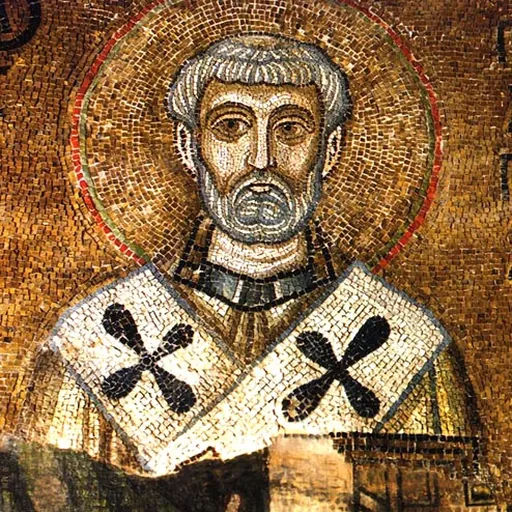
Symbolism Anchored Cross, also known as Mariner's or Saint Clement's cross. In workings of art, Clement can be recognized by having an anchor at his side or tied to his neck. He is most often depicted wearing papal vestments, including the pallium, and sometimes with a papal tiara but more often with a mitre. He is also sometimes shown with papal symbols such as the papal cross and the Keys of Heaven. In reference to his martyrdom, he often holds the palm of martyrdom.
Clement can be seen depicted near a fountain or spring, relating to the incident from his hagiography, or lying in a temple in the sea. The Anchored Cross or Mariner's Cross is also referred to as St. Clement's Cross, in reference to the way he was martyred.
Don’t just read it —
keep it.
Full-length biographies made to live with: read them, listen on the way to work, watch them tonight.
- E-book
- Audio
- Video
Instant download · yours to keep · every purchase keeps this site free
Important facts
more
Pope Kelemen I, Pope Klyment I, Pope Klemens I, Clement the Bishop, Clemens the Bishop, Flavius Clemens, Saint Clemens, San Clemente, St. Clement, St. Clemens, Clemens, Clemens Romanus, Iklīmindis al-Rūmānī, Kelemen, Klemens, Klēmēs, Kliment, Klyment, KlymentiĭRelated people
Same field, nearest in time


Frequently asked questions
Who was Clement?
4th Pope of the Catholic Church
When was Clement born?
Clement was born in Rome.
When did Clement die?
Clement died in Chersonesus.
What was Clement's occupation?
Clement was a theologian and catholic priest.
What nationality was Clement?
Clement was Roman.
Sources & further reading
Cite this page
APA: Biography.guide. (2026). Clement. https://biography.guide/clement-theologian/
MLA: "Clement." Biography.guide, https://biography.guide/clement-theologian/.
Chicago: "Clement." Biography.guide. https://biography.guide/clement-theologian/.
Data last updated: 2026-09-23 · Spot an error? Report a correction.
Portrait: Wikimedia Commons · author & licence
Page generated 2026-09-27 05:08 UTC