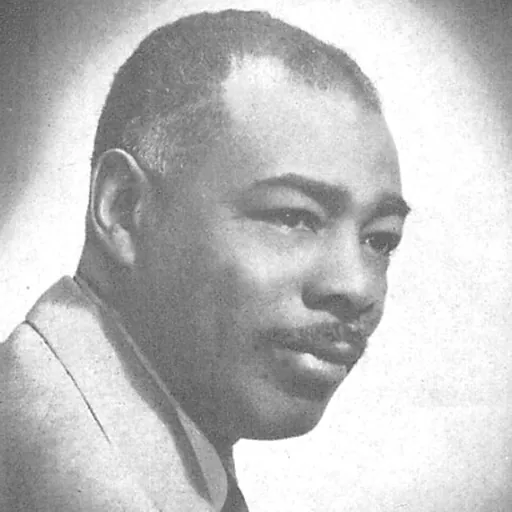
About Claude Lightfoot
Lived 1910 – 1991 (aged 80–81). Claude Lightfoot was an American writer.
Claude M. Lightfoot (January 19, 1910 – July 17, 1991) was an African American activist, politician, and author. From 1957 until his death in 1991 Lightfoot was a functionary of the Communist Party USA (CPUSA) and was several times the nominee of that party for public office. The author of many books and articles about racism and communism, Lightfoot also traveled and lectured throughout the world.
On June 26, 1954, during the McCarthy era, Lightfoot was arrested based on the Smith Act of 1940 and put on trial. While previous Smith Act indictments had been of individuals accused directly of attempting to overthrow the US government by force or violence, Lightfoot was indicted merely for being a member of the Communist Party, which, in turn, was alleged to be attempting to overthrow the government. His conviction in January 1955 was appealed all the way to the U.S. Supreme Court, which reversed the conviction , resulting in Lightfoot's acquittal in 1961.
Early life Claude M. Lightfoot was born on January 19, 1910, in Lake Village, Arkansas. Soon after his birth his parents left him to be cared for by his grandmother, Frances Henderson Lightfoot, A former slave who managed to acquire a large cotton farm in Lake Village. Claude lived with his grandmother for the first six years of his life before moving to Little Rock, Arkansas to be with his parents. In Little Rock, the living conditions were much worse than they had been on his grandmother's farm in Lake Village. His parents struggled to put food on the table, a major factor contributing their decision to move north to Chicago's South Side in 1917. Other members of his family began to migrate north and by the following year his entire family had settled in Chicago.
In Chicago, Lightfoot began to develop his interest in politics. This is also the period where he began to realize more fully the disadvantaged position that African Americans occupy in society. He noted that despite the popular notion that racism in the North did not compare with racism in the south, Lightfoot noticed that as an African-American, Jim Crow would follow him wherever he went. During this time in his life, Lightfoot became drawn to Marcus Garvey and black nationalism. At this time he believed in black capitalism, and the idea that African Americans should form their own economy separate from the economy run by the whites and exploiting blacks. A few of the things that drew Lightfoot to Garvey were the poor treatment of African American veterans coming back from World War One, the Chicago race riot of 1919, as well as other members of his family who were also attracted to Garvey's ideas.
Lightfoot's formal education came to an end when he was forced to drop out of high school in order to help make money for his family. With the exception of spending one year at Virginia Union University in Richmond the rest of his education would be self taught.
Becoming a communist Lightfoot continued to believe in Marcus Garvey's black nationalist vision into his twenties. While in his twenties he joined the Democratic party breaking from his previous alliance with the Republican party which he had previously identified with due to its reputation as the party of Abraham Lincoln. In 1930 he helped to form the Young Men's Black Democratic Club. He continued to work towards improving the living conditions of African Americans through economic enrichment.
During the Great Depression Lightfoot became disillusioned with the Democratic Party and with the idea of capitalism as a whole. He came to the conclusion that African Americans could never achieve true equality within the capitalist system as it is controlled by whites and even through black capitalism African Americans would still be reliant on the white business moguls above them. Because of this, Lightfoot concluded that the best way to achieve racial equality in America is through abandoning capitalism and creating an equal society through communism.
Political career
Lightfoot officially became a member of the Communist Party USA in the summer of 1931. In 1932 he ran for Illinois State Senate on the Communist Party ticket and received a total of 33,000 votes. In 1935, Lightfoot traveled to the Soviet Union as a delegate to the 7th World Congress of the Comintern. In 1936, he was the Communist Party nominee for Illinois Attorney General. A staunch communist by this point, Lightfoot originally opposed American intervention in World War II. However, he changed his opinion upon the Nazi invasion of the Soviet Union, becoming a strong supporter of the war and joining the U.S. Army, Green was forced to give up the presidency of the party and Lightfoot took over the Illinois Communist Party under the title of Executive Secretary.
Lightfoot's appeal of the verdict was initially shot down by the U.S. court of appeals on January 20, 1956. After this he announced that he would call for a rehearing in a lower court and if this failed he would appeal the verdict to the U.S. Supreme Court. Two months after this, his appeal was granted by the court of appeals. In October 1957 the seventh circuit court of appeals reversed the ruling on the technicality that the defense did not have access to the FBI reports which were used as evidence against Lightfoot in the trial. This ruling triggered a retrial which would be repeatedly delayed until 1961 when, due to new standards of proof and rules on evidence, on November 15, 1961, the United States Federal government was forced to drop the charges against Lightfoot. They conceded that their evidence was insufficient to prove that Lightfoot had either "knowledge of the party’s advocacy of the violent overthrow of the Government, or personally advocated it". For the first time in almost seven years the threat of imprisonment was no longer hanging of Lightfoot's head.
Later life In the 1970s Lightfoot wrote newspaper columns for the Chicago Courier. In 1973 he received an honorary doctorate from the University of Rostock in East Germany for his book Racism and Human Survival: Lessons of Nazi Germany for Today's World. He was also honored by the W.E.B. DuBois Clubs of America and the Bulgarian and Soviet Communist parties.
Personal life Lightfoot married Geraldyne Gray in 1938. She was a CPUSA organizer who died of cancer in 1962; they adopted a disabled son, Earl, around 1955. Lightfoot married a woman named Joyce in 1965 and adopted a daughter named Tanya. He donated his papers to the Chicago Historical Museum in 1986.
Lightfoot's autobiography, which was also his doctoral thesis at the University of Illinois, is From Chicago's Ghetto to World Politics: The Life and Struggles of Claude M. Lightfoot. It was first published as Black America and the World Revolution (New York: New Outlook Publishers, 1970). A 1980 augmented edition was titled Chicago Slums to World Politics.
Daily World gallery
Works An American looks at Russia: Can we live together in peace? (New York: New Century Publishers, 1951), 23 pp. "Not guilty!" The Case of Claude Lightfoot, by Claude M. Lightfoot (New York: New Century Publishers, 1955), 15pp. (Based on a speech delivered Mar. 26, 1955 in Los Angeles, Calif.) The Struggle to End the Cold War at Home (New York: New Century Publishers, 1956). (Reprinted from Political Affairs, September, 1955) The Challenge of the '56 elections (New York: New Century Publishers, 1956), 24 pp. (Report to the National Committee of the Communist Party) The Negro Question in the U.S.A. (New York: New Century Publishers, 1960). (Address to the 17th National Convention of the Communist Party, USA) Turning Point in Freedom Road: The fight to end Jim Crow now (New York: New Century Publishers, 1962), 46 pp. "Building a Negro and White alliance for progress," in: Negro liberation: A Goal for all Americans, by Henry Winston Winston, Gus Hall, Claude M Lightfoot and William L Patterson (New York: New Currents Publishers, 1964). "The Path to Negro Freedom," World Marxist Review, VIII, no. 10 (October 1965), pp. 20–29. Black power and liberation: A communist view (New York: New Outlook Publishers, 1967), 46 pp. Ghetto Rebellion to Black Liberation (New York: International Publishers, 1968), 192 pp. O poder negro em revolta (Río de Janeiro: Paz e Terra, 1969). (Portuguese translation of Ghetto Rebellion to black liberation) "Black liberation in a socialist, Asian and African perspective," in: Some aspects of the Black liberation struggle: Two lectures, by William Patterson and Claude Lightfoot (Black Liberation Commission, Communist Party, United States of America, 1969). (lecture delivered at Fisk University on October 15, 1969, at a Moratorium Day Rally to End the War in Vietnam) The Civil War and black liberation today (New York: New Outlook Publishers, 1969), 45 p. Racism and human survival: Lessons of Nazi Germany for today's world (New York, International Publishers, 1972), 287 pp. illus. Vosstanija v getto za osvobozzdenie negrov (Moscow: Izd. Progress, 1972). The Effect of education on racism: The two German states and the USA (New York, New Outlook, 1973). Der Kampf für die Befreiung der Afroamerikaner (Berlin: Dietz, 1973), 216 pp. (translation of Ghetto rebellion to black liberation) Human rights U.S. style: From colonial times through the New Deal (New York: International Publishers, 1977), 229 pages. Salute to Black history honoring Dr. Claude Lightfoot (Salsedo Press, Chicago: 1979), pamphlet. Chicago Slums to world politics: Autobiography of Claude M. Lightfoot (New York: New Outlook, 1980), 226 pp, illus. (with Timothy V Johnson) "A New Outlook on Life," in: Political Affairs 71:2(February 1992), 18–25.
Footnotes
Don’t just read it —
keep it.
Full-length biographies made to live with: read them, listen on the way to work, watch them tonight.
- E-book
- Audio
- Video
Instant download · yours to keep · every purchase keeps this site free
Important facts
People in Claude Lightfoot's life
Named in this biography and alive at the same time






Related people
Same field, nearest in time

Contemporaries
People whose lives overlapped Claude Lightfoot's






Frequently asked questions
Who was Claude Lightfoot?
author and Communist
When was Claude Lightfoot born?
Claude Lightfoot was born in 1910.
When did Claude Lightfoot die?
Claude Lightfoot died in 1991.
What was Claude Lightfoot's occupation?
Claude Lightfoot was a writer.
What nationality was Claude Lightfoot?
Claude Lightfoot was American.
Sources & further reading
Cite this page
APA: Biography.guide. (2026). Claude Lightfoot. https://biography.guide/claude-lightfoot/
MLA: "Claude Lightfoot." Biography.guide, https://biography.guide/claude-lightfoot/.
Chicago: "Claude Lightfoot." Biography.guide. https://biography.guide/claude-lightfoot/.
Data last updated: 2026-09-24 · Spot an error? Report a correction.
Portrait: Wikimedia Commons · author & licence
Page generated 2026-09-27 05:08 UTC