
About Claude-Auguste Lamy
Lived 1820 – 1878 (aged 57). Claude-Auguste Lamy was a French physicist, chemist and university teacher, known for Thallium.
Claude Auguste Lamy (; 15 July 1820 – 20 March 1878) was a French physicist and chemist who discovered the element thallium independently from William Crookes in 1862; as a result, they are considered co-discoverers, although they did not collaborate.
Early life and education
Lamy was born in the commune of Ney in the department of Jura, France in 1820. Lamy's father-in-law was Frédéric Kuhlmann.
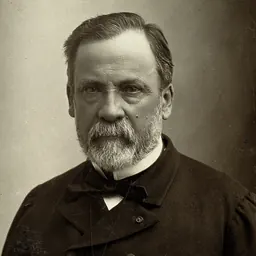
After secondary school in Poligny, Dole and finally Paris, Auguste Lamy entered the École Normale Supérieure and was a fellow student of Louis Pasteur; he graduated in 1842. He became a teacher at and again in Lille. In 1845, he was awarded the agrégation in physics and the licencié in natural sciences.
Working life
From 1848 to 1850, he began his career as a physics teacher at a college in Lille (following Louis Pasteur there), then at Limoges, then at the Écoles académiques de Lille from 1852. He defended his doctoral thesis in Paris in 1851. He taught about thermodynamics, industrial physics and hydraulic presses, distillation and explosions.
In 1854 he became a professor at the faculty of sciences of Lille (Université Lille Nord de France). He taught at École des arts industriels et des mines (École centrale de Lille). In 1866 he changed to the École Centrale des Arts et Manufactures (École centrale de Paris).was awarded the chair of physics at the faculté des sciences de Lille in 1854.
He also taught at the École des arts industriels et des mines in Lille (École centrale de Lille) for 11 years before moving to Paris, where in 1865 he was awarded the Chair of Industrial Chemistry at the École centrale des arts et manufactures, as successor to Anselme Payen.
A member of the Société des sciences, de l'agriculture et des arts de Lille, he became president of the Société française de chimie in 1873.
Discovery of thallium
In 1862, in Lille, Claude Auguste Lamy identifies and isolates 14 grams of the element thallium using the spectroscope loaned by his brother-in-law, the chemist Jules Frédéric Kuhlmann. In 1861, however, this chemical element had been previously described by William Crookes who was studying by spectroscopy the light emitted by a heated selenium ore.
Don’t just read it —
keep it.
Full-length biographies made to live with: read them, listen on the way to work, watch them tonight.
- E-book
- Audio
- Video
Instant download · yours to keep · every purchase keeps this site free
Important facts
People in Claude-Auguste Lamy's life
Named in this biography and alive at the same time



Related people
Same field, nearest in time




Contemporaries
People whose lives overlapped Claude-Auguste Lamy's



Frequently asked questions
Who was Claude-Auguste Lamy?
19th-century French chemist
When was Claude-Auguste Lamy born?
Claude-Auguste Lamy was born on 15 June 1820 in Ney.
When did Claude-Auguste Lamy die?
Claude-Auguste Lamy died on 20 March 1878 in Paris.
What was Claude-Auguste Lamy's occupation?
Claude-Auguste Lamy was a physicist, chemist and university teacher.
What was Claude-Auguste Lamy known for?
Claude-Auguste Lamy was known for Thallium.
What nationality was Claude-Auguste Lamy?
Claude-Auguste Lamy was French.
Sources & further reading
· Wikipedia: Claude-Auguste Lamy
· DBpedia: Claude-Auguste Lamy
Cite this page
APA: Biography.guide. (2026). Claude-Auguste Lamy. https://biography.guide/claude-auguste-lamy/
MLA: "Claude-Auguste Lamy." Biography.guide, https://biography.guide/claude-auguste-lamy/.
Chicago: "Claude-Auguste Lamy." Biography.guide. https://biography.guide/claude-auguste-lamy/.
Data last updated: 2026-09-20 · Spot an error? Report a correction.
Page generated 2026-09-27 05:24 UTC