
About Clare of Assisi
Lived 1194 – 1253 (aged 59). Clare of Assisi was a nun, author, religious writer, founder of Catholic religious community, mystic and philosopher.
Chiara Offreduccio (16 July 1194 – 11 August 1253), known as Clare of Assisi (sometimes spelled Clara, Clair or Claire; ), is an Italian saint who was one of the first followers of Francis of Assisi.
Inspired by the teachings of St. Francis, St. Clare founded the Order of Poor Ladies, a monastic religious order for women in the Franciscan tradition. The Order of Poor Ladies was different from any other order or convent because it followed a rule of strict poverty. Clare wrote their Rule of Life, the first set of monastic guidelines known to have been written by a woman. Following her death, the order she founded was renamed in her honor as the Order of Saint Clare, commonly referred to today as the Poor Clares. Her feast day is on the 11th of August every year.
Early life
Clare was born in Assisi to the Offreduccio household during the High Middle Ages, the eldest daughter of Favarone or Favorino Sciffi, Count of Sasso-Rosso, and his wife Ortolana. Traditional accounts say that Clare's father was a wealthy representative of an ancient Roman family, who owned a large palace in Assisi and a castle on the slope of Mount Subasio. Ortolana belonged to the noble family of Fiumi, and was a very devout woman who had undertaken pilgrimages to Rome, Santiago de Compostela, and the Holy Land. Later in life, after being widowed, Ortolana entered Clare's monastery.
Clare's younger sisters, Beatrix and Catarina, followed her into religious life. (The latter took the name Agnes and became an early abbess in the order. She established it in additional communities, and was declared a saint herself in the mid-18th century.)
As children, Clare and her sisters were taught the ways of Christianity by their mother; they all became very religious and devoted to prayer. When Clare was 12 years old, her parents wanted her to marry a wealthy young man; however, she protested and said that she did not want to marry until she turned 18. As a teen, she heard Francis preach during a Lenten service in the church of San Giorgio at Assisi.
Inspired by his words and knowing that marriage was rapidly approaching, Clare went to Francis and asked him to help her to live after the manner of the Gospel.
Life in the convent Saint Clare intervenes to save a child from a wolf; panel by Giovanni di Paolo, 1455. Saint Clare makes vows into the hands of Saint Francis. Stained glass window in the convent of the Holy family in Manitowoc, Wisconsin.
Francis placed Clare in the convent of the Benedictine nuns of San Paulo, near Bastia. Her father, along with other members of her family, attempted to convince her to return home. At first, they tried to persuade her by enticing her with wealth, and the privileges of nobility through marriage, but she resisted each attempt, professing that she would have no other husband but Jesus Christ.
Finally, when they tried to use force she clung to the altar of the church and threw aside her veil to show her cropped hair. It was only after seeing her cropped hair that her family relented and left her in peace. San Damiano emerged as the most important house in the order, and Clare became its undisputed leader. By 1263, just ten years after Clare's death, the order had become known as the Order of Saint Clare.
Unlike the Franciscan friars, whose members moved around the country to preach, Clare's sisters lived in enclosure, since an itinerant life was hardly conceivable at the time for women. Their life consisted of manual labour and prayer. The nuns went barefoot, slept on the ground, ate no meat, and observed almost complete silence. Clare referred to herself by such terms as mother, handmaid, or servant rather than an abbess. from the pope would allow her order to keep living in strict poverty as they wanted. Although Innocent III had approved Clare's privilege and his successor Honorius III had no issue with it, Honorius III's successor Gregory IX did have a problem with Clare's lifestyle of strict poverty. Gregory IX was the Cardinal Huglino who had previously known and worked with Clare and her order at San Damiano.
During this time, he came to care for Clare and she became very dear to him.
In her later years, Clare endured a long period of poor health. She died on 11 August 1253 at the age of 59, one day after having her Rule approved by Pope Innocent IV. Her last words are reported to have been, "Blessed be You, O God, for having created me." At Pope Innocent's request the canonization process for Clare began immediately. While the whole process took two years, the examination of Clare's miracles took just six days. On 26 September 1255, Pope Alexander IV canonized Clare as Saint Clare of Assisi. Construction of the Basilica of Saint Clare was completed in 1260, and on 3 October of that year Clare's remains were transferred to the newly completed basilica where they were buried beneath the high altar. In further recognition of the saint, Pope Urban IV officially changed the name of the Order of Poor Ladies to the Order of Saint Clare in 1263.
On her deathbed, Clare was heard to say to herself, "Go forth in peace, for you have followed the good road. Go forth without fear, for He Who created you has made you holy, has always protected you, and loves you as a mother. Blessed be You, my God, for having created me."
Some 600 years later in 1872, Clare's relics were transferred to a newly constructed shrine in the crypt of the Basilica of Saint Clare, where her relics can still be venerated today.
Legacy
Clare was canonized on 26 September 1255 by Pope Alexander IV,
Construction of the Basilica di Santa Chiara began a year after Clare's canonization, and her relics were translated there on 3 October 1260 from the Church of Saint George, also in Assisi. Her bones are enshrined in the basilica crypt, having been rediscovered in 1850.
In art, Clare is often shown carrying a monstrance or pyx, in commemoration of when she drove away the invading troops of Frederick II from her convent by exposing the Blessed Sacrament and kneeling in prayer.
Pope Pius XII designated Clare as the patroness saint of television in 1958, on the basis that when one Christmas night she was too ill to attend Midnight Mass, Clare reportedly had been able to hear the liturgical chants and see the crib as if she were present in the church.
There are traditions of offering chicken eggs to the Poor Clares so they may pray for good weather, especially for weddings. This tradition has remained popular in the Philippines, particularly at the Real Monasterio de Santa Clara in Quezon City, and Obando, Bulacan. According to the Filipino essayist Alejandro Roces, the practice arose because of a similarity to Clare's name: the Castilian clara refers to an interval of clear weather, and egg white (albumen).
Many places, including churches, convents, schools, hospitals, towns, and counties, are named for Saint Clare, Santa Clara, or other variants. Lake Saint Clair, between Lake Erie and Lake Huron, was navigated and named on her feast day in 1679. The Saint Clair River, St. Clair Shores, Michigan, and St. Clair County, Michigan were also consequently named for her.
Mission Santa Clara, founded by Spanish missionaries in Northern California in 1777, has given its name to the university, city, county, and Santa Clara Valley, the valley in which it sits, the latter of which has been famously nicknamed "Silicon Valley" since the 1970s.
Some to the southeast of Santa Clara Valley, Southern California's Santa Clara River gave its name to the nearby city of Santa Clarita.
The early California missions were founded by Franciscan Friars, who had a special devotion to Saint Clare.
Santa Clara Pueblo, New Mexico, celebrates its Santa Clara Feast Day annually on 12 August, as the feast was celebrated before the 1969 calendar change.
The first convent in Cuba, Convento de Santa Clara de Asis, was dedicated to Saint Clare, as well as her namesake city and its cathedral, Catedral de Santa Clara de Asís.
Columbus's ship known as Niña, which visited Cuba twice, was officially named Santa Clara.
Clare is one of five characters in the oratorio Laudato si' , composed in 2016 by Peter Reulein on a libretto by Helmut Schlegel, the others being an angel, Mary, Francis of Assisi, and Pope Francis.
Clare of Assisi is remembered in the Church of England and other churches of the Anglican Communion with a Lesser Festival on 11 August.
She was played by Dolores Hart - who later became a nun herself - in the 1961 film Francis of Assisi.
In art
Don’t just read it —
keep it.
Full-length biographies made to live with: read them, listen on the way to work, watch them tonight.
- E-book
- Audio
- Video
Instant download · yours to keep · every purchase keeps this site free
Important facts
more
Saint Clare, St. Clare, St. Clare of AssisiPeople in Clare of Assisi's life
Named in this biography and alive at the same time
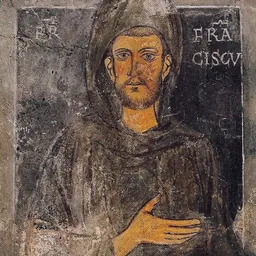
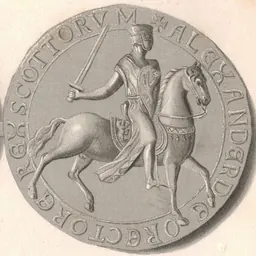
Related people
Same field, nearest in time
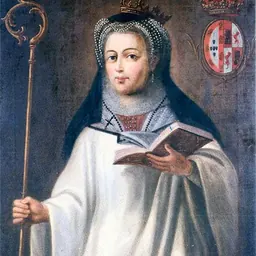
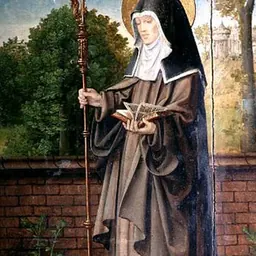


Contemporaries
People whose lives overlapped Clare of Assisi's





Frequently asked questions
Who was Clare of Assisi?
Italian saint (1194–1253)
When was Clare of Assisi born?
Clare of Assisi was born on 16 July 1194 in Assisi.
When did Clare of Assisi die?
Clare of Assisi died on 11 August 1253 in Assisi.
What was Clare of Assisi's occupation?
Clare of Assisi was a nun, author, religious writer, founder of Catholic religious community, mystic and philosopher.
Sources & further reading
Cite this page
APA: Biography.guide. (2026). Clare of Assisi. https://biography.guide/clare-of-assisi/
MLA: "Clare of Assisi." Biography.guide, https://biography.guide/clare-of-assisi/.
Chicago: "Clare of Assisi." Biography.guide. https://biography.guide/clare-of-assisi/.
Data last updated: 2026-09-27 · Spot an error? Report a correction.
Page generated 2026-09-27 05:17 UTC