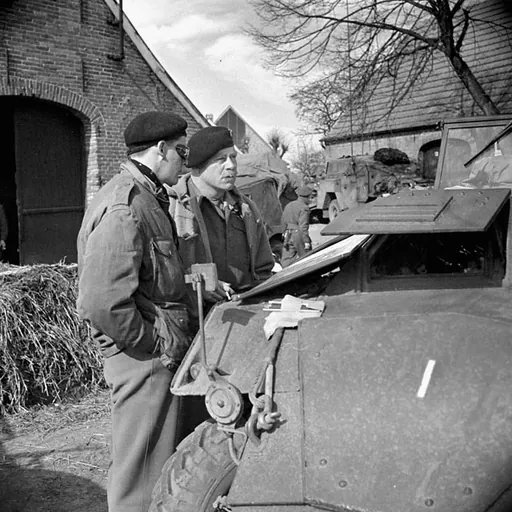
About Christopher Vokes
Lived 1904 – 1985 (aged 80). Christopher Vokes was a Canadian military personnel.
Major-General Christopher Vokes (13 April 1904 – 27 March 1985) was a Canadian Army officer who fought in World War II. Born in Armagh, Ireland, he commanded the 2nd Canadian Infantry Brigade during the Allied invasion of Sicily. Promoted to major-general, Vokes led the 1st Canadian Infantry Division through several battles of the Italian campaign, which included fierce house-to-house fighting in the Battle of Ortona and the advance north to the Hitler Line.
In 1944, he took over command of the 4th Canadian Armoured Division and fought in Operation Blockbuster. During the latter stages of this battle, Vokes ordered his division to raze the German town of Friesoythe. The division subsequently destroyed around 85–90% of the town and used the rubble to make good the cratered local roads. After the war, he commanded the Canadian Army Occupation Force in Europe, before returning to Canada to undertake further command assignments. Vokes retired in 1959 and died in 1985 at the age of 80.
Family Born in the town of Armagh, Ireland, on 13 April 1904, Vokes was the son of a British officer, Major Frederick Patrick Vokes, and Elizabeth Vokes. They came to Canada in 1910 and Vokes's father served as the engineering officer at the Royal Military College of Canada (RMC). The family lived in the Married Quarters at Ridout Row, RMC.
Christopher Vokes's brother, Lieutenant-Colonel Frederick Vokes, took a leading part in the assault on Dieppe in August 1942. In early 1944 he was sent to Italy as commanding officer of the 9th Armoured Regiment (The British Columbia Dragoons). On 31August 1944 he was seriously wounded in action and died in a field hospital on 4September.
Early military service From 1921 to 1925 Vokes attended the Royal Military College of Canada and was commissioned into the Royal Canadian Engineers. He then attended McGill University from 1926 to 1927 where he received a Bachelor of Science degree and was a member of the Kappa Alpha Society. From 1934 to 1935 he attended Staff College, Camberley in England. While there he received a promotion to captain in January 1934. In Depression-era Canada many military bases were improved by civilians working in relief camps under supervision of professional military officers, including Camp Dundurn. The original engineer drawings for the concrete rifle range butts were signed by Chris Vokes, in that capacity. Barrack blocks in Dundurn resemble similar buildings constructed at Camp Valcartier in the same time frame.
World War II Field Marshal Sir Bernard Montgomery poses for a group photograph with members of his staff, along with his corps and division commanders, at Walbeck, Germany, 22 March 1945. Pictured standing in the third row, sixth from the right, is Major General Christopher Vokes.
Starting in 1939, the year World War II began in Europe, Vokes rapidly rose through the ranks of the Canadian General Staff. With the 1st Canadian Infantry Division, he served as Adjutant General, Assistant Quartermaster General, General Staff Officer, grade 1, and as Officer Commanding Princess Patricia’s Canadian Light Infantry. He proved to be an outstanding operational officer and in June 1942 was promoted to brigadier and put in charge of the 2nd Canadian Infantry Brigade. The 2nd was one of three brigades forming part of the 1st Canadian Infantry Division, with which he had served since 1939 and which was then commanded by Major-General George Pearkes until Major-General H. L. N. Salmon replaced him in September (although he, too, was replaced by Major-General Guy Simonds after being killed in a plane crash in April 1943). Vokes commanded his brigade the following year during the Allied invasion of Sicily (codenamed Operation Husky) from July−August 1943, which was followed soon afterwards by Operation Baytown, part of the Allied invasion of Italy and the beginning of the Italian campaign, in early September.
Shortly after the beginning of the Italian campaign, Vokes temporarily took command of the 1st Canadian Division after its current General Officer Commanding (GOC), Major-General Simonds, fell ill, with Bert Hoffmeister taking over the 2nd Canadian Brigade. He soon became the division's permanent GOC and was promoted to the rank of major general on 1 November 1943. General Sir Bernard Montgomery, the commander of the British Eighth Army (under whose command the 1st Canadian Division had been serving since July), ordered Vokes's 1st Canadian Division to attack along the coast towards Ortona early in December. During an attack on a ravine southwest of Ortona, Vokes continued to send battalion after battalion to attack the mine-fortified German defense for nine days. For this he became known as the "Butcher" among his men.
From left to right, Major-General Christoper Vokes, General Harry Crerar, Field Marshal Sir Bernard Montgomery, Lieutenant-General Brian Horrocks, Lieutenant-General Guy Simonds, Major-General Daniel Spry, and Major-General Bruce Matthews, pictured here in early 1945 during Operation Veritable.
The town was defended by some 200 paratroopers of Battalion Raabe of the 7th German Parachute Division. These paratroopers repelled the first attack by the Lake Superior Regiment (Motor) on 13 April. The Lake Superior Regiment suffered two dead and nineteen wounded. German casualties are not known. Vokes ordered the resumption of the attack the next day by The Argyll and Sutherland Highlanders of Canada (Princess Louise's) commanded by Lieutenant Colonel Frederick E. Wigle. The attack went well, with the Argylls securing the town by 10:30 hours. However, at 08:30 a small number of German soldiers caught Wigle's tactical headquarters by surprise; resulting in the death of Wigle and several other soldiers.
Vokes determined on an immediate reprisal. "A first-rate officer of mine, for whom I had a special regard and affection, and in whom I had a particular professional interest because of his talent for command, was killed. Not merely killed, it was reported to me, but sniped in the back". Vokes then announced his draconian decision. "I summoned my GSO1 . . 'Mac,' I roared at him, 'I'm going to raze that goddam town. Tell 'em we're going to level the fucking place. Get the people the hell out of their houses first.
Units and soldiers of the Argylls had spontaneously begun the arson of Friesoythe to revenge the death of their colonel, but after Vokes issued his direct order, the town was systematically set on fire with flamethrowers mounted on Wasp Carriers. The rubble was used to reinforce district roads for the division's tanks. According to German estimates, 85% to 90% of the town was destroyed, making it one of the most devastated towns in Germany at the time. Vokes said that he had "no feeling of remorse over the elimination of Friesoythe." badgeimage = badge = symbolism = previous_versions = other_versions =
Don’t just read it —
keep it.
Full-length biographies made to live with: read them, listen on the way to work, watch them tonight.
- E-book
- Audio
- Video
Instant download · yours to keep · every purchase keeps this site free
Important facts
People in Christopher Vokes's life
Named in this biography and alive at the same time
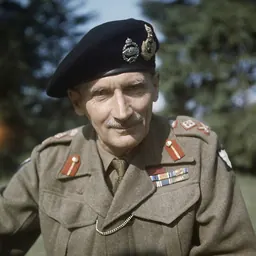


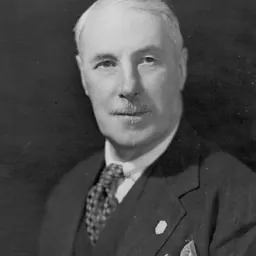

Related people
Same field, nearest in time



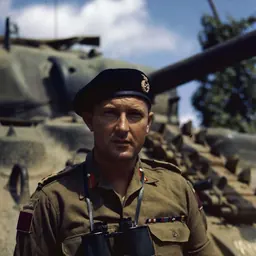
Contemporaries
People whose lives overlapped Christopher Vokes's


Frequently asked questions
Who was Christopher Vokes?
Canadian general (1904–1985)
When was Christopher Vokes born?
Christopher Vokes was born on 13 April 1904 in Armagh.
When did Christopher Vokes die?
Christopher Vokes died on 27 March 1985 in Oakville.
What was Christopher Vokes's occupation?
Christopher Vokes was a military personnel.
What nationality was Christopher Vokes?
Christopher Vokes was Canadian.
Sources & further reading
· Wikipedia: Christopher Vokes
Cite this page
APA: Biography.guide. (2026). Christopher Vokes. https://biography.guide/christopher-vokes/
MLA: "Christopher Vokes." Biography.guide, https://biography.guide/christopher-vokes/.
Chicago: "Christopher Vokes." Biography.guide. https://biography.guide/christopher-vokes/.
Data last updated: 2026-09-23 · Spot an error? Report a correction.
Portrait: Wikimedia Commons · author & licence
Page generated 2026-09-27 05:05 UTC