
About Chonghou
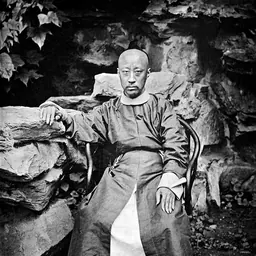
Lived 1826 – 1893 (aged 66). Chonghou was a Chinese diplomat, politician, beamter and official.
Chonghou (, ), courtesy name Dishan (地山), art names Ziqian (子謙) and Hecha (鶴槎), was an official and diplomat of the Qing dynasty. He was a member of the Wanyan clan, descended from the Emperor Shizong of Jin.
Early life and career He was the second son of Linqing (麟慶) of the Jurchen Wanyan clan, and is thus said to have been a lineal descendant of the imperial clan of the Jin dynasty of the 12th and 13th centuries. He assisted Prince Gong during the negotiations of the Convention of Peking (1860), and the prince made him Superintendent of Trade in 1861 for the three northern treaty ports of Tianjin (where he was stationed), Yantai, and Yingkou. During this time, Chonghou negotiated with Denmark, the Netherlands, Spain, Belgium, and Austria. incompetent, and ignorant.
Chonghou himself described his reasoning as such: Only because our military forces were exhausted, our treasury was short of money, our border defenses were also inadequate to rely on, and because I wanted to safeguard our national interests, I had no choice but to agree under pressure.
Zeng Jize replaced Chonghou, but Russia refused to renegotiate the treaty unless Chonghou was pardoned. After months of tension and appeals by foreign ambassadors and leaders, including Queen Victoria, and Zeng as well, the Qing government relented, and commuted his death sentence, but Chonghou still had to make a contribution of 300,000 taels to purchase his freedom. Zeng eventually negotiated the Treaty of Saint Petersburg, and Chonghou retired to private life. In 1885, he was allowed to present Empress Dowager Cixi greetings on her 50th birthday, and restored to a rank two levels lower than his original rank. He died in obscurity in 1893.
Historical reputation Historian S. C. M. Paine believes that given his prior experience in France and in negotiating trade agreements in Tianjin, it is very unlikely that Chonghou would have agreed to the terms of the treaty on his own. Instead, it is more likely that he was poorly advised by the Zongli Yamen. Russia had been in communication with the Qing government during its occupation of Xinjiang, so Russian demands should have been well-known long before Chonghou left for Saint Petersburg. During his voyage, he was also in frequent contact with the Zongli Yamen via mail and telegraph. Back in China, Prince Gong, who was the head of the ministry and who had years of experience dealing with foreigners, was involved in a power struggle with Cixi regarding who would replace the Tongzhi Emperor: her nephew or the prince's son. Another experienced diplomat, Wenxiang, had died a few years previously. Furthermore, the Zongli Yamen was only one of several agencies involved in international relations, and even within itself there was an ideological split between those who were open to foreigners and those who were more xenophobic. The power struggle meant the bureaucrats were unsure of which faction would be in charge and thus unwilling to do any more than their immediate responsibilities. In short, he was made into a scapegoat to cover for the shortcomings of the Zongli Yamen.
Paine acknowledges that much of that argument is speculation, as Chonghou was made into a nonperson. He was expunged from government records and his letters were not published posthumously, as was the custom for Chinese court officials. Furthermore, neither the Chinese nor Russian governments retained any documents from the negotiations, thus making it difficult to determine how China ended up with an unequal treaty despite being in the better negotiating position (the Russian army in Xinjiang was outnumbered and the Russian treasury was drained due to the Russo-Turkish War). But evidence remains in the writings of others such as Zuo that points to that explanation.
Don’t just read it —
keep it.
Full-length biographies made to live with: read them, listen on the way to work, watch them tonight.
- E-book
- Audio
- Video
Instant download · yours to keep · every purchase keeps this site free
Important facts
People in Chonghou's life
Named in this biography and alive at the same time



Related people
Same field, nearest in time


Contemporaries
People whose lives overlapped Chonghou's

Frequently asked questions
Who was Chonghou?
diplomat (1826-1893)
When was Chonghou born?
Chonghou was born on 7 October 1826.
When did Chonghou die?
Chonghou died on 26 March 1893.
What was Chonghou's occupation?
Chonghou was a diplomat, politician, beamter and official.
What nationality was Chonghou?
Chonghou was Chinese.
Sources & further reading
Cite this page
APA: Biography.guide. (2026). Chonghou. https://biography.guide/chonghou/
MLA: "Chonghou." Biography.guide, https://biography.guide/chonghou/.
Chicago: "Chonghou." Biography.guide. https://biography.guide/chonghou/.
Data last updated: 2026-09-22 · Spot an error? Report a correction.
Page generated 2026-09-27 05:33 UTC