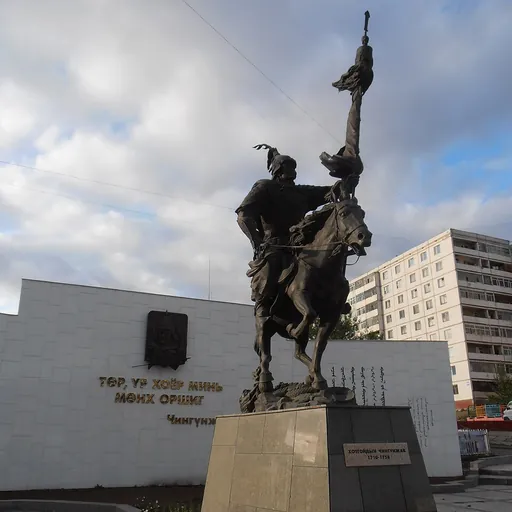
About Chingünjav
Lived 1710 – 1757 (aged 46–47). Chingünjav was a military personnel.
Chingünjav (, Classical Mongolian: , ), also known as Commander Chingünjav (, 1710–1757), was the Khalkha prince ruler (Shadar Wang) of the Khotogoids and one of the two major leaders of the 1756-57 rebellion in Outer Mongolia. Although his rebellion failed, he is nowadays often hailed as a fighter for Outer Mongolia's independence from the Manchu-led Qing dynasty of China.
Early life and career
Chingünjav was born in 1710 at the shore of Sangiin Dalai Lake, in the Khotogoid's Erdeni Degüregchi Wang khoshuu (banner) of Zasagt Khan aimag, or today's Bürentogtokh sum of Khövsgöl aimag.
Chingünjav's grandfather, Büübei, voluntarily accepted Manchu citizenship and conquered the territory of the modern Russian Republic of Tuva for the Qing Empire. For his faithful service to the Manchus, he received the rank of а "Gun", and then а "Beile". Chingünjav's father, Bandi, was the khoshuu's Zasag Noyon between 1730 and 1737. In 1737, Chingünjav succeeded his father. Chingünjav made a career in the Manchu military and eventually reached the rank of an assistant general of Zasagt Khan aimag.
Conspiracy with Amursana
During the 1755 Manchu campaign against the Dzungar Khanate, Chingünjav and Amursana conspired to start a rebellion in the autumn of the same year; however, their seniors discovered their plans and separated them. Unrest spread throughout Khalkha, where Mongolian rebels attacked the Qing garrisons and robbed Chinese merchants. However, support from other nobles and even from the 2nd Jebtsundamba Khutughtu did not materialize, and Chingünjav never commanded more than about 1,000–2,000 men. The Manchus, although not as brutal as they had been towards the Dzungars, sent punitive units to Mongolia to deal on the spot with all those rebels they could find; nobles who were suspected of having sympathized with Chingünjav were also executed. The second Jebtsundamba Khutugtu Luvsandambiydonmi "died" in January 1757 at the age of 34, and the Tüsheet Khan shortly afterwards in 1759. The Qianlong Emperor was involved in the recognition of the third Jebtsundamba Khutugtu, Ishdambiynyam, found in Tibet, thus he was able to demonstrate his authority to the gathered Mongol nobles.
Legacy
Although never having had a realistic chance to succeed, Chingünjav passed into the realm of folklore. In 2012, Mongolian Bronze Foundry created a monument in his honor in Ulaanbaatar, inscribed, "May my state and children live eternal" .
Literature
Charles R. Bawden, The Modern History of the Mongols, London 1968, p. 114 - 134
Don’t just read it —
keep it.
Full-length biographies made to live with: read them, listen on the way to work, watch them tonight.
- E-book
- Audio
- Video
Instant download · yours to keep · every purchase keeps this site free
Important facts
People in Chingünjav's life
Named in this biography and alive at the same time
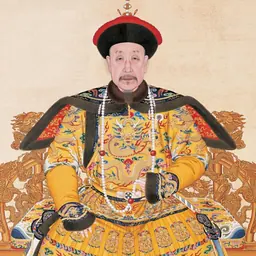
Related people
Same field, nearest in time




Contemporaries
People whose lives overlapped Chingünjav's




Frequently asked questions
Who was Chingünjav?
Mongolian follower of Qing dynasty, and then rebel in 1756
When was Chingünjav born?
Chingünjav was born in 1710 in Khövsgöl Province.
When did Chingünjav die?
Chingünjav died in 1757 in Beijing.
What was Chingünjav's occupation?
Chingünjav was a military personnel.
Sources & further reading
Cite this page
APA: Biography.guide. (2026). Chingünjav. https://biography.guide/chingunjav/
MLA: "Chingünjav." Biography.guide, https://biography.guide/chingunjav/.
Chicago: "Chingünjav." Biography.guide. https://biography.guide/chingunjav/.
Data last updated: 2026-09-20 · Spot an error? Report a correction.
Portrait: Wikimedia Commons · author & licence
Page generated 2026-09-27 04:57 UTC