
Chief Ouray
Ute chief
About Chief Ouray
Lived 1833 – 1880 (aged 46). Chief Ouray was an American.
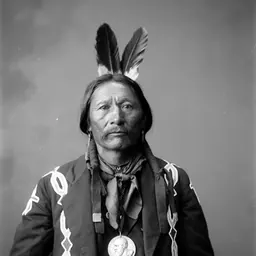
Chief Ouray (, c. 1833 – August 20, 1880) was a Native American chief of the Tabeguache (Uncompahgre) band of the Ute tribe, then located in western Colorado. Because of his leadership ability, Ouray was acknowledged by the United States government as a chief of the Ute and he traveled to Washington, D.C. to negotiate for the welfare of the Utes. Raised in the culturally diverse town of Taos, Ouray learned to speak many languages that helped him in the negotiations, which were complicated by the manipulation of his grief over his five-year-old son, abducted during an attack by the Sioux. Ouray met with Presidents Lincoln, Grant, and Hayes and was called the "man of peace" because he sought to make treaties with settlers and the government.
Following the White River War of 1879, he traveled in 1880 to Washington, D.C. He tried to secure a treaty for the Uncompahgre Ute, who wanted to stay in Colorado; but, the following year, the United States forced the Uncompahgre and the White River Ute to the west to reservations in present-day Utah.
Early life and education
Ouray was born in 1833 near the Taos Pueblo in Nuevo México, now in the state of New Mexico.
Treaty of 1868
Around 1866, there were some Native Americans who had stolen livestock and otherwise upset new settlers. In the meantime, the government became interested in obtaining some more Ute land. Since the government had not lived up to its agreement to provide provisions for the winter months, Ouray was reluctant to give the government more land. Many Native Americans, though, were "in dire straits" and he agreed to be part of a delegation.
Meeker Massacre An etching that appeared in the December 6, 1879 edition of Frank Leslie's Illustrated Newspaper depicts the aftermath of the "Meeker Massacre." Meeker grave at lower left; W.H. Post grave at lower right Tensions increased in the area following the Meeker Massacre (1879) at the White River Indian Agency. Not understanding the Utes' love of horses, Nathan Meeker had their race track plowed and tried to force the nomadic hunters and gatherers to farm, and Meeker sought military help. Seeking peace, a tribe of Ute men led by Chief Douglas asked Meeker for peace, but a fight ensued. This made further negotiations for peace between Native Americans and whites very difficult. Local settlers demanded that the Utes be moved. When Ouray found out about the massacre, he asked, as head of the Utes, for the warriors to disperse and release hostages to him. The hostages, including Josephine Meeker, were delivered to Ouray's house at the Los Piños Indian Agency and were cared for by Chipeta.
Personal life
Ouray's first wife, Black Mare, died after the birth of their only child, a boy named Queashegut, also known as Pahlone, and called Paron (apple) by his father because of his round, dimpled face. In 1859, Ouray married the sixteen-year old Chipeta (Ute meaning: White Singing Bird), who had been caring for Ouray's son since Black Mare's death earlier that year.
When Queashegut was five years old, Ouray took him along on a buffalo hunt with a total party of 31 men in 1860 or 1863. Their hunting camp, near Fort Lupton, was attacked by 300 Sioux warriors and Queashegut left the tepee where he sought shelter with Chipeta to follow Ute warriors. After the fight, they were unable to find him. Chipeta was a member of a Methodist church; Ouray was an Episcopalian. Forty-five years later, in 1925, his bones were re-interred in a full ceremony led by Buckskin Charley and John McCook at the Ignacio cemetery.
A 1928 article in the Denver Post reads in part, "He saw the shadow of doom on his people" and a 2012 article writes, "He sought peace among tribes and whites, and a fair shake for his people, though Ouray was dealt a sad task of liquidating a once-mighty force that ruled nearly 23 million acres of the Rocky Mountains."
Legacy and honors Ouray's obituary in The Denver Tribune stated: In the death of Ouray, one of the historical characters passes away. He has figured for many years as the greatest Indian of his time, and during his life has figured quite prominently. Ouray is in many respects...a remarkable Indian...pure instincts and keen perception. A friend to the white man and protector to the Indians alike.
Places named for Ouray Camp Chief Ouray, located in Granby, Colorado. Mount Ouray in the Sawatch Mountain Range and Ouray Peak in Chaffee County, both in Colorado, were named for him. Ouray County and its county seat, the town of Ouray in Colorado, as well as the community of Ouray, Utah are named for him. SS Chief Ouray, a World War II liberty ship, now named USS Deimos
Don’t just read it —
keep it.
Full-length biographies made to live with: read them, listen on the way to work, watch them tonight.
- E-book
- Audio
- Video
Instant download · yours to keep · every purchase keeps this site free
Important facts
People in Chief Ouray's life
Named in this biography and alive at the same time



Contemporaries
People whose lives overlapped Chief Ouray's




Frequently asked questions
Who was Chief Ouray?
Ute chief (1833-1880)
When was Chief Ouray born?
Chief Ouray was born on 13 November 1833 in Taos.
When did Chief Ouray die?
Chief Ouray died on 24 August 1880.
What nationality was Chief Ouray?
Chief Ouray was American.
Sources & further reading
Cite this page
APA: Biography.guide. (2026). Chief Ouray. https://biography.guide/chief-ouray/
MLA: "Chief Ouray." Biography.guide, https://biography.guide/chief-ouray/.
Chicago: "Chief Ouray." Biography.guide. https://biography.guide/chief-ouray/.
Data last updated: 2026-09-20 · Spot an error? Report a correction.
Page generated 2026-09-27 05:27 UTC