
About Chico Vaughn
Lived 1940 – 2013 (aged 73). Chico Vaughn was an American basketball player.
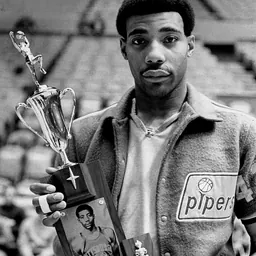
Charles "Chico" Vaughn Sr. (February 19, 1940 – October 25, 2013) was an American basketball player. As a 6 ft 2 in (1.88 m) guard, he played five seasons in the National Basketball Association (NBA) with the St. Louis Hawks and Detroit Pistons, and three seasons in the American Basketball Association (ABA) with the Pittsburgh/Minnesota Pipers. Vaughn became a fulltime starter for the first time as a professional with the Pipers in the 1967–68 season. He averaged nearly 20 points per game, was selected to play in the 1968 ABA All-Star Game, and the Pipers were ABA champions in 1968. In his first two seasons with the Pipers, he was second in the ABA in three-point field goals attempted, made, and three-point field goals made per game. In a March 1969 game for the Minnesota Pipers, Vaughn set an ABA record by scoring 12 points in less than one minute; and later that season set a new record for three-point field goals made in a single playoff game.
He set and still holds the all-time record for total points scored among male high school basketball players in Illinois, playing at Tamms High School in Southern Illinois (1954 to 1958). He attended Southern Illinois University where he played basketball with the Southern Illinois Salukis (1958 to 1962), setting school records in total points scored and scoring average, even though he missed a large part of his senior season, which remain school records. United Press International named Vaughn a second-team Little All-American in 1960 and a first-team Little All-American in 1961. He played in the Interstate Intercollegiate Athletic Conference (IIAC) where he was named first-team All-IIAC in his first three seasons at SIU, and was selected as the IIAC's most valuable player in 1959–60. Vaughn's jersey No. 20 was retired by SIU and he was inducted into the Salukis Hall of Fame in 1978.
Early life Vaughn was born on February 19, 1940, in Hodges Park, Illinois to Milton and LaVern Vaughan. He was the fifth child born among four brothers and three sisters. He originally played for the school's freshman basketball team, but was elevated to the varsity team early in the season and went on to lead the varsity team in scoring that year. It has also been reported that he had 3,378 points in high school. During his high school career, Vaughn scored over 60 points in a game three times, and once scored 30 points in the fourth quarter of a game, among other offensive accomplishments. He then planned to attend the University of Dayton, in Ohio, and was working at Dayton during the summer after graduating high school. However, during a trip home to Illinois he was actively recruited by Southern Illinois University's (SIU) new head basketball coach Harry Gallatin. He played forward and guard for the Salukis during his college career. In an early December 1958 game against Drury College, Vaughn, playing forward, scored 28 points in leading SIU to Gallatin's first career win at the school.
As a freshman (1958–59), Vaughn led the IIAC in conference scoring (23.6 points per game), and did so again as a sophomore (25.8 points per game). Vaughn was also a strong rebounder. As a freshman he averaged 10 rebounds per game, and set a Saluki record with 20 rebounds in a single game. He was first-team All-NAIA District 20 again as a sophomore. Vaughn was first-team All-IIAC as both a freshman (at forward) and sophomore, and he was selected by the conference's seven coaches as the IIAC's most valuable player for the 1959–60 season. Vaughn also set nine new individual SIU records that season, including most points in a game (43). In 1960, United Press International (UPI) named Vaughn a second-team Little All-American, and it has been reported that he barely missed being named a UPI first-team Little All-American that year. UPI gave him honorable mention as an All-American.
In 1960–61, Vaughn averaged 23.4 points per game, leading the Salukis in scoring. He was named first-team All-IIAC for the third consecutive season, as a guard. Vaughn had missed some games in the first part of that season because of academic ineligibility.
As a senior (1961–62), he led the team in free throw shooting percentage (.804), Salukis' coach Harry Gallatin said of Vaughan "'his specialty is his fade-away jump shot and the way he handles himself there is absolutely no defense to stop him . . . the shot is unorthodox but it's basically sound. And it's impossible to defense unless you're behind his back'". Vaughn's unusual jump-shooting style began as a child, when he had to pull the ball back behind his ear to get enough strength to reach the basket on a jump shot. Vaughn was actually selected by the Chicago Packers, but the Packers owed the Hawks this pick as part of an earlier trade and drafted Vaughn for the Hawks. In mid-March 1962, before the draft, the Hawks had hired Harry Gallatin, Vaughn's SIU coach, to be the Hawks' new head coach. Gallatin brought Vaughn to the Hawks. In the first game of the first round of the NBA playoffs that season against the Detroit Pistons, Vaughn played an important role in the Hawks' victory by speeding up the game's pace to the Hawks' favor. The Hawks won that series three games to one. Vaughn averaged 26.8 minutes, 6.5 points, 3.5 assists, and 3.5 rebounds per game during that series.
The Hawks then played in the NBA's Western Division finals against the Los Angeles Lakers, losing three games to four. Vaughn played in all seven games, averaging 29.6 minutes, 12 points, 2.4 assists and 2.4 rebounds per game. After losing the first game, Gallatin made Vaughn a starter in the second game of the series. He played only 21 minutes and scored six points in the Hawks' 101–99 loss. In Game 3, Vaughn started again, scoring 23 points in 36 minutes in a 125–112 Hawks' win; making ten field goals in 16 attempts. Only future Naismith Hall of Fame teammate Bob Pettit scored more points for the Hawks in that game. Vaughn scored 14 points in 30 minutes in the Hawk's Game 4 win, led the Hawks in scoring in a Game 5 loss, had 14 points in 29 minutes in the series tying Game 6 win, and scored eight points in 34 minutes in Game 7.
The following season (1963–64), Vaughn averaged nearly 20 minutes per game in 68 games for the Hawks. He averaged 8.6 points, 1.9 rebounds, and 1.9 assists per game. The Hawks defeated the Lakers three games to two in the Western Division semifinals, with Vaughn averaging 21 minutes, 8.6 points, 3.2 rebounds, and 1.8 assists per game. In the Hawks' Game 2 win, Vaughn scored 15 points in 26 minutes. The Hawks lost to Wilt Chamberlain and the San Francisco Warriors in the Western Division finals, three games to four. Vaughn averaged 19.6 minutes, 8.9 points, 1.3 rebounds, and 1.7 assists per game in the series.
In 75 games with the Hawks in 1964–65, Vaughn averaged NBA career highs in minutes per game (26.2) and points per game (11.6). In late December of the following season (1965–66), the Hawks traded Vaughn and John Tresvant to the Detroit Pistons for Rod Thorn. In trading for Vaughn, Pistons player-coach Dave DeBusschere said "'Vaughn is the hard-nosed type of player who should bolster our defense . . . He's strong, aggressive and can score from the outside as well as close in'". At the time of the trade, Vaughn had played in 19 games for the Pistons that season, averaging 23.4 minutes, 10 points, 2.4 rebounds, and 1.9 assists per game. He played in 37 games for the Pistons to finish the season, averaging 20.9 minutes, 7.6 points, 2.8 assists, and 1.7 rebounds per game.
The 1966–67 season was Vaughn's final NBA season, playing in only 51 games for the Pistons while averaging career lows of 4.3 points and 13.3 minutes per game.
Vaughn played in 327 regular season NBA games, averaging 21.6 minutes, 8.9 points, 2.2 rebounds, and 2.3 assists per game. He also played in 27 NBA playoff games, averaging 23.4 minutes, 8.9 points, 2.3 rebounds, and 2.3 assists per game. For the first time in his professional career Vaughn was a fulltime starter. He averaged 38.6 minutes per game as the Pipers' shooting guard. Vaughn averaged 19.9 points, four rebounds, and 1.9 assists per game, and was selected to play in the 1968 ABA All-Star Game, along with teammate Connie Hawkins. During the regular season, Vaughn was the team's fourth leading scorer, behind Hawkins, Art Heyman, and Charlie Williams. and then defeated the Minnesota Muskies four games to one in the Eastern Division finals. The Pipers then defeated the New Orleans Buccaneers in seven games to win the 1968 ABA championship. Against the Pacers, Vaughn averaged 14.3 points, four assists, and 3.3 rebounds per game. He averaged 21 points per game against the Muskies, and averaged 16.9 points and 3.1 rebounds per game in the seven games against the Buccaneers.
This was the first time at any level of organized basketball that Vaughn played under rules that included three-point field goals. He was second in the ABA that season in three-point field goals attempted (410) and made (137), and was virtually tied for the ABA lead in averaging 1.9 three-point field goals made per game (1.9). He was third in the ABA in three-point field goal percentage (.334). In a mid-January 1968 win over the Pacers Vaughn scored 40 points, including five successful three-point shots.
Before the start of the 1968–69 season, the Pipers moved from Pittsburgh to Minnesota. Vaughn played in 69 games for the Minnesota Pipers that season, averaging 33.3 minutes per game. He averaged 17.8 points, 2.4 rebounds, and 1.6 assists per game. Vaughan was again second in the ABA in three-point field goals attempted (145) and made (523), and three-point field goals made per game (2.1); but 11th in the ABA in three-point field goal percentage (.277). During the 1969 ABA playoffs, Vaughn set an ABA playoff record by making six three-point field goals in a game (broken the following season by Roger Brown). In a March 4 game against the Denver Rockets, while playing as a reserve, Vaughn set an ABA record by scoring 12 points in 55 or 58 seconds; consisting of three three-point field goals, one two-point field goal, and a free throw.
Pipers team owner Gabe Rubin moved the team back to Pittsburgh for the 1969–70 season. This was Vaughn's last ABA season. He underwent knee surgery and missed the majority of the season. He played in only 21 games, averaging 19.1 minutes and 9.7 points per game. He retired in 1970. SIU has retired Vaughn's No. 20 jersey. It has been reported that Vaughn's was the first jersey number to be retired in school history,
Personal life and death After retiring from professional basketball, Vaughn was involved with youth and adult recreation. Vaughn obtained his bachelor's degree in recreation at SIU in 1988.
Regular season Year Team GP MPG FG% 3P% FT% RPG APG PPG
Playoffs Year Team GP MPG FG% 3P% FT% RPG APG PPG
Don’t just read it —
keep it.
Full-length biographies made to live with: read them, listen on the way to work, watch them tonight.
- E-book
- Audio
- Video
Instant download · yours to keep · every purchase keeps this site free
Important facts
People in Chico Vaughn's life
Named in this biography and alive at the same time






Related people
Same field, nearest in time


Contemporaries
People whose lives overlapped Chico Vaughn's


Frequently asked questions
Who was Chico Vaughn?
American basketball player (1940-2013)
When was Chico Vaughn born?
Chico Vaughn was born on 19 February 1940 in Portland.
When did Chico Vaughn die?
Chico Vaughn died on 25 October 2013 in Carbondale.
What was Chico Vaughn's occupation?
Chico Vaughn was a basketball player.
What nationality was Chico Vaughn?
Chico Vaughn was American.
Sources & further reading
Cite this page
APA: Biography.guide. (2026). Chico Vaughn. https://biography.guide/chico-vaughn/
MLA: "Chico Vaughn." Biography.guide, https://biography.guide/chico-vaughn/.
Chicago: "Chico Vaughn." Biography.guide. https://biography.guide/chico-vaughn/.
Data last updated: 2026-09-20 · Spot an error? Report a correction.
Page generated 2026-09-27 05:23 UTC