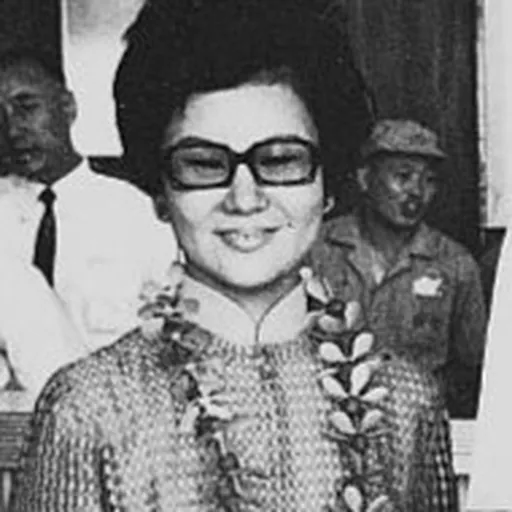
About Chen Min-Hwa
Born 1934. Chen Min-Hwa is a Chinese and Taiwanese poet and presenter.
Chen Min-hwa (; born 7 September 1934) is a Taiwanese poet and television presenter known as the "Crystal Poetess". She is one of the founders of the Vineyard Poetry Society and was nominated for the Nobel Prize in Literature in 1974, becoming the first female Chinese author to be nominated.
Biography Early life Chen was born on 7 September 1934 in Huangxian, Shandong, China. In 1949, she went to Taiwan due to the Chinese Civil War. After graduating at Providence University, she eventually hosted the "Literary Showcase" program of Education Radio and the "Literary Salon" program of Taiwan Television for several years.
Literary career In April 1962, after graduating from the "New Poetry Research Class" sponsored by the Chinese Literature and Art Association, she cofounded the literary club "Vineyard Poetry Society" with Wang Zaijun, Gu Ding, Wen Xiaocun, Li Peizheng, Song Houying and others (all of whom were students of the research class). The club was located in her home in the Yonghe District. On July 15 of the same year, the Vineyard Poetry Society issued the quarterly Vineyard. The magazine called for "all poets who are isolated from society and readers to wake up early, bravely abandon nihilism, obscurity and weirdness, and return to reality, return to clarity, and create poems with flesh and blood." It advocated the popularization of poetry and adhered to the principle of "health, clarity and China". The "Vineyard Poetry Society" thus laid the foundation for the transformation of contemporary Taiwanese poetry creation from "Westernized" modernism to "local" realism.
In 1965, Chen was elected as the president of the Vineyard Poetry Society succeeding Li Peizheng. On 25 August 1969, Chen together with Ji Xian, Zhong Dingwen, Lin Lu, Luo Men, Rong Zi and Lu Di represented Taiwan at the "1st World Congress of Poets" in Manila, Philippines. Chen eventually won a commemorative gold medal at the conference. In 1975, she left the poetry world and went to Costa Rica to study Spanish for several years. In the 1980s, she moved to Redwood City in the San Francisco Bay Area, California and participated in the establishment of the Chinese cultural organization "Chinese Art Society" in the said Bay Area, and served as its president and consultant. As of March 2024, Chen is the honorary president of the Chinese Art Society.
Poetry Most of Chen's works are poetry that pursue the realm of "beauty" and describe the scenery by combining the real and the imaginary, borrowing the subject to express ideas. The poem as follows:
-----
Daisy Her poems also reflects the spirit of traditional Chinese culture, profoundly and implicitly expressing the glory and continuity of traditional Chinese culture, and describes the lives of the local poor in Taiwan.
Since most Taiwanese female writers in the mid-20th century wrote novels and essays, Chen belongs to a group of pioneers of Taiwanese female poetry that includes Rong Zi, Chen Xiuxi, Fangge Dupan and Chang Hsiu-ya. These poets all adopted the form of modern poetry to express their feminine consciousness, proving that true feminist poetry as a group has emerged in Greater China.
Honors Chen has won awards such as the Asian Outstanding Poet Award, the 60th Annual Literature Award of the Ministry of Education and Culture, and the 12th Literature and Poetry Creation Award of the 12th Chinese Literary and Art Association. In December 1969, upon the recommendation of the United Poets Laureates International, the British International College awarded Chen an honorary master of arts degree.
In 2025, after the Swedish Academy revealed the official nominations list in 1974 kept secret for 50 years, Chen was included on the recommendation of Emeterio Barcelón y Barceló-Soriano, president of the Philippine Academy of the Spanish Language.
Publications Daisy [雏菊], 1967. Through the Crystal Glass [水晶集], (Taipei: Grape Garden Magazine, 1970 and 1972). Qin Window Poetry Collection [琴窗诗抄] (Taipei: San Min Book Company, 1971 and 1979). As Dawn Whistles Over the Sea [星海的风笛], (Taipei: Grape Garden Magazine, 1973).
Don’t just read it —
keep it.
Full-length biographies made to live with: read them, listen on the way to work, watch them tonight.
- E-book
- Audio
- Video
Instant download · yours to keep · every purchase keeps this site free
Important facts
People in Chen Min-Hwa's life
Named in this biography and alive at the same time




Related people
Same field, nearest in time



Contemporaries
People whose lives overlapped Chen Min-Hwa's




Frequently asked questions
Who is Chen Min-Hwa?
Taiwanese poet
When was Chen Min-Hwa born?
Chen Min-Hwa was born on 7 September 1934 in Huang County.
What is Chen Min-Hwa's occupation?
Chen Min-Hwa is a poet and presenter.
What nationality is Chen Min-Hwa?
Chen Min-Hwa is Chinese and Taiwanese.
Sources & further reading
Cite this page
APA: Biography.guide. (2026). Chen Min-Hwa. https://biography.guide/chen-min-hwa/
MLA: "Chen Min-Hwa." Biography.guide, https://biography.guide/chen-min-hwa/.
Chicago: "Chen Min-Hwa." Biography.guide. https://biography.guide/chen-min-hwa/.
Data last updated: 2026-09-23 · Spot an error? Report a correction.
Portrait: Wikimedia Commons · author & licence
Page generated 2026-09-27 05:08 UTC