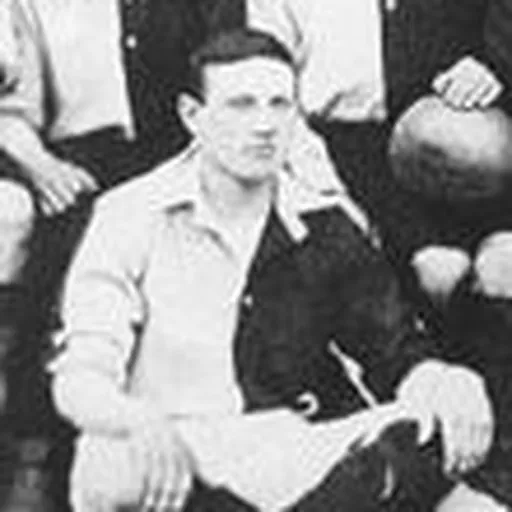
About Charlie Parry
Lived 1870 – 1922 (aged 51–52). Charlie Parry was a British association football player.
Everton Parry soon came to the attention of Everton who were keen to sign him, but initially Parry was reluctant to move to the English club saying that he was worried that he was "not class enough". Despite this, Parry was persuaded and signed for Everton in the spring of 1889.
Parry made his Everton league debut in the opening match of the Football League's second season, scoring in a 3–2 victory against Blackburn Rovers. Parry was sent off in the 81st minute for "persistently fouling Forrest". He followed this with goals in the next two matches, against Burnley and Wolverhampton Wanderers. Parry was ever-present as Everton finished the season as runners-up in the league.
Parry was an extremely versatile player who was equally comfortable at full-back or half-back; he possessed good positional sense, a strong tackle and good speed and was an extremely accurate kicker. and made 13 appearances, spending the early part of the season in the reserves, with new signing William Campbell taking his place in the first team. Following an injury to Alex Latta sustained in a friendly against Third Lanark, Daniel Kirkwood was moved to outside right with Parry being recalled at centre half for the match against Derby County on 4 October. "The combination worked well – so well" that the match ended in a 7–0 victory to Everton, who moved to the top of the table. Parry retained his place for the following five matches, but after a run of three defeats, he lost his place for the match against Sunderland on 15 November. Parry was quickly recalled in time for the crucial 1-0 victory at Molineux that saw Everton replace Wolverhampton Wanderers as League leaders on December 5th . Everton finished the season as champions of the Football League for the first time.
Parry got married in March 1891; the club agreed to pay him "an advance of £15 out of next season's wages . . . in consideration of (his) marriage". For the 1891–92 season his wages were increased to £2 per week during the summer and £2.10.0 during the winter.
Parry played at left-half in the first match of the 1891–92 season, a 4–0 defeat at West Bromwich Albion but then lost his place to Alex Lochhead. (Lochhead was in turn replaced after four matches, by Hope Robertson.) Parry requested to leave the club in October 1891; the board agreed to release him and gave him "full permission to join any other Club on repayment of £34 received during summer months together with the amount due to the club for loans advanced."
Parry appears to have temporarily joined Ardwick AFC playing eleven times (scoring once) between November 1891 and January 1892.
During the summer of 1892, off-field disputes led to Everton leaving the Anfield stadium and moving across Stanley Park to a new stadium at Goodison Park.
Parry was re-engaged by Everton in December 1892, on wages of £2 per week and returned to the first team in January 1893, when he took over from Jimmy Jamieson at left back for the match at Sunderland. Parry played in various positions in ten matches over the next three months until losing his place at left half to Alec Stewart for the final match of the season, following a 3–0 defeat at Burnley. During this period, Everton reached the final of the FA Cup, but Parry was not selected for any of the cup matches.
In September 1893, Parry was suspended for two weeks with no pay for drunkenness. For the 1893–94 season, manager Dick Molyneux used a reasonably settled first team, with eleven players appearing in 20 or more of the 30 league matches. As a result, it was not until 23 December that Parry played his first game of the season, replacing England international Bob Howarth at right back after Howarth suffered "lameness". The match against Sheffield Wednesday ended in an 8–1 victory, with four goals from Jack Southworth, and was followed a week later by a 7–1 victory over West Bromwich Albion in which Southworth scored a further six goals. For the latter match, Parry lined up alongside his fellow Welsh international, Smart Arridge at left back. Parry was recalled to the team for the last two matches of the season. with former Scotland international James Adams alongside him on the right. Parry only missed three matches as Everton finished as runners-up in the Football League, five points behind Sunderland.
Parry only made two appearances for Everton in the 1895–96 season, with his final appearance coming in a 3–4 defeat at Aston Villa on 30 September 1895. In this match, Jack Bell scored a hat-trick for Everton but Parry conceded a penalty by "deliberately handling" the ball in the area. The penalty was taken by Ireland and England international Jack Reynolds, but his kick hit the post and went out of play.
In his six years at Everton, Parry made 94 appearances in Football League and FA Cup matches, scoring five goals.
Later career Following a short-lived move to Ardwick, for whom he made no first-team appearances, in Newtown and joined the local club, In 1897, he helped Newtown reach the final of the Welsh Cup, where they were defeated 2–0 by Wrexham.
In November 1898, Everton played a match at Newtown for the benefit of Parry; the match ended in a 5–1 victory for the visitors with Wilfred Oldham scoring a hat-trick.
In 1899, Parry joined Aberystwyth Town;
Parry returned to his home town, Oswestry, in 1900 where Oswestry United were in need of a goalkeeper. Parry became their "custodian" and "performed creditably" over the next six years before eventually retiring in 1906.
International career Parry made his international debut for Wales, playing at left half in the 1891 British Home Championship match against England played at Newcastle Road, Sunderland on 7 March 1891, thus becoming the first Everton player to represent Wales. England won the match 4–1, with two of England's goals coming from Parry's Everton team-mates, Edgar Chadwick and Alf Milward. He kept his place in the Wales team for the next match against Scotland, two weeks later, at the Racecourse Ground, Wrexham. Parry was hurt in the first half and was injured again shortly after half time and was unable to play on, leaving Wales to complete the match with ten men. Scotland came from behind to win the match 4–3, with a late goal from Bob Boyd of Mossend Swifts. In their annual player assessment, the Football Association of Wales described Parry in 1891 as "a good half back but out of condition and got injured; played a splendid game v. England". His next international appearance came a year later, when he scored an own goal in a 5–1 defeat by England on 12 March 1894.
Parry's best match for Wales came in the 1–1 draw against England in March 1895. although this was followed by a 9–1 defeat by England, for whom Steve Bloomer scored five goals. In the latter match, he lined up alongside his former Everton colleague, Smart Arridge.
Despite dropping out of the Football League and playing non-league football, Parry retained his international place until 1898. In his thirteen international appearances, Wales won only one match, with two draws and ten defeats.
Date Venue Opponent Result GoalsPosition Competition 7 March 1891 Newcastle Road, Sunderland 1–4 0 LH 1891 British Home Championship 21 March 1891 Racecourse Ground, Wrexham 3–4 0 LH 1891 British Home Championship 13 March 1893 Victoria Ground, Stoke-on-Trent 0–6 0 LB 1893 British Home Championship 12 March 1894 Racecourse Ground, Wrexham 1–5 Own goal RB 1894 British Home Championship 18 March 1895 Queen's Club, London 1–1 0 RB1895 British Home Championship 23 March 1895 Racecourse Ground, Wrexham 2–2 0 LB (Capt.) 1895 British Home Championship 29 February 1896 Racecourse Ground, Wrexham 6–1 0 RB (Capt.) 1896 British Home Championship 16 March 1896 Arms Park, Cardiff 1–9 0 RB (Capt.) 1896 British Home Championship 21 March 1896 Carolina Port, Dundee 0–4 0 RB1896 British Home Championship 6 March 1897 Solitude Ground, Belfast 3–4 0 LB 1897 British Home Championship 19 February 1898 The Oval, Llandudno 0–1 0 RB (Capt.) 1898 British Home Championship 19 March 1898 Fir Park, Motherwell 2–5 0 RB 1898 British Home Championship 28 March 1898 Racecourse Ground, Wrexham 0–3 0 RB 1898 British Home Championship WinDrawLoss
Key LB – Left-back RB – Right-back LH – Left-half Capt. – Captain
Life after football Following his retirement from playing, Parry became a referee in the Birmingham and District League. and arranged a friendly at Oswestry to raise funds for him. The match was held on 14 April at Oswestry in front of 3,000 spectators with Oswestry winning 1–0.
Parry's health continued to deteriorate and he died on 4 February 1922, leaving a widow and six children. He was buried at Oswestry Cemetery in an unmarked grave; with help of contribution by the Everton FC Heritage Society a headstone was unveiled on 1 March 2019.
Honours Everton Football League champions: 1890–91 Football League runners-up: 1889–90 Football League runners-up: 1894–95
Newtown Welsh Cup finalists: 1897
Aberystwyth Town Welsh Cup winners: 1900
Don’t just read it —
keep it.
Full-length biographies made to live with: read them, listen on the way to work, watch them tonight.
- E-book
- Audio
- Video
Instant download · yours to keep · every purchase keeps this site free
Important facts
People in Charlie Parry's life
Named in this biography and alive at the same time





Related people
Same field, nearest in time



Contemporaries
People whose lives overlapped Charlie Parry's



Frequently asked questions
Who was Charlie Parry?
Welsh footballer (1870-1922)
When was Charlie Parry born?
Charlie Parry was born in 1870 in Llansilin.
When did Charlie Parry die?
Charlie Parry died on 4 February 1922 in Oswestry.
What was Charlie Parry's occupation?
Charlie Parry was an association football player.
What nationality was Charlie Parry?
Charlie Parry was British.
Sources & further reading
Cite this page
APA: Biography.guide. (2026). Charlie Parry. https://biography.guide/charlie-parry/
MLA: "Charlie Parry." Biography.guide, https://biography.guide/charlie-parry/.
Chicago: "Charlie Parry." Biography.guide. https://biography.guide/charlie-parry/.
Data last updated: 2026-09-23 · Spot an error? Report a correction.
Portrait: Wikimedia Commons · author & licence
Page generated 2026-09-27 05:07 UTC