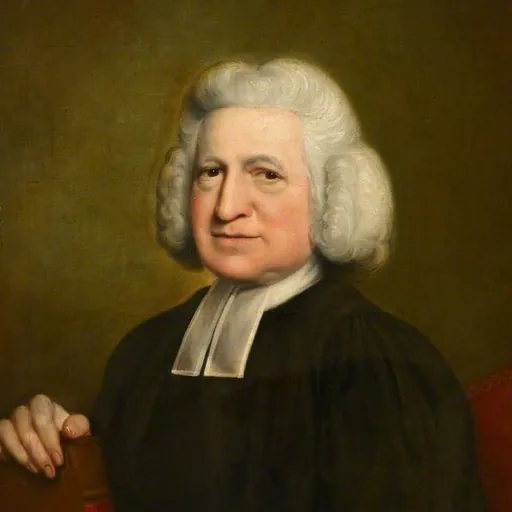
About Charles Wesley
Lived 1707 – 1788 (aged 80). Charles Wesley was a British theologian, philosopher, writer, hymnwriter, cleric and preacher.
Charles Wesley (18 December 1707 – 29 March 1788) was an English Anglican cleric and a principal leader of the Methodist movement. Wesley was a prolific hymnwriter who wrote over 6,500 hymns during his lifetime. His works include "And Can It Be", "O for a Thousand Tongues to Sing", "Christ the Lord Is Risen Today", "Love Divine, All Loves Excelling", the carol "Hark! The Herald Angels Sing", and "Lo! He Comes With Clouds Descending".
Wesley was born in Epworth, Lincolnshire, the son of Anglican cleric and poet Samuel Wesley and his wife Susanna. He was a younger brother of Methodist founder John Wesley and Anglican cleric Samuel Wesley the Younger. He was the father of musician Samuel Wesley and the grandfather of musician Samuel Sebastian Wesley.
He was educated at Oxford University, where his brothers had also studied, and he formed the "Holy Club" among his fellow students in 1729. John Wesley later joined this group, as did George Whitefield. Charles followed his father and brother into ministry in 1735, and he travelled with John to Georgia in America, returning a year later. Following their evangelical conversions in 1738, the Wesley brothers travelled throughout Britain, converting followers to the Methodist revival through preaching and hymn singing. In 1749, he married Sarah Gwynne, the daughter of a Welsh gentleman who had been converted to Methodism by Howell Harris. From 1756 his ministry became more static and he ministered in Bristol, and later London.
Despite their closeness, Charles and John did not always agree on questions relating to their beliefs. In particular, Charles was strongly opposed to the idea of a breach with the Church of England in which they had been ordained.
Biography
At Oxford, Wesley formed a prayer group among his fellow students in 1727; his elder brother, John, joined in 1729, soon becoming its leader and moulding it in line with his own convictions. They focused on studying the Bible and living a holy life. Other students mocked them, saying they were the "Holy Club", "Sacramentarians", and "the Methodists", being methodical and exceptionally detailed in their Bible study, opinions and disciplined lifestyle. Matters did not turn out well, and he was largely rejected by the settlers. In July 1736, Wesley was commissioned to England as the bearer of dispatches to the trustees of the colony. On 16 August 1736, he sailed from Charleston, South Carolina, never to return to the Georgia colony although he contemplated a return if he recovered from health issues.
Ministry In 1738 the Wesley brothers, both dejected following their unsuccessful mission, had religious experiences: Charles experienced an evangelical conversion (or "renewal of faith" ) on 21 May and John had a similar experience in Aldersgate Street just three days later. A City of London blue plaque at 13 Little Britain, near the church of St Botolph, Aldersgate, off St. Martin's Le Grand, marks the site of the former house of John Bray, reputed to be the scene of Wesley's evangelical conversion. It reads, "Adjoining this site stood the house of John Bray. Scene of Charles Wesley's evangelical conversion, May 21st 1738". Wesley commemorated the first anniversary of his religious experience by composing an 18-stanza poem, with its seventh verse, beginning "O for a thousand tongues to sing", now serving as the opening of a shorter hymn. From 1740, Charles and John were the joint leaders of the Methodist Revival and evangelised throughout Britain and Ireland. They were opposed by many Anglican clergy, especially when their appointed lay preachers began to preach in parishes without seeking permission. In Newcastle upon Tyne, Wesley established its first Methodist society. He faced mob violence in Wednesbury and Sheffield in 1743 and at Devizes in 1747. Increasingly in his later years, Wesley became the mouthpiece of the so-called "Church Methodists"—he was strongly opposed to a separation of Methodism from its Anglican roots.
Marriage and children
In April 1749, he married the much younger Sarah Gwynne (1726–1822), also known as Sally. They moved into a house at 4 Charles Street in Bristol in September 1749. The house in Bristol still stands and has been restored, Their other children, John, Martha Maria, Susannah, Selina and John James are all buried in Bristol, having died between 1753 and 1768. (See monument in garden on north side of junction of Lewis Mead and The Haymarket, Bristol.) Both Samuel and Charles junior were musical child prodigies and, like their father, became organists and composers. Charles junior spent most of his career as the personal organist of the Royal Family, and Samuel became one of the most accomplished musicians in the world and is often called "the English Mozart". Samuel Wesley's son, Samuel Sebastian Wesley, was one of the foremost British composers of the 19th century. His body was carried to the church by six clergy of the Church of England. A memorial stone to him stands in the gardens in Marylebone High Street, close to his place of burial. One of his sons, Samuel, became the organist at the church.
Hymns and other works
Wesley was a prolific hymnwriter. Among the collections (hymnals) of Wesley's hymns published in his lifetime were Hymns on God's Everlasting Love (1741, 1742), Hymns on the Lord's Supper (1745), and Short Hymns on Select Passages of the Holy Scriptures (1762), together with others celebrating the major festivals of the Christian year.
Wesley's poetry included epistles, elegies and political and satirical verse. A collected edition of The Poetical Works of John and Charles Wesley, edited by George Osborn, was published in thirteen volumes in 1868–1872. Osborn's collection has now been supplemented by the three volumes of The Unpublished Poetry of Charles Wesley.
Jason E. Vickers states that Wesley's 'conversion experience' in 1738 had a clear impact on his doctrine, especially doctrine concerning the power of the Holy Spirit. The change was most prominent in his hymns written after the same year. From his published work Hymns and Prayers to the Trinity and in Hymn number 62 he writes "The Holy Ghost in part we know, For with us He resides, Our whole of good to Him we owe, Whom by His grace he guides, He doth our virtuous thoughts inspire, The evil he averts, And every seed of good desire, He planted in our hearts." Charles communicates several doctrines: the personal indwelling of the Holy Spirit, the sanctifying work of the Spirit, the depravity of mankind, and humanity's personal accountability to God. and in his many publications.
Some 150 of his hymns are in the Methodist hymn book Hymns and Psalms, including "Hark! the Herald Angels Sing", and The Church Hymn Book (In New York and Chicago, US, 1872) where "Jesus, Lover of My Soul" is published. Many of his hymns are translated into other languages, and form the foundation for Methodist hymnals, as well as the Swedish Metodist-Episkopal-Kyrkans Psalmbok printed in Stockholm in 1892.
Psalms Wesley's hymns are notable as interpretations of Scripture. He also produced paraphrases of the Psalms, contributing to the long tradition of English metrical Psalmody. A notable feature of his Psalms is the introduction of Jesus into the Psalms, continuing a tradition of Christological readings of the Psalms evident in the translations of John Patrick and Isaac Watts. The introduction of Jesus into the Psalms was often the source of controversy, even within Wesley's own family. Charles' brother Samuel Wesley wrote a poem against such practice.
Legacy Wesley Oak historical marker, near Christ Church, St. Simons, Georgia Wesley is still remembered for his ministry while in St. Simon's Island, Georgia, by the South Georgia Conference of the United Methodist Church; in 1950, the conference opened a Christian retreat centre on the island by the banks of the Frederica River, designating it Epworth by the Sea in honour of his and John's birthplace.
In the 19th century, Charles Wesley's legacy was downplayed by Methodist historians, largely because of his opposition to separating from the Church of England.
He is commemorated in the Calendar of Saints of the Evangelical Lutheran Church in America on 2 March with his brother. The brothers are also commemorated on 3 March in the Calendar of Saints of the Episcopal Church. Charles is commemorated on 29 March in the Calendar of Commemorations by the Methodist Order of Saint Luke; John is commemorated on 2 March; their parents are also commemorated.
As a result of his enduring hymnody, the Gospel Music Association recognised Wesley's musical contributions to the art of gospel music in 1995 by listing his name in the Gospel Music Hall of Fame.
Wesley's hymns are utilised in not only Methodist churches but other Protestant denominations, and have been adopted by the Roman Catholic Church. Wesley wrote two of the so-called Great Four Anglican Hymns: "Hark! The Herald Angels Sing" and "Lo! He Comes With Clouds Descending".
Memorials
Tercentenary 24 May 2007 was celebrated as the tercentenary of Wesley's birth, with many celebratory events held throughout England, even though Wesley was in fact born in December 1707. The date of 24 May is known to Methodists as Aldersgate Day and commemorates the spiritual awakening of first Charles and then John Wesley in 1738.
In November 2007, An Post, the Irish Post Office, issued a 78-cent stamp to commemorate the 300th anniversary of Wesley's birth.
In film A Heart Set Free – T. N. Mohan, 2007, a feature-length documentary on Charles Wesley's life and hymns. Wesley – Foundery Pictures, 2009, starring Burgess Jenkins as John Wesley, R. Keith Harris as Charles Wesley, and featuring June Lockhart as Susanna Wesley and Kevin McCarthy as Bishop Ryder
Don’t just read it —
keep it.
Full-length biographies made to live with: read them, listen on the way to work, watch them tonight.
- E-book
- Audio
- Video
Instant download · yours to keep · every purchase keeps this site free
Important facts
Family & relationships
People in Charles Wesley's life
Named in this biography and alive at the same time


Related people
Same field, nearest in time




Contemporaries
People whose lives overlapped Charles Wesley's




Frequently asked questions
Who was Charles Wesley?
English Methodist and hymn writer (1707-1788)
When was Charles Wesley born?
Charles Wesley was born on 18 December 1707 in Epworth.
When did Charles Wesley die?
Charles Wesley died on 29 March 1788 in London.
What was Charles Wesley's occupation?
Charles Wesley was a theologian, philosopher, writer, hymnwriter, cleric and preacher.
What nationality was Charles Wesley?
Charles Wesley was British.
Sources & further reading
Cite this page
APA: Biography.guide. (2026). Charles Wesley. https://biography.guide/charles-wesley/
MLA: "Charles Wesley." Biography.guide, https://biography.guide/charles-wesley/.
Chicago: "Charles Wesley." Biography.guide. https://biography.guide/charles-wesley/.
Data last updated: 2026-09-21 · Spot an error? Report a correction.
Portrait: Wikimedia Commons · author & licence
Page generated 2026-09-27 04:59 UTC