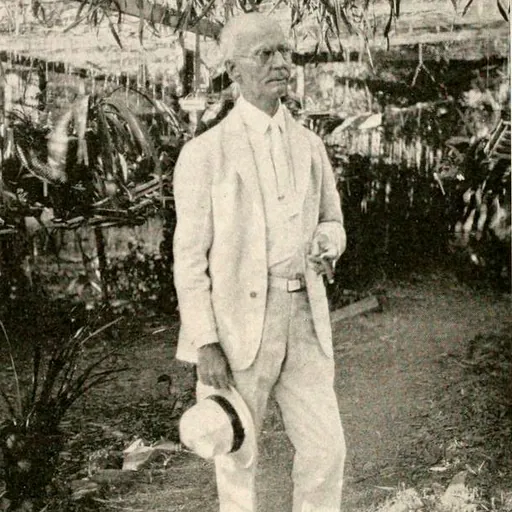
About Charles Wesley Powell
Lived 1854 – 1927 (aged 73). Charles Wesley Powell was an American botanist.
Charles Wesley Powell (May 5, 1854 – August 18, 1927) was an American hobbyist turned horticulturist specializing in the study of orchids (Orchidaceae). He is credited with providing scientists the first large-scale collection of orchid specimens found in Panama. In the early 1900s, he became internationally famous for his new discoveries and valuable contributions to orchidology by gathering, rediscovering, cultivating, preserving, documenting, and submitting-for-study a diverse assortment of hundreds of distinct specimens: yielding many new to science species.
Powell's specimen records (also known as herbarium specimens) and his Panama garden were studied by researchers at the Royal Botanical Gardens, the Berlin Botanical Garden, the Orchid Herbarium of Oakes Ames at Harvard University, the National Museum of Natural History at the Smithsonian Institution, and the Missouri Botanical Garden (MBG). Dozens of orchid species were named in his honor. Powell's work remains relevant not only because his records document valuable scientific data, but they continue to provide material for study – many of his digitized herbarium specimens are freely available online via virtual herbaria.
In 1926, Powell donated his world-class orchid garden (orchidarium) to the renowned MBG of St. Louis, Missouri. Under Powell's direction, a Tropical Station was created by the MBG in Balboa, Panama; 7,000 plants from Powell's orchid garden populated the satellite operation. For the MBG, a snowball effect occurred in the tropics; orchid collecting began there in earnest and over the next 13 years, orchids from its Tropical Station would appreciably augment the collection of the parent garden in St. Louis. "Today, the Missouri Botanical Garden’s orchid collection represents one of the largest and finest in the United States."
Early life
Known to orchid enthusiasts as C. W. Powell, he was born Charles Lesslie Pullen in Richmond, Virginia, to Benjamin King Pullen Sr. and Minerva "Minnie" Anner (née Smith) Pullen. He was the first-born of eight children. In a letter to Minnie dated July 29, 1854, from Richmond, Ben Pullen writes about his son:
In 1860, 6 year old Lesslie and his family moved, by train, southwest to Memphis, Tennessee, for the opening of his father's china store. Shortly thereafter, Lesslie was uprooted again when his family relocated south for several years. There they struggled to survive on a cousin's farm near Sardis, Mississippi, during the Union Army's occupation of Memphis in the American Civil War and Ben Pullen Sr.'s service as a Confederate Army officer. Perhaps this experience was Lesslie's introduction to agriculture.
Family life, bookkeeper, book-lover, genealogist 1870s After the War, the Pullens moved back to Memphis. In 1871, hard times in the South forced Lesslie's father to advertise his store's closing. By the mid-1870s, Ben Pullen Sr. was a bookkeeper for the State National Bank and Lesslie, now calling himself Charles, was a collector for the bank.
In 1877 he married Adelaide "Addie" Belle Prince (1858-1901), the daughter of a Mississippi antebellum cotton planter. In 1879, the couple's first child, Charles Lesslie was born (living only a few months). Six more children would follow: Bessie, an unnamed infant, David (died young), Adelaide "Addie", Minerva "Minnie", and Margaret. Bessie was born in 1880, and the couple's latter three daughters were born in 1887, 1891, and 1898 respectively.
The Yellow Fever Epidemic hit Memphis in 1878 claiming, among thousands, the life of Pullen's mother. 1880s In the early 1880s, Pullen was appointed to serve Memphis in several leadership positions. Detail oriented, well-read, and popular, he served as Secretary of the Legislative Council of Memphis; Secretary of the Fire and Police Commissioners Board; and Clerk for the Supervisors of Public Works, earning $100 per month. Documenting the day-to-day business of a struggling city, he proved valuable to the citizens who put him in office. "Memphis began to recover quickly after [the Yellow Fever Epidemic of] 1878. Its artesian water supply was discovered and turned into one of the purest water supplies in the nation in the 1880s. Its charter was restored. Its sanitation and sewer systems became models for other cities." In 1885 he bought part-interest in a weekly paper The Sunday Times and was its business manager. He was not only a bookkeeper, but also a book-lover; Pullen collected rare books. His interests went beyond the literary world, however. He conducted exhaustive research on his Pullen and Smith genealogy. Relentless in his pursuit of ancestral names and important dates, he advertised for information throughout New England.
1890s Legal troubles plagued the Pullen family in 1890. By 1894, Pullen, his father, two brothers, a sister, and their families had moved south, settling in Houma and New Orleans, Louisiana. In 1895 he was bookkeeping for the Mutual Insurance Company in New Orleans, and his younger brother, Benjamin K. Pullen Jr., was a travel agent there. 1900s In the 1900 U.S. Census, Pullen, his wife, and 4 daughters are found living in New Orleans. His father died in July of that year; his wife died shortly thereafter in February 1901. In 1902, Pullen's eldest daughter, Bessie, married Ernest Johnson and moved to Texas. His younger girls would be cared for by an aunt living in Central America. His daughter Minnie would marry Texan Joseph Ross, a railroad superintendent, and spend time in Guatemala where their second son was born in 1913. Addie married Charles Foster who worked throughout Central America and Jamaica. About his life in New Orleans and his budding interest in flowers he would say: "I had a little greenhouse in New Orleans before I went to the Canal Zone."
New life: country, name, career, passion
Also known as (aka) Charles Wesley Powell Some combination of events prompted a relatively unconnected Charles L. Pullen to move south to Panama. Exactly when and why he reinvented himself as Charles Wesley Powell is a mystery. In a 1928 biography of Powell, some elements of his pre-Panama days are not supported by facts: leading one to wonder why and by whom (probably Powell, for reasons best known by himself) the details of his life in the U. S. were altered. "Pescadore Grande" "In 1908 Powell transferred to Porto Bello [on the Caribbean Sea] as a dispensary assistant and took up fishing as a hobby, using a row-boat. Early 1910 finds Powell working in a dispensary in [old] Gorgona (now submerged 80 feet below the surface of Gatun Lake) and fishing in Panama Bay. The local fishermen called him 'Pescadore Grande' (great fisherman). Switching his fishing from Panama Bay to Gatun Lake soon followed." "The waters had risen until they presented a surface through which the upper portions of thousands of tall trees protruded. Their craft cut paths between treetops. Hunter exclaimed, 'Look, Powell–orchids! Oodles of orchids! Treefuls of orchids! Let's get some of 'em.'"
Powell's orchid garden takes root "I can remember my first orchid, I was just looking over the country one Sunday, about 18 months after I got down there when I saw it way up near the top of a tall tree. 'You're certainly a beauty,' I said. 'I must have you.' While I was standing there wondering how on earth to climb that tree a bare-footed Indian came along. 'I'll give you 25 cents gold to get that flower,' I said. The Indian used the vines to swing to the tree [like Tarzan] and cut off the orchid." About the books he remarked: "I couldn't read a French or German newspaper, but with a little Latin I could make out the technical works." "Powell started his collection on his front porch. When that got so packed with plants he couldn't move, he started an annex by building a tier of shelves on the rear wall of his house." "The ancient Greeks associated it with virility, and the Aztecs were said to drink a mixture of the vanilla orchid and chocolate to give them power and strength." To others, "orchids possess a sensual, quasi-mystical aura: thought of as sexual, wild, rare creatures." In the 1939 book The Orchid Hunters, Norman MacDonald wrote: "For when a man falls in love with orchids, he'll do anything to possess the one he wants. It's like chasing a green-eyed woman [being consumed by desire] or taking cocaine. A sort of madness..." In a 2002 NOVA interview, Susan Orlean (Author, The Orchid Thief, non-fiction) revealed her research findings: "Nothing in science can account for the way people feel about orchids. Orchids arouse passion more than romance. They are the sexiest flowers on Earth." And in 2006, an article about "Fanatical collectors driving a £6 billion black market of 'trophy' specimens" was published in The Telegraph. In this article, Eric Hansen (Author, Orchid Fever, non-fiction) recalls a flower-grower telling him: 'You can get off alcohol, drugs, women, food and cars, but once you're hooked on orchids you're finished. You never get off orchids. Never.'"
Specifically, the prevailing belief about orchids during Powell's lifetime was described thusly: "There is one plant, which stands so far above all the rest for unique beauty and grandeur that it is universally regarded as the aristocrat of the floral kingdom, namely, the orchid. The Central American orchids, above all others in North or South America, are regarded as furnishing the climax [occupying the highest point] and should be called the 'aristocrat of the aristocrats.'"
Powell the orchid hunter
Falling under the wild orchid's powerful spell, Powell fit the profile of a classic orchid hunter with one exception–he was not interested in selling his treasures–he wanted to collect them. At first he collected locally; ultimately, his objective was to "assemble a complete collection of Panama species." Powell's last collecting trip was to the Veraguas Province in March, 1925." On a February 12, 1919, specimen (Mormodes powellii Schltr.) sent to Rolfe, Powell remarked: "Metallic bees nearly ate it up before I could cut it."
Herbarium specimen preparation
Transitioning from hobbyist to horticulturist, Powell needed a way to forward his finds to researchers and preserve them for future reference. He studied the standardized method for specimen preservation and storage. Specimens were dried by extracting moisture in a device called a plant press; however in one instance he noted: "Live flower mashed flat with finger." Although he was initially cautioned against it, he added artificial heat (an electric light bulb or electric iron) which aided in the quality of the results in the tropics. In a letter to Rolfe, Powell asks: "It [the drying] was done over an Electric Light Bulb while lighted up. I have done a lot of experimenting in the drying of flowers, both with stove and sun heat, but this seems to have been the most successful. How is it for a Specimen?" The pressed plant could then be affixed to a mounting sheet (11 X 17 inch paper). Label data (essential documentary information) was added. Once label data was added to the mounting sheet, it was ready for shipping. The mounting sheet (specimen) became a candidate for long-term storage in a repository (like the Harvard University Herbaria). Once accepted, the mounting sheet would then be known as a herbarium specimen. At first he sent just the preserved flowers, but soon he was asked to send preserved plants that included the roots, stems, leaves, flowers, and seeds. Powell painstakingly crafted his mounting sheets; he enhanced them with fieldnotes, illustrations, flower cutouts, and photographs. His original sheets would stand on their own as works of art; over time they have evolved into beautiful, remarkably detailed documents.
Herbarium specimen examples Many of Powell's earliest specimens–most now available as digitized images–are found in the herbarium at Kew; some records there include letters from Powell to Rolfe. Over 400 distinct examples of Powell's collection records, many with images of his herbarium specimens, are found in a virtual herbarium at the Harvard University Herbaria and Libraries. Tropicos (maintained by the MBG), The Swedish Museum of Natural History, and other repositories (to a lesser extent) provide additional sources for online viewing of herbarium specimens.
For No. 1 Oncidium oerstedii with photographs.
For No. 20 Cyncnoches guttulatum with photos, letter, sprays. Curated at Kew Royal Botanic Gardens, England.
For his spider orchid (Brassia caudata) with cutout.
For his Prosthechea fragrans (Sw.) W.E. Higgins showing the evolution of a herbarium specimen.
Herbarium specimen examples with hand-drawn illustrations Powell's signature, CWP. (CW is overlapping), is found in the lower right.
Epidendrum fragrans enhanced with Powell's flower-only drawing
Information included in Powell's label data and fieldnotes
In July 1918, Powell began to send Rolfe a series of herbarium specimens. It took roughly 8 months for a portion (29) to be identified, communication slowed; Rolfe was in ill health and died before he had a chance to [fully] study Powell's collection. Rolfe's death was a great disappointment to Powell; he had derived much encouragement and help from Rolfe's kindly cooperation and guidance." He was energized by the thrill of the hunt. His fellow researchers began to take notice. Powell was persistent, he infused enthusiasm in his dealings, and he instilled in his fellow researchers the confidence that—he had something to offer in the confusing world of the Orchidaceae. "Mr. Powell's enthusiasm for these plants has caused him to be locally termed 'the Orchid Man' ('Parasita Grande'), and his garden is one of the show places in Balboa to both the botanist and tourist." Perhaps while acting as tour guide, the idea sprouted—to someday donate his garden; little did he know how much joy and peaceful beauty his expanding orchid collection would one day bring to visitors of a botanical garden away. The reputation of Powell's Horticultural Garden, Balboa, Canal Zone began to grow on a global scale.
Images of Powell and his Canal Zone garden Exterior garden view. Powell on left, dressed in white, for scale "Orchids are surprisingly difficult to see in the wild; the majority being epiphytic, growing high in the canopy on trunks, branches or in crotches out of sight." In Powell's garden they were at eye-level—a sight to behold. "A rustic gate gives entrance to this miniature paradise. The gate posts are formed of dead jungle trees covered with Orchids. The walks, bordered with beautiful ferns and lilies, lead between Orchid-covered dead trees that are a riot of colour." Powell Orchid Garden #2. Powell dwarfed by the size of his garden
Thumbnail image of Powell captured in 1923, examining a night-blooming cereus from his garden: hosted by the Hunt Institute for Botanical Documentation.
Associations with world's leading authorities The relationships between the orchid experts of the time were complicated; mutual respect, admiration, cooperation and financial support of each other were interwoven with intense competition, rivalry, and double-dealing. Regarding multi-country cooperation via plant exchanges, in 1938, the Missouri Botanical Garden Bulletin reported: "A system of exchange of plants with other countries, begun by Mr. Powell, had been discontinued for some years. During the year it was re-established and exchanges were made with nine countries."
Powell and Schlechter Beginning in 1919, thanks to a tip from a correspondent in Costa Rica, German botanist, taxonomist, and author Rudolf Schlechter (curator of the herbarium at the Berlin Botanical Garden) began corresponding with and receiving numerous duplicate specimens (ones originally sent to Rolfe) from Powell. "Schlechter immediately recognized the importance of the plant collection, and encouraged Mr. Powell in every way to send in further specimens."
Powell, Oakes Ames, and Blanche Ames In 1922, Powell began relations with Harvard University's Oakes Ames, a botanist, and the most eminent American orchid authority at the time. Due to intense competition with Schlechter, "Ames went so far as to sign with Powell a formal contract in which the latter would collect orchids for him for U.S. $100 per month. From that point forward, Powell only sent Schlechter duplicate specimens. Ames, his wife Blanche, and daughter Pauline traveled to Central America in early 1923, partly to meet Powell and see his garden; after this visit, Ames received some of Powell’s specimens. Of these, 29 were new to science.
Powell and Lankester In September 1922, Powell sent a letter to Ames introducing "my good friend" :es:Charles H. Lankester. Lankester, a British coffee grower, naturalist, and orchidologist, was living in Cartago, Costa Rica, a country with great potential for new to science orchid species. Powell facilitated what would become a "deep friendship between Lankester and Ames that lasted 25 years."
Powell and Standley
In the 1924 Annual Report to the Board of Regents of The Smithsonian Institution, Paul C. Standley reported about Powell: "Years of experience, through which the best methods have been discovered, combined with the attention to details such as other collectors rarely attain, have enabled him to make specimens which are unsurpassed. Among the vines that cover the trellises in the Powell garden are various plants of Vanilla, of which there are two common species in Panama, V. planifolia with narrow leaves (see image above) and V. pompona with wide leaves." "In 1923 Pring visited the Panama Canal Zone, where he spent six months, weeks of which were at Powell's garden talking orchids from 6 a.m. to 3 a.m." This association would prove mutually beneficial; back at the MBG, "a great interest arose for Panama’s orchids." "Powell’s collection marked the beginning of the Garden’s reputation in orchid horticulture."
Retiring on October 10, 1926, Powell's service record in the Canal Zone's Sanitation department documents his annuity.
Desiderata: "The answer was orchids"
Life in early 1900s Panama presented a unique opportunity for Powell to find his passion in orchids. The labor requirement for the construction of the Panama Canal provided him with a livelihood; and an outing on the newly created Gatun Lake awakened a desire to "catch" orchids instead of fish. Powell submitted at least 496 distinct specimens; in 1926, 109 were reported as new to science.
"Orchids are a difficult and confusing taxonomic group. People who specialize in the Orchid family usually spend years naming different species based on DNA and morphology."
Orchidaceae-Pronunciation or-kid-AY-see-ee, Alternative Pronunciation: or-kid-AY-see-eye
powellii-Pronunciation pow-EL-ee-eye
Books referencing Powell Orchidaceae Powellianae Panamenses (collections by C. Powell) Schedulae Orchidianae No. 3 Schedulae Orchidianae No. 4 Schedulae Orchidianae No. 5 Schedulae Orchidianae No. 6 Schedulae Orchidianae No. 7 Schedulae Orchidianae No. 8 Schedulae Orchidianae No. 9 Schedulae Orchidianae No. 10 Flora of the Panama Canal Zone The Orchidaceae, Flora of Panama (4 parts in Missouri Botanical Garden Bulletins 1946 and 1949)
Organization memberships American Folklore Society 1888 1889 Office Men's Club, New Orleans, Louisiana. Recording secretary 1895 Virginia Historical Society 1896
Don’t just read it —
keep it.
Full-length biographies made to live with: read them, listen on the way to work, watch them tonight.
- E-book
- Audio
- Video
Instant download · yours to keep · every purchase keeps this site free
Important facts
People in Charles Wesley Powell's life
Named in this biography and alive at the same time




Related people
Same field, nearest in time



Contemporaries
People whose lives overlapped Charles Wesley Powell's




Frequently asked questions
Who was Charles Wesley Powell?
botanist (1854-1927)
When was Charles Wesley Powell born?
Charles Wesley Powell was born on 5 May 1854 in Richmond.
When did Charles Wesley Powell die?
Charles Wesley Powell died on 18 August 1927 in Panama Canal Zone.
What was Charles Wesley Powell's occupation?
Charles Wesley Powell was a botanist.
What nationality was Charles Wesley Powell?
Charles Wesley Powell was American.
Sources & further reading
· Wikipedia: Charles Wesley Powell
· DBpedia: Charles Wesley Powell
Cite this page
APA: Biography.guide. (2026). Charles Wesley Powell. https://biography.guide/charles-wesley-powell/
MLA: "Charles Wesley Powell." Biography.guide, https://biography.guide/charles-wesley-powell/.
Chicago: "Charles Wesley Powell." Biography.guide. https://biography.guide/charles-wesley-powell/.
Data last updated: 2026-09-22 · Spot an error? Report a correction.
Page generated 2026-09-27 05:10 UTC