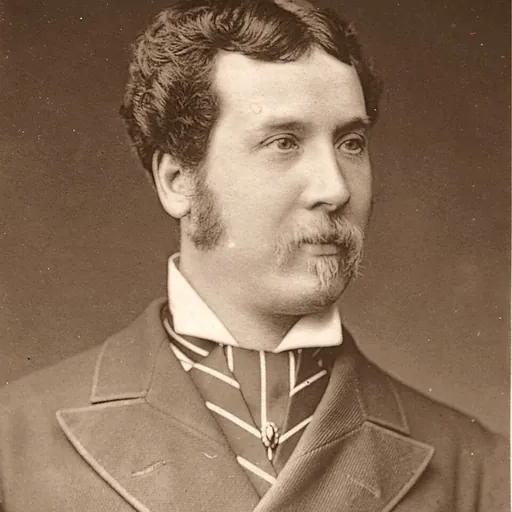
About Charles Warner
Lived 1846 – 1909 (aged 62). Charles Warner was a British stage actor.
Charles John Warner (né Lickfold, 10 October 1846 – 11 February 1909) was an English stage actor whose career of over forty years spanned the Victorian and Edwardian eras. Warner performed in a variety of styles, from Shakespeare's plays to comedies, but he was best known for his dramatic roles and the emotional intensity of his performances. His most famous character was the alcoholic 'Coupeau' in Charles Reade's melodrama Drink (based on Émile Zola's novel, L'Assommoir), a part that the actor performed many times during his career. Warner performed in the principal theatres in London during the period 1864 to 1887. He had a successful tour of Australia and New Zealand from December 1887 to June 1890, after which he returned to England. In 1906 Warner travelled to New York where he appeared on stage in several productions. In February 1909 he committed suicide in his Manhattan hotel room.
Biography
Early years
Charles John Lickfold was born on 10 October 1846 in the central London district of Kensington, the third child of James Lickfold and Hannah (née Holland). His father worked as a straw-hat maker and seller. Lickfold was educated at Westbury College in the north London suburb of Highgate.
Lickfold made his first appearance on the stage in 1861, aged fifteen, at a special performance at Windsor Castle before Queen Victoria, performing as a page in Edward Bulwer-Lytton's historical drama, Richelieu (with the veteran actor Samuel Phelps in the lead role).
Lickfold worked briefly in the office of his uncle, an architect. In 1863, aged seventeen, he left that employment and his home, determined to pursue a theatrical career. Lickford had secured a position as a "utilitarian" actor in a theatre company under the management of James Rogers, based in the provincial town of Hanley in Staffordshire. When he left home Lickfold was accompanied by his sister, "who had got wind of my intention and insisted on going with me". The company of actors worked "the Hanley, Leicester, Lichfield, and Worcester circuit", performing dramas such as The Castle Spectre and The Mysteries of Paris. Lickfold remained with the company for just under a year, playing two parts a night in a constant turn-over of productions. He later remarked: "It was there that I really learned my profession, the continual change of plays ensuring versalitity".
In 1864 Lickfold briefly joined Henry Nye Chart's company in Brighton. Soon afterwards, however, he was offered the opportunity to appear on the stage in London. It was Phelps that became the young actor's mentor; as Warner later stated: "the late Samuel Phelps... really took me in hand, and helped me to achieve the position which I now hold". At the Lyceum he succeeded Henry Irving in the role of 'Alfred Jingle' in Pickwick (James Albery's stage adaptation of The Pickwick Papers). Amongst his other roles at the Lyceum, Warner also played the role of 'Orpheus' in Euripides' Medea. At the Vaudeville he also appeared in Boucicault's Old Heads and Young Hearts ("a charming comedy") and as 'Charles Courtley' in London Assurance (that played for 400 nights).
Warner's role involved a "realistic presentment of the death of the wretched Coupeau from delirium tremens". He studied the causes and symptoms of the condition, "so that no element of reality should be wanting" in his performance. One London newspaper described that section of the play as "the most terrible scene ever presented on the English stage". In 1909 after Warner's suicide in New York the actor Gordon Bailey, who had played alongside him in Drink, "stated that after the performance Mr. Warner was completely broken up, and that the passion and violence he put into his acting was enough to unhinge any brain".
Warner played the role of Coupeau at the Princess' Theatre "for a year and three months without cessation". He later played it in revivals in London at the Adelphi, Princess' and Surrey theatres, and the Standard Theatre in Shoreditch (in London's East End). At the Standard the play averaged £1,200 a week for seven weeks "at cheap prices... not even the pantomime there ever realised such a sum".
Sadler's Wells Theatre
In 1880 Walter Gooch offered Warner a three-year engagement at the Princess' Theatre when it re-opened after a complete rebuild. At about the same time the renowned American Shakespearean actor Edwin Booth announced his intention to appear in London and Gooch also engaged him for six months. This caused a problem, with Booth refusing to share the stage with the English actor (Warner later claimed he had been willing to allow Booth his choice of roles, but the American declined). The Princess' Theatre re-opened in November 1880, with Booth and his company in a production of Hamlet. Rather than face the prospect of being "shelved for several months", Warner joined the company at the Sadler's Wells Theatre, in the Clerkenwell district of central London.
Warner remained at the Sadler's Wells Theatre for nine months, where he played a range of Shakespearean characters such as 'Othello' and 'Macbeth', as well as appearing in other plays (including revivals of The School for Scandal and The Road to Ruin). In late-January 1881 Warner performed as 'Walter Lee' in Henry Pettitt's drama, Taken from Life. The production was a success, playing for 100 performances. During August 1881 Warner directed a revival of Dion Boucicault's Janet Pride, also playing 'Richard Pride' in the production. It's Never Too Late to Mend by Charles Reade opened in September 1881, with Warner in the role of 'Tom Robinson'. In January 1883 Warner played the lead role in a revival of Dora, Reade's adaption of Tennyson's poem. From October 1883 to March 1885 Warner played 'Ned Drayton' in the drama, In the Ranks (written by Henry Pettitt and George R. Sims), a play that ran "for nearly 500 consecutive nights". After the opening night Warner was described as "the typical hero of the Adelphi romance" who "seemed to carry the play on his shoulders to success". The Last Chance written by George R. Sims, from April to June 1885 with Warner in the role of 'Frank Daryll'. This was followed by Robert Buchanan's Sophia (an adaption of Fielding's Tom Jones) in which Warner played the role of 'Tom Jones'. Sophia was highly successful, with a run of "nearly 600 nights".
In December 1886 Warner returned to the Princess' Theatre, where he opened in H. A. Jones' The Noble Vagabond. From April 1887 he performed as 'Colonel Charles Prescott' in Held by the Enemy, a Civil War drama by the American playwright William Gillette. At that stage Warner's engagement was to be for six weeks only.
A farewell matinee benefit for Charles Warner was held at the Theatre Royal in Drury Lane on 9 December 1887, on the occasion of his impending departure for Australia. The event, a series of performances and songs, involved "all the principal London artists" who had donated their services to the benefit. Warner was involved in several of the sequences, including the second act of Romeo and Juliet (with William Terriss, Leonard Boyne and his daughter Grace Warner in her stage début). Warner also performed with others in the sixth act of Drink.
Australia
Warner and his daughter Grace departed from London on 2 January 1888 aboard the R.M.S.S. Victoria of the P. and O. Company's line. The voyage, via Aden and Colombo, took 35 days, arriving in Melbourne on 6 February. During the trip various amusements (such as "fancy dress balls, concerts, negro minstrelsy, tableaux vivants, athletic sports, and histrionic entertainments") were organised by the passengers "to make their time pass merrily, and sometimes instructively". On the voyage Warner and his daughter performed the balcony scene from Romeo and Juliet; a scene from Hamlet was also staged, in which a passenger, Miss Chirnside, took on the role of Ophelia. After his arrival in Melbourne, Warner wrote a letter to the editor of The Argus newspaper regarding the voyage. He admitted that "it was almost with dread, amounting to positive horror" that he undertook "so long a sea voyage", not having beforehand "travelled further than Paris and Germany". However, once he had settled aboard the vessel, Warner wrote that his "pleasure and delight grew as the voyage progressed".
On Saturday, 18 February 1888, Charles Warner made his début on the Australian stage at Melbourne's Theatre Royal in Drink, the play "in which he achieved his great London success nearly nine years ago". When the English actor first appeared on stage, "the storm of applause which broke from all parts of the house arrested the progress of the piece for some little time". Warner's share of the takings for his first week of performances in Melbourne was £500.
On 15 June 1888 a special 'Shakespearean night' was presented at the Princess's Theatre marking the close of Warner's Melbourne season. During the evening Warner played the characters of Hamlet, Romeo, Shylock and Othello in selected scenes from Shakespeare's plays.
In June 1888 Warner and his company travelled to Adelaide for a month-long season at the Theatre Royal, during which they presented "a number of theatrical treats" to the Adelaide playgoers. The Adelaide season also proved to be lucrative. The three nights of Hamlet alone returned £600. In mid-August a production of The Lady of Lyons was staged, with Warner in the role of 'Claude Melnotte'. A clash with the touring London Gaiety Company in August prompted a week of performances in Newcastle, where Warner and his company played "to the largest audiences on record in that city". The play was highly successful, playing for twelve weeks in Melbourne "to the highest receipts ever known in the colonies". For a period of just seven performances, "the figures were up to £1,800".
In mid-February 1889 the drama Captain Swift opened at Sydney's Theatre Royal, with Warner in the title role and Gracie Warner also in the cast. he play was written by C. Haddon Chambers, a London-based dramatist who had been born in Sydney. The Sydney season of Captain Swift was not considered a success, with audience numbers down and the play being the subject of criticism in the local press. In contrast to its Sydney performances, Captain Swift played to full houses in Brisbane.
After the Adelaide season had finished Warner returned to Melbourne. The Williamson, Garner and Musgrove Dramatic Company that had been supporting Warner was disbanded and Warner set about forming and rehearsing a new company (with some members common to both).
In August 1889 a popular English actress named Jennie Lee, who had been engaged by Williamson, Garner and Musgrove, was performing in The Grasshopper at Melbourne's Princess' Theatre. On 13 August she was "suddenly taken ill" and her understudy played her part that evening. Miss Lee was diagnosed with "a severe bronchial attack", which placed her management in a dilemma, as it was impractical for her understudy to replace the popular actress for the required period of recovery. Williamson, Garner and Musgrove had contemplated closing the theatre, but Warner rescued the situation by offering to perform Captain Swift at the Princess' Theatre for two weeks, despite a previous arrangement to perform with his new company at Ballarat during that period. Warner placed a notice in The Ballarat Star on 20 August, explaining "the reason of his not appearing as announced" and expressing his intention to visit Ballarat at a later date "in order not to disappoint the public". Williamson, Garner and Musgrove sent a company to Ballarat to fulfil Warner's commitments there, opening with Hands Across the Sea at the Academy of Music with J. H. Clyndes, a recently arrived English actor, replacing Warner in the male lead role. Despite all the elaborate arrangements, the staging of Captain Swift at the Princess' Theatre in Melbourne proved to be a "financial failure" due to poor attendances during the fortnight.
In early September 1889 Warner and his company played a short season at the Royal Princess Theatre in Sandhurst (Bendigo), performing productions such as Hands Across the Sea, Drink, Dora, the comedy The Barrister and The Lady of Lyons. Later in the month Warner's company commenced a tour of Tasmania, beginning in Launceston and finishing on 26 September at Hobart.
On 10 October 1889 Warner and his company commenced a tour of New Zealand at Dunedin, opening with Hands Across the Sea at the Princess Theatre. They also performed at Christchurch, Wellington and Auckland. It was reported that Charles Warner cleared £3,000 from his tour of New Zealand.
After his successful tour of New Zealand, Warner appeared in a revival of Hands Across the Sea at the Theatre Royal in Melbourne in February 1890. In May 1890 Warner played 'Old Tom' in the revival of Dion Boucicault's melodrama, After Dark, at Melbourne's Theatre Royal.
In late-June 1890 Warner and his daughter Gracie featured in three farewell performances of Hamlet at the Theatre Royal in Adelaide, supported by the MacMahon Dramatic Company. In early July they departed for England aboard the R.M.S. Orizaba. Warner had been initially engaged for a six-week tour of Australia, soon afterwards extended to sixteen weeks, but he ended up remaining in the country for two years and six months. Later Warner revived roles for which he was known, such as Drink and It Is Never Too Late to Mend.
In May 1895 it was reported that Warner had been "touring in the English provinces", performing a play called Under the Mask. Warner and his daughter Grace performed in the newly built Lyric Theatre at Hammersmith in July 1895. The opening bill consisted of a new drama, A House of Lies and the stage adaption of Tennyson's Dora.
Warner's wife Fanny died in January 1899 at Clacton-on-Sea, county Essex.
In late-January 1903 Warner performed in A Snug Little Kingdom, a three-act comedy by Mark Ambient, at the Royalty Theatre in Soho.
In December 1904 Warner played the role of 'Canio' in a dramatic version by Charles Brookfield of Leoncavallo's opera, Pagliacci, at the Savoy Theatre in London's West End. A reviewer for The Times praised Warner's melodramatic performance, remarking that "he was bold enough and wise enough to play the part 'for all it was worth', risking now and then the danger of being ridiculous for the sake of being effective".
From May 1905 Warner played the role of "the renowned burglar" 'Kleschna' in the melodrama, Leah Kleschna (with Lena Ashwell in the title role), written by the American playwright C. M. S. McLellan. The play was staged in the New Theatre in London's West End. Warner's performance as "the genial, capable, cruel and yet kind Kleschna" was described as "an extraordinary bit of work", the reviewer commenting on "the intense interest which this actor takes in the minutest detail of his part".
In September 1906 Warner appeared in Herbert Beerbohm Tree's production of Shakespeare's The Winter's Tale, at London's His Majesty's Theatre.
New York
Warner arrived in New York in late 1906 to work and to visit his son Henry, who had been establishing a career on the American stage. In December 1906 Warner appeared in vaudeville performances at the Alhambra Theatre in Harlem, New York. In February 1907 he appeared in "a condensed version" of Drink at Hyde and Behman's Theatre in Brooklyn.
Warner hoped to arrange an American tour of Drink and other plays, but this did not eventuate. He became accustomed to playing cards at The Lambs Club, a social club associated with theatrical professions in West 44th Street, and reading in the club's library. Warner also left cash "for the payment of his board and funeral expenses".
The evidence suggests that Griffith's film was a direct tribute to Warner after his tragic death in New York on 11 February 1909. Griffith devised and directed a total of seventy-three films during the first half of 1909 for distribution by the Biograph Company (an average of more than two films a week). The timing of Warner's death, the particular construction of the narrative and the subsequent release date of the film points to the production of the moving picture following directly from Warner's suicide. In its advertising directed to exhibitors, Biograph drew attention to the intended connection with Drink and its powerful message: "The play [within the film] happens to be a dramatization of Emile Zola's L'Assommoir, 'Drink'. Here [the father] sees the awful result of intemperance and resolves to abstain from intoxicants for the rest of his life".
Don’t just read it —
keep it.
Full-length biographies made to live with: read them, listen on the way to work, watch them tonight.
- E-book
- Audio
- Video
Instant download · yours to keep · every purchase keeps this site free
Important facts
People in Charles Warner's life
Named in this biography and alive at the same time




Related people
Same field, nearest in time


Contemporaries
People whose lives overlapped Charles Warner's


Frequently asked questions
Who was Charles Warner?
British actor-singer (1846–1909)
When was Charles Warner born?
Charles Warner was born on 10 October 1846 in Kensington.
When did Charles Warner die?
Charles Warner died on 12 February 1909.
What was Charles Warner's occupation?
Charles Warner was a stage actor.
What nationality was Charles Warner?
Charles Warner was British.
Sources & further reading
Cite this page
APA: Biography.guide. (2026). Charles Warner. https://biography.guide/charles-warner-stage-actor/
MLA: "Charles Warner." Biography.guide, https://biography.guide/charles-warner-stage-actor/.
Chicago: "Charles Warner." Biography.guide. https://biography.guide/charles-warner-stage-actor/.
Data last updated: 2026-09-20 · Spot an error? Report a correction.
Page generated 2026-09-27 05:10 UTC