
About Charles Sims
Lived 1899 – 1929 (aged 30). Charles Sims was a British flying ace.
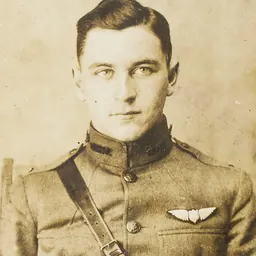
Flight Lieutenant Charles John Sims, (20 December 1899 – 30 December 1929) was an English World War I flying ace credited with nine aerial victories. His most notable victory saw him shoot down an enemy aircraft that crashed into another, giving Sims a double win. However, his Distinguished Flying Cross was awarded for his courage in ground attack missions.
Early life Charles John Sims was born in Bournemouth, England on 20 December 1899.
World War I Sims entered the Royal Naval Air Service as a probationary flight officer with seniority from 24 October 1917. He was assigned to No. 13 (Naval) Squadron, which later became No. 213 Squadron RAF when the RNAS was merged with the Army's Royal Flying Corps to form the Royal Air Force on 1 April 1918. Flying a Sopwith Camel single-seat fighter he was diligent in trench strafing and ground support missions. He also scored nine aerial victories between 9 July and 9 November 1918, just before the end of hostilities. His most notable wins were on 25 September, when one Fokker D.VII he downed spun into a second, taking it out also; and his triple win on 14 October. His final tally was a balloon and four German aircraft destroyed solo, two shared with other pilots, and two driven down out of control.
He was awarded the Distinguished Flying Cross on 2 November 1918. His citation read: Lieutenant Charles John Sims (Sea Patrol). "In a recent raid on an aerodrome this officer at 200 feet altitude bombed the objective, obtaining a direct hit; he then descended to about 50 feet altitude and attacked some Fokker biplanes lined up outside the hangars. He is an officer of exceptional courage and ability, possessing remarkable powers of observation."
List of aerial victories +Combat record
In November 1920 he was elected a student member of the Royal Aeronautical Society, and in October 1922 was selected for Aeronautical Research Course "C" at the Imperial College of Science and Technology in London. He finally presented his thesis in October 1925 and was awarded a Diploma of Imperial College for advanced study and research. He published a paper detailing his experiments with fuel additives for aircraft engines in May 1926.
On 1 January 1926, he was promoted from flying officer to flight lieutenant. On 10 September 1926 he was posted to No. 24 Squadron, based at RAF Kenley, but his stay was a brief one, as he was reassigned to the RAF School of Photography at RAF Farnborough on 27 October.
In July 1929 Sims went to Iraq to "make secret experiments". On 30 December 1929, about a month after he returned from Iraq, he was found dead in his bedroom at Farnborough with a bullet wound in his side and a gun nearby; an inquest returned an open verdict.
Don’t just read it —
keep it.
Full-length biographies made to live with: read them, listen on the way to work, watch them tonight.
- E-book
- Audio
- Video
Instant download · yours to keep · every purchase keeps this site free
Important facts
People in Charles Sims's life
Named in this biography and alive at the same time

Related people
Same field, nearest in time



Contemporaries
People whose lives overlapped Charles Sims's




Frequently asked questions
Who was Charles Sims?
British flying ace (1899-1929)
When was Charles Sims born?
Charles Sims was born on 20 December 1899 in Bournemouth.
When did Charles Sims die?
Charles Sims died on 30 December 1929.
What was Charles Sims's occupation?
Charles Sims was a flying ace.
What nationality was Charles Sims?
Charles Sims was British.
Sources & further reading
· DBpedia: Charles Sims (RAF officer)
Cite this page
APA: Biography.guide. (2026). Charles Sims. https://biography.guide/charles-sims/
MLA: "Charles Sims." Biography.guide, https://biography.guide/charles-sims/.
Chicago: "Charles Sims." Biography.guide. https://biography.guide/charles-sims/.
Data last updated: 2026-09-20 · Spot an error? Report a correction.
Page generated 2026-09-27 05:31 UTC