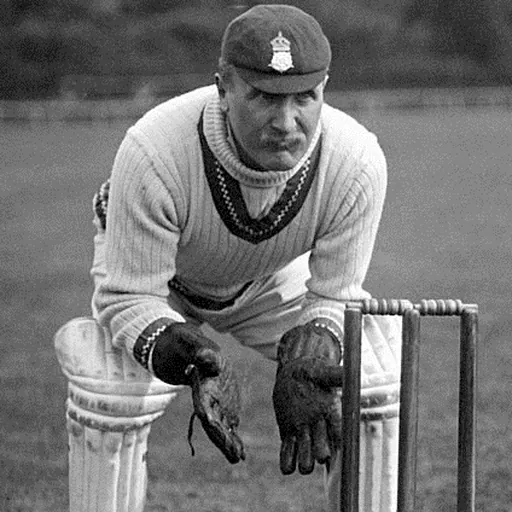
About Charles Robson
Lived 1859 – 1943 (aged 84). Charles Robson was a British cricketer and association football coach.
Charles Robson (20 June 1859 – 27 September 1943) was an English cricketer, who played first-class cricket as a wicket-keeper for Middlesex between 1881 and 1883, and for Hampshire from 1891 to 1906, for whom he served as captain for three years from 1900 to 1902. He was later associated with W. G. Grace's London County team. He was also secretary to Southampton St Mary's Football Club for one season, from 1895 to 1896, and was one of the founding directors of the company which was established in 1897 when the club changed its name to Southampton Football Club.
Cricket career Middlesex Robson was born at Kilburn (then in Middlesex) in June 1859. He was educated firstly at Bruce Castle School, before attending Chatham House Grammar School; he was a member of the cricket eleven at both schools. Robson made his debut in first-class cricket for Middlesex against Surrey at Lord's in 1881, with him making twelve appearances in first-class cricket Middlesex to 1883. In these, he scored 246 runs at an average of 12.94, though at this early stage in his first-class career he did not keep wicket, with A. J. Webbe being Middlesex's long-established wicket-keeper. While playing for Middlesex in 1883, Robson also appeared in a first-class match for the Marylebone Cricket Club (MCC) against Sussex. He soon became Hampshire's wicket-keeper, and often the opened the batting in partnership with Russell Bencraft. Hampshire regained their first-class status in October 1894, allowing them to join the County Championship for 1895. He made his debut for Hampshire in first-class matches in their return debut County Championship match against Somerset at Taunton. He made fourteen appearances in the 1895 season, and followed that up in 1896 with a further fourteen appearances, in which he recorded two half centuries, and made thirty appearances for Hampshire over the proceeding two seasons. in which Robson made two first-class appearances against the Gentlemen of Philadelphia. captaining a particularly weak Hampshire side that had lost many of its players to military service in the Second Boer War. He scored his only first-class century in 1900, making 101 against Warwickshire at Edgbaston. In his first season as captain, Hampshire finished bottom of the County Championship; Robson contributed 545 runs across the season, averaging 16.02 with the bat. Robson played a notable innings during that season against Lancashire at Liverpool. Having been bowled out in the first innings for only 106, Lancashire replied with 413–8 declared, and when Hampshire opened their second innings, it looked unlikely that Lancashire would need to bat again. J. G. Greig opened the batting and the Hampshire score had reached 374 for 9, with Robson, who was batting at number eleven, putting on 113 for the tenth wicket, with Robson contributing 52 runs alongside Grieg's unbeaten 249 not out; their endeavours ensured Lancashire had to chase 181 in 140 minutes, but rain intervened with Lancashire having reached 111 for 5.
In August 1901, Robson was extended an invitation to tour Australia with Archie MacLaren's touring party, which he accepted and acted as deputy to Dick Lilley. and relinquished his wicket-keeping duties to Jimmy Stone in the same season. He decided to step back from playing in 1903, in order to allow younger players an opportunity in the Hampshire team,
During the 1903 season, with Hampshire having no games until June, Robson began his association with W. G. Grace's London County when he played against the MCC at Lord's; he played three first-class matches for London County in 1903, in addition to playing for the Gentlemen in the Gentlemen v Players fixture at The Oval, in addition to playing for the Gentlemen of the South against the Players of the South during the Bournemouth Cricket Week.
Robson was one of the founder directors when the football club was incorporated into a limited company, "Southampton Football and Athletic Company Limited" in July 1897; on the Memorandum of Association he was listed as "Charles Robson, Mineral Water Merchant and Hampshire wicket-keeper" of Hill Lane, Southampton. He remained a director of the company for several years.
Personal life In Southampton, Robson entered into business as a mineral water manufacturer in the later 1880s. He was summoned to court in August 1892, for allegedly breaching the Factory Act. He had a son, Russell, who was injured during the First World War while serving with the Royal Flying Corps. Robson died at his residence in Abingdon in September 1943.
Don’t just read it —
keep it.
Full-length biographies made to live with: read them, listen on the way to work, watch them tonight.
- E-book
- Audio
- Video
Instant download · yours to keep · every purchase keeps this site free
Important facts
People in Charles Robson's life
Named in this biography and alive at the same time



Related people
Same field, nearest in time



Contemporaries
People whose lives overlapped Charles Robson's


Frequently asked questions
Who was Charles Robson?
English cricketer (1859-1943)
When was Charles Robson born?
Charles Robson was born on 20 June 1859 in London.
When did Charles Robson die?
Charles Robson died on 27 September 1943 in Abingdon-on-Thames.
What was Charles Robson's occupation?
Charles Robson was a cricketer and association football coach.
What nationality was Charles Robson?
Charles Robson was British.
Sources & further reading
· DBpedia: Charles Robson (cricketer)
Cite this page
APA: Biography.guide. (2026). Charles Robson. https://biography.guide/charles-robson-cricketer/
MLA: "Charles Robson." Biography.guide, https://biography.guide/charles-robson-cricketer/.
Chicago: "Charles Robson." Biography.guide. https://biography.guide/charles-robson-cricketer/.
Data last updated: 2026-09-22 · Spot an error? Report a correction.
Portrait: Wikimedia Commons · author & licence
Page generated 2026-09-27 05:03 UTC