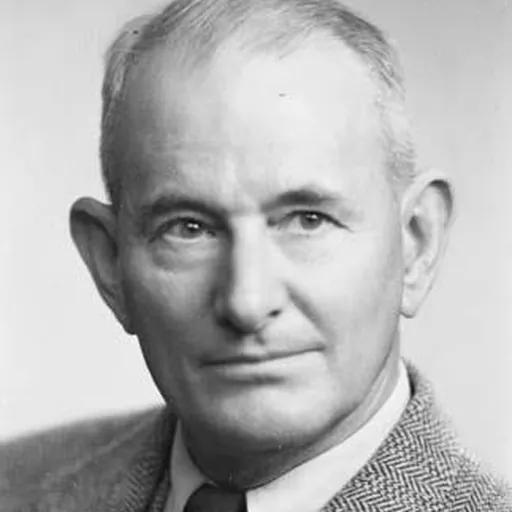
Charles P. Mountford
Australian photographer, film maker and anthropologist
About Charles P. Mountford
Lived 1890 – 1976 (aged 86). Charles P. Mountford was an Australian anthropologist, photographer, director, documentary filmmaker and ethnologist.
Charles Pearcy "Monty" Mountford OBE (8 May 1890 16 November 1976) was an Australian anthropologist and photographer. He is known for his pioneering work on Indigenous Australians and his depictions and descriptions of their art. He also led the American-Australian Scientific Expedition to Arnhem Land.
Mountford's written works, along with those by contemporaries, foreshadowed subsequent scholarly investigations like T. G. H. Strehlow's Journey to Horseshoe Bend (1969) and iconic late-20th-century works such as Stephen Muecke, Krim Benterrak, and Paddy Roe's Reading the Country: Introduction to Nomadology (1984).
Mountford's final book, Nomads of the Australian Desert, was the subject of an important court case due to its inclusion of culturally restricted content.
Early years and education Charles Pearcy Mountford was born on 8 May 1890, the son of Charles Mountford and Arabella Mountford (née Windsor) at Hallett, South Australia, where his parents and grandfather had adjoining farmlets. and had two children, Kenneth Pearcy Mountford and Joyce Anna Mountford. In 1920 he was promoted to the Darwin Post Office as mechanic-in-charge, work that took him to remote outposts in which he became familiar with Aboriginal communities. Suffering poor health from the tropical climate and hard work, Mountford, aged 33, was posted back to the Adelaide GPO workshops, living at 52 West Street, Torrensville, where they were in 1916.
Mountford's interest in Indigenous culture and artworks in particular was revived while staying with his parents in Dawson, where his father was stationed as a Methodist missionary. They found at nearby Merowie Springs a rock with dozens of carved grooves which he traced and photographed. Ethnologist Norman B. Tindale at the South Australian Museum in Adelaide was interested and he and Mountford collaborated on a short paper "Native Markings on Rocks at Morowie, South Australia" was read to the Royal Society of South Australia in 1926, the first of many which Mountford was to present to learned societies; in 1928 he spoke again on the subject to the Australasian Association for the Advancement of Science.
Exploration for Indigenous art Members of the anthropological expedition to the Warburton Range in Western Australia, 1935. From left: Charles Mountford, E. O. Stocker, N. B. Tindale (leader), and Dr C. J. Hackett. Mountford and his father became founding members of the Anthropological Society of South Australia in 1926. Encouraged by the society's president, Frederic Wood Jones, he conducted surveys of engravings in the Panaramittee and Mount Chambers Gorge areas.
On 28 October 1933, at the Gartrell Memorial Church in Rose Park, he wed Bessie Ilma Johnstone, a 42-year-old civil servant. In 1935, he took on the role of secretary for a board of inquiry tasked with investigating reports of mistreatment of Indigenous Australians in the Northern Territory, specifically at Hermannsburg and Uluru by mounted constable William (Bill) McKinnon. One of the incidents being investigated was the shooting death of Yokununna on 13 October 1934. In the same year, he joined an expedition organised by the University of Adelaide's board for anthropological research to the Warburton Range in Western Australia, alongside Tindale, C. J. Hackett, a physical anthropologist, and E. O. Stocker, a cine-photographer. Mountford contributed as a stills photographer and art recorder, amassing numerous photographs and over 400 crayon drawings illustrating various sites and dreaming tracks.
Recognition Members of the 1948 AASEAL Expedition party, on Groote Eyland, Charles Mountford 3rd from left, middle row. Mountford-Sheard Collection, State Library of South Australia The Curator of the South Australian Museum, Philip Jones, pointed out that by the 1940s, Mountford had advanced the anthropological significance of Australia Aboriginal art before any market for such art had emerged. Furthermore, Mountford understood that Aboriginal art is fundamentally inseparable from narrative, place, and identity, transmitted through song and ceremony.
Mountford gained recognition in the US for his exceptional communication skills and knowledge of Aboriginal culture, which were enhanced by his adeptness with visual media. With the support of the Australian Director-General of Information, Mountford conducted two lecture tours in the US in 1945 and 1946, drawing an audience of four thousand Society members in Washington DC, and an account of his expeditions was featured in the January 1946 edition of National Geographic. This eventually paved the way for the establishment of the American-Australian Arnhem Land Scientific Expedition of 1948, comprising American and Australian experts in various fields, including flora, fauna, archaeology, anthropology, photography, filmmaking, and health.
In 1949, Australia members of UNESCO engaged Mountford's assistance in creating a photographic publication showcasing bark and cave paintings. With sponsorship from the Commonwealth Department of Information, Mountford returned to Oenpelli in 1949, accompanied by professional photographer W. M. Brindle, and they produced the book Australia: Aboriginal Paintings, Arnhem Land, one of UNESCO's world art series. James Cant's copies or interpretations of Ubirr rock art created a sensation when exhibited at the Berkeley Galleries in London. From 1956 to 1964, a series of volumes documenting the expedition was published, including Mountford's own on Aboriginal art.
Memberships Foundation member and past president, Anthropological Society of South Australia; foundation secretary, Australian Anthropological Association; fellow, Royal Anthropological Society of Great Britain and Ireland; member, Board for Anthropological Research, University of Adelaide; fellow of the Royal Society of South Australia; Acting Ethnologist, South Australian Museum, 1937–38; twice president, Adelaide Camera Club; member, Explorers' Club, New York, US. 1955: O.B.E. in the Civil Division 1955 John Lewis gold medal of the Royal Geographical Society of Australasia (South Australian branch) 1955: Thomson gold medal of the Royal Geographical Society of Australasia (Queensland branch) which has been inscribed on UNESCO's Memory of the World. It is of cultural significance to Aboriginal Australians, particularly those in central Australia, the Flinders Ranges (Adnyamathanha people), Arnhem Land (Yolngu people) and the Tiwi Islands (Tiwi people), and the material is respectful of the people whose lives it documents. Mountford's articles on allied subjects were published in The Bulletin, Walkabout, Pacific Islands Monthly, Australasian Photo-Review and others now digitised and publicly accessible at the National Library of Australia. His publications contributed to the global exposure of Aboriginal art and the development of an international market for it and, as noted by Berndt, such artworks were sold for increasingly high prices in the US and London by 1954.
Nomads of the Australian Desert Mountford's final book Nomads of the Australian Desert (1976) contained details and pictures of secret ceremonies that had been revealed to Mountford in confidence during his fieldwork in the 1930s and 1940s. Members of the Pitjantjara Council swiftly launched legal action and sought an ex parte injunction preventing the book's publication in the Northern Territory. They argued that the Pitjantjara men who had revealed culturally restricted information with Mountford did so on the understanding that he would not share it with women, children, or uninitiated Aboriginal men.
The plaintiffs were successful, and Justice Muirhead agreed to grant the injunction. He concluded that a number of photographs, drawings and descriptions of persons, places and ceremonies featured in the book held deep religious and cultural significance to the plaintiffs, and that their publication could harm the community.
Although this injunction only applied to the Northern Territory, the book's publishers ultimately decided to withdraw the book from sale everywhere.
Don’t just read it —
keep it.
Full-length biographies made to live with: read them, listen on the way to work, watch them tonight.
- E-book
- Audio
- Video
Instant download · yours to keep · every purchase keeps this site free
Important facts
People in Charles P. Mountford's life
Named in this biography and alive at the same time






Related people
Same field, nearest in time

Contemporaries
People whose lives overlapped Charles P. Mountford's




Frequently asked questions
Who was Charles P. Mountford?
Australian photographer, film maker and anthropologist (1890–1976)
When was Charles P. Mountford born?
Charles P. Mountford was born on 8 May 1890 in Hallett.
When did Charles P. Mountford die?
Charles P. Mountford died on 16 December 1976 in Norwood.
What was Charles P. Mountford's occupation?
Charles P. Mountford was an anthropologist, photographer, director, documentary filmmaker and ethnologist.
What nationality was Charles P. Mountford?
Charles P. Mountford was Australian.
Sources & further reading
· Wikipedia: Charles P. Mountford
· DBpedia: Charles P. Mountford
Cite this page
APA: Biography.guide. (2026). Charles P. Mountford. https://biography.guide/charles-p-mountford/
MLA: "Charles P. Mountford." Biography.guide, https://biography.guide/charles-p-mountford/.
Chicago: "Charles P. Mountford." Biography.guide. https://biography.guide/charles-p-mountford/.
Data last updated: 2026-09-20 · Spot an error? Report a correction.
Page generated 2026-09-27 05:10 UTC