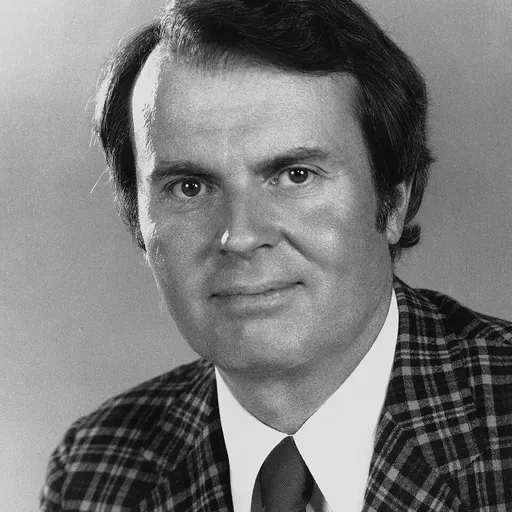
About Charles Osgood
Lived 1933 – 2024 (aged 91). Charles Osgood was an American journalist and news presenter.
Charles Osgood Wood III (January 8, 1933 – January 23, 2024) was an American radio and television commentator, writer, and musician. Osgood was the host of CBS News Sunday Morning, a role he held for over 22 years from April 10, 1994, until September 25, 2016. He also hosted a series of daily radio commentaries: The Osgood File, from 1971 until December 29, 2017.
Osgood narrated Horton Hears a Who!, an animated film released in 2008 based on the book of the same name by Dr. Seuss. He published a memoir of his boyhood in 2004.
Early life and education Osgood was born in Manhattan, New York City, on January 8, 1933. As a child, he moved with his family to the Liberty Heights neighborhood of Baltimore, Maryland. He attended St. Cecilia High School in Englewood, New Jersey.
His memoir about growing up in Baltimore during World War II is called Defending Baltimore Against Enemy Attack (2004), in which he recounts his perspective at age nine.
Osgood graduated from Fordham University in 1954 with a Bachelor of Science degree in economics.
United States Army Band Immediately after graduating from Fordham University, Osgood was hired as an announcer by WGMS (AM) and WGMS-FM, the classical music stations in Washington, D.C. (today WWRC and WTOP-FM respectively). Shortly afterward, however, he enlisted in the military to be the announcer for the United States Army Band. In 1991, he explained this turn of events in an interview with the Los Angeles Times.
Besides acting as the band's master of ceremonies, he performed as a pianist with the band and sang with the United States Army Chorus.
His roommate, John Cacavas, composed arrangements for the band. They would collaborate on many songs, a relationship that would continue through the 1960s. In 1967, along with U.S. Senator Everett Dirksen (R- Illinois), they shared a Grammy Award for best spoken word performance for their single Gallant Men. As Dirksen read Osgood's patriotic words (originally intended to be sung) about the dignity of duty in the armed forces, it was framed by Cacavas' martial music and stirring choral refrains. In 1967 it peaked at number 16 on the Billboard 200 record chart.
Other work Stationed adjacent to Arlington National Cemetery at Fort Myer during his service with the U.S. Army Band, using pseudonyms, Osgood worked as an announcer for radio stations in the Washington area to supplement his income and experience. He hosted the morning show on WEAM (WZHF today) as "Charlie Woods." At WGMS, he called himself "Carl Walden." At WPGC (AM) (WJFK (AM) today), a rock station, he referred to himself as "Chuck Forest."
In September 1955, President Dwight D. Eisenhower suffered a serious heart attack during a vacation in Denver, Colorado, and was confined to a hospital room there until November. During this time, under the auspices of WGMS, Osgood hosted a closed-circuit program of classical music delivered exclusively to the president's room to encourage his relaxation and convalescence.
WGMS Radio When his tour with the U.S. Army Band was completed, in October 1957, Osgood returned to WGMS full-time as announcer Charles Wood and as a special assistant to the general manager. Before the end of 1958, WGMS promoted him to program director.
In 1960, credited by name and as a WGMS announcer, he provided introductions and commentary on a six-record album of a collection of thirty-three speeches by President Franklin Delano Roosevelt titled FDR Speaks. Edited by historian Henry Steele Commager, it included a welcome by the president's widow, former first lady Eleanor Roosevelt. Their son Franklin Delano Roosevelt, Jr. recited one of his father's speeches. Billboard magazine reported that FDR Speaks "was one of the most listened-to-attractions" at the 1960 Democratic National Convention which nominated senators John F. Kennedy and Lyndon B. Johnson as its candidates for President and Vice President of the United States.
WHCT Television In April 1962, the parent company of WGMS, RKO General, transferred Osgood to Hartford, Connecticut, and promoted him to his first job in television: the general manager of Channel 18, WHCT (WUVN today).
WHCT was the first TV station in the United States to be licensed to use Phonevision, a system developed by Zenith that scrambled the station's picture and sound. This limited viewing to paid subscribers who were issued decoders attached to their television sets and telephone lines. The station offered its subscribers premium programming such as first-run movies, live sporting events, and cultural programs like ballets and symphonies, all with no commercials. Although RKO expected to operate WHCT at a loss for the three years before the Federal Communications Commission was due to renew the station's license, by early 1963, the financial realities became too difficult to bear unabated. In a 1985 interview with Broadcasting magazine, Osgood explained:
[The station] lost money at an alarming rate ... [RKO] let me off the hook very gently. They said, "you're fired."
"I went from being the world's youngest station manager to being the world's oldest cub reporter", he quipped in a 1981 interview with People magazine.
Another new McGuire hire for Flair Reports, whom Osgood befriended at ABC, was Ted Koppel.
Becoming "Charles Osgood" While he was at ABC, he began using the name "Charles Osgood" because the network already had an announcer named "Charles Woods". In a 2005 interview with Inside Radio, Osgood related the story:
They didn't want to have a Charles Woods and a Charles Wood. When they told me to pick a name, I used my middle name as my last name. It's worked out well and is a little more distinctive and professional.
Later career at CBS Radio Osgood moved over to CBS Radio in 1967 when it became clear, in his words, that he "wasn't going anywhere" at ABC. He worked as a reporter and anchor for WCBS. In August 1967, he anchored the first morning drive shift for WCBS after its conversion to an all-news format. The first day of all-news programming aired on WCBS-FM after an airplane crashed into the AM station's antenna tower on New York's High Island, keeping WCBS off air until a temporary tower could be erected.
Osgood anchored The Osgood File on Westwood One, a daily commentary morning show. It began as a segment on WCBS in 1967 and went national in 1971. Each three-minute Osgood File focused on a single story, ranging from a breaking development of national importance to a whimsical human-interest vignette. Some of those he did in rhyme, which is why he was known as CBS's "Poet in Residence." He continued these broadcasts until December 29, 2017.
Television On television, Osgood joined CBS News in 1971. He was a reporter, and served as anchor of the CBS Sunday Night News from 1981 to 1987, co-anchor of the weekday CBS Morning News and frequent news reader on CBS This Morning from 1987 to 1992, as well as occasional anchor of the CBS Afternoon News and the CBS Evening News with Dan Rather.
Osgood hosted CBS News Sunday Morning from April 10, 1994, to September 25, 2016, succeeding the original host Charles Kuralt. Osgood's tenure of twenty-two years as host exceeded Kuralt's fifteen years.
Among Osgood's personal trademarks were his bow tie, his weekly TV signoff "Until then, I'll see you on the radio", and his propensity for delivering his commentaries in whimsical verse. Example: When the Census Bureau invented a designation for cohabitant(s) as "Person(s) of Opposite Sex Sharing Living Quarters", or "POSSLQ", Osgood turned it into a pronounceable three-syllable word and composed a prospective love poem that included these lines, which he later used as the title of one of his books:
Osgood also pronounced the years between 2000 and 2010 as "twenty oh-" as opposed to the more common "two thousand (and)-."
End of broadcasting career On December 21, 2017, it was announced Osgood would retire from The Osgood File due to health concerns, ending his broadcast career. His final broadcasts were on December 29, 2017.
Other works In 1956, Osgood wrote a three-act play called A Single Voice.
Osgood was the narrator in the 2008 animated film Horton Hears a Who!.
Osgood wrote a biweekly syndicated newspaper column. He authored seven books: Nothing Could Be Finer Than a Crisis That Is Minor in the Morning (Holt, Rinehart & Winston, 1979) There's Nothing That I Wouldn't Do If You Would Be My POSSLQ (Holt, Rinehart & Winston, 1981) Osgood on Speaking: How to Think on Your Feet Without Falling on Your Face (William Morrow and Company, 1988) The Osgood Files (G.P. Putnam's Sons, 1991) See You on the Radio (G.P. Putnam's Sons, 1999) Defending Baltimore Against Enemy Attack (Hyperion, 2004). A Funny Thing Happened on the Way to the White House (Hyperion, 2008).
He also edited two books: Kilroy Was Here (Hyperion, 2001). Funny Letters From Famous People (Broadway Books, 2003).
Personal life and death Osgood's first marriage to Theresa Audette ended in divorce after 16 years. He and his second wife, Jeanne Crafton, had five children, who were raised in Englewood, New Jersey. Osgood also maintained a summer home in Sainte-Maxime on the French Riviera from 1997 until his death, using a basement studio to record his radio broadcasts.
Osgood died from complications of dementia at his home in Saddle River, New Jersey, on January 23, 2024, at age 91.
Honors 1990: National Association of Broadcasters Hall of Fame, radio division 2004: Walter Cronkite Award for Excellence in Journalism. 2005: Paul White Award, Radio Television Digital News Association
Don’t just read it —
keep it.
Full-length biographies made to live with: read them, listen on the way to work, watch them tonight.
- E-book
- Audio
- Video
Instant download · yours to keep · every purchase keeps this site free
Important facts
People in Charles Osgood's life
Named in this biography and alive at the same time





Related people
Same field, nearest in time

Contemporaries
People whose lives overlapped Charles Osgood's




Frequently asked questions
Who was Charles Osgood?
American radio and television commentator
When was Charles Osgood born?
Charles Osgood was born on 8 January 1933 in New York City.
When did Charles Osgood die?
Charles Osgood died on 23 January 2024 in Saddle River.
What was Charles Osgood's occupation?
Charles Osgood was a journalist and news presenter.
What nationality was Charles Osgood?
Charles Osgood was American.
Sources & further reading
Cite this page
APA: Biography.guide. (2026). Charles Osgood. https://biography.guide/charles-osgood/
MLA: "Charles Osgood." Biography.guide, https://biography.guide/charles-osgood/.
Chicago: "Charles Osgood." Biography.guide. https://biography.guide/charles-osgood/.
Data last updated: 2026-09-20 · Spot an error? Report a correction.
Page generated 2026-09-27 05:09 UTC