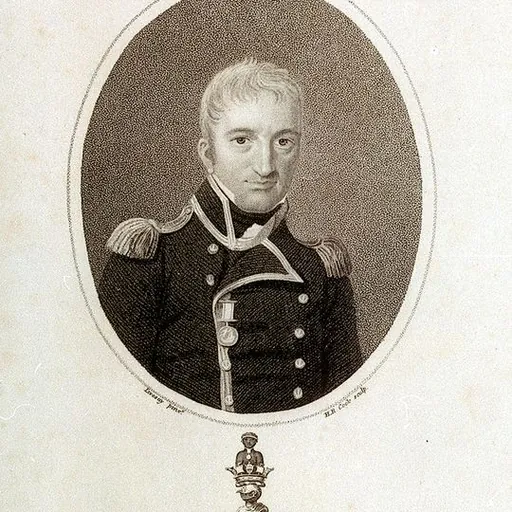
About Charles Lydiard
Lived 1780 – 1807 (aged 27). Charles Lydiard was a British military personnel.
Charles Lydiard (fl. 13 May 1780 – 29 December 1807) was a Royal Navy officer who served in the French Revolutionary and Napoleonic Wars. Lydiard's origins are obscure, but he joined the navy in 1780 and rose through the ranks after distinguished service in the early years of the French Revolutionary Wars, particularly during the Siege of Toulon. He saw action in several engagements in the Mediterranean, and had a part in the defeat of a French frigate in 1795. The chance for promotion passed him by however when the French ship escaped. He again demonstrated his qualities on a cutting-out expedition under the guns of a French shore battery, and this time was successful in escaping with his prize.
Lydiard was promoted and appointed to the command of his prize, and went on to be captain of several small vessels before a period of unemployment caused by his promotion to post-captain. He returned to active service in 1805 with command of the razee , in which ship he distinguished himself in a number of incidents in the West Indies, capturing a Spanish frigate, attacking a French ship of the line, and helping to capture the island of Curaçao. He returned to Britain after these exploits, but his ship was caught in a gale, and despite his best efforts, was driven ashore and wrecked. Lydiard did his utmost to save as many of his men as he could, before being swept away and drowned.
Early life Lydiard's origins are largely unknown, but his entry to the navy is recorded as being on 13 May 1780, when he joined the 100-gun as a captain's servant. The Britannia was at this time the flagship of Vice-Admiral George Darby, commander of the Channel Fleet. Lydiard was appointed an able seaman on 25 July 1781, and on 27 May 1782 was transferred to the 44-gun , at first as an able seaman, but receiving a promotion to midshipman on 12 October that year. Sincere was then paid off and Lydiard transferred to the 74-gun , where he saw action at the Battle of Genoa on 14 March and the Battle of Hyères Islands on 13 July 1795. The French finally came out on the evening of the fifteenth day, and were engaged by Southampton, despite the French possessing considerably more firepower. Macnamara promptly took his ship in under the guns of the batteries, and apparently having been mistaken for a French or neutral frigate, closed to within pistol shot of the French ship, and demanded her captain surrender.
Command Lydiard spent some time in the Adriatic before returning to Britain in 1797 as a convoy escort, after which Utile was paid off. He was appointed to command the bomb vessel in May 1798, followed by the sloop in November that year. He served aboard Kite in the North Sea until his promotion to post-captain on 1 January 1801, at which point he was superseded in the command of the Kite. Anson had originally been a 64-gun third rate, but had been razeed in 1794. He sailed Anson to the West Indies in early 1806 and in August was sailing in company with Captain Charles Brisbane's when on 23 August they came across the 38-gun Spanish frigate Pomona off Havana, guarded by a shore battery and twelve gunboats. The gunboats came out to defend her, whereupon the two British frigates anchored between the shore battery and gunboats on one side, and the Pomona on the other. A hard-fought action began, which lasted for 35 minutes until the Pomona struck her colours. The shore battery was obliged to stop firing after an explosion in one part of it.
Anson and Foudroyant Lydiard remained cruising off Havana, and on 15 September sighted the French 84-gun Foudroyant. The Foudroyant, carrying the flag of Vice-Admiral Jean-Baptiste Willaumez, had been dismasted in a storm and was carrying a jury-rig. Despite the superiority of his opponent and the nearness of the shore Lydiard attempted to close on the French vessel and opened fire. After being unable to manoeuvre into a favourable position and coming under heavy fire, Lydiard hauled away and made his escape. They were joined in December by and Brisbane decided to launch an attack on 1 January 1807. Both Lydiard and Brisbane then led their forces on shore, and stormed Fort Amsterdam, which was defended by 270 Dutch troops. The dramatic success of the small British force carrying the heavily defended island was rewarded handsomely. Brisbane was knighted, and the captains received swords, medals and vases.
Wreck of Anson
Anson was sent back to Britain shortly afterwards, and Lydiard rejoined his ship at Plymouth. He made for the Lizard, but in the poor weather, came up on the wrong side and became trapped on a lee shore, with breakers ahead. Lydiard ordered the ship to be run onto a beach in the hope of saving as many lives as possible, and resolved to remain aboard to oversee the evacuation.
The pounding surf prevented boats from being launched from the ship or the shore, and a number of the crew were swept away. Some managed to clamber along the fallen main-mast to the shore, while Lydiard clung to the wheel to encourage them on. Eyewitnesses recorded that Lydiard had exhausted himself with the effort of organising the evacuation and clinging to the wreck in the violence of the storm. The body was later interred in the family vault at Haslemere, Surrey.
Don’t just read it —
keep it.
Full-length biographies made to live with: read them, listen on the way to work, watch them tonight.
- E-book
- Audio
- Video
Instant download · yours to keep · every purchase keeps this site free
Important facts
People in Charles Lydiard's life
Named in this biography and alive at the same time

Related people
Same field, nearest in time



Contemporaries
People whose lives overlapped Charles Lydiard's




Frequently asked questions
Who was Charles Lydiard?
officer of the Royal Navy (1780-1807)
When was Charles Lydiard born?
Charles Lydiard was born on 13 May 1780.
When did Charles Lydiard die?
Charles Lydiard died on 29 December 1807.
What was Charles Lydiard's occupation?
Charles Lydiard was a military personnel.
What nationality was Charles Lydiard?
Charles Lydiard was British.
Sources & further reading
Cite this page
APA: Biography.guide. (2026). Charles Lydiard. https://biography.guide/charles-lydiard/
MLA: "Charles Lydiard." Biography.guide, https://biography.guide/charles-lydiard/.
Chicago: "Charles Lydiard." Biography.guide. https://biography.guide/charles-lydiard/.
Data last updated: 2026-09-23 · Spot an error? Report a correction.
Portrait: Wikimedia Commons · author & licence
Page generated 2026-09-27 05:08 UTC