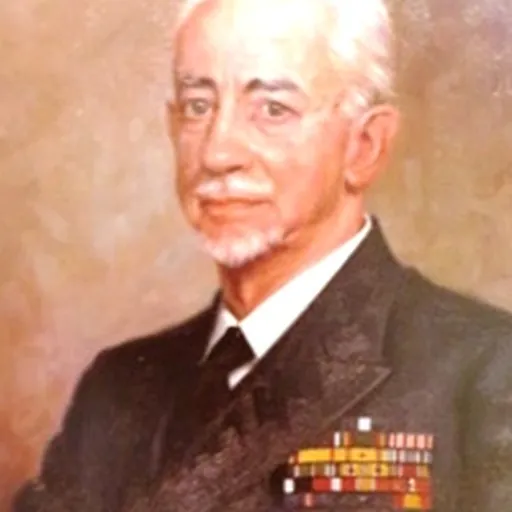
Charles L. Carpenter
United States Rear Admiral
About Charles L. Carpenter
Lived 1902 – 1992 (aged 89). Charles L. Carpenter was an American military personnel, executive Director, genealogist and united Theological Seminary.
Rear Admiral Charles Lorain Carpenter (July 31, 1902 – February 21, 1992) was a Naval officer and a holder of the Navy Cross and a Purple Heart. His career encompassed combat action in Nicaragua. He was involved in all three Theaters of Operations in World War II and naval combat in the Pacific. He commanded attack transports during the war and an animal research vessel in the post-World War II-era Operation Crossroads series of atomic bomb tests. He earned nine Service Bars, the U.S. Navy Combat Command Insignia, and foreign decorations from the governments of Nicaragua, Peru, and Spain. Of his 30 years of active military service, 22 years were spent at sea or on foreign shores.
Early life Midshipman Charles L. Carpenter biography entry in the United States Naval Academy 1926 Lucky Bag Charles, also known as "Chuck" when younger and "Charlie" when older, was born July 31, 1902, in Greensburg, Pennsylvania. Carpenter received his early education in the public schools of Wilkinsburg, Pennsylvania, east of Pittsburgh, Pennsylvania. He enjoyed running and track, which he continued through his upper education. He was also a member of the Sigma Alpha Epsilon Fraternity.
After graduating from high school, Carpenter attended the University of Pittsburgh,
US Navy career Following his commissioning, Carpenter was deployed to naval service in what was later called the Second Nicaraguan Campaign. Galveston was with the Special Service Squadron and conducted gunboat diplomacy out of Christobal and Balboa, Panama.
Carpenter participated in several landing force details, including one at León, Nicaragua. It was at this time that he was recognized and awarded the Navy Cross for his valor.
USS Trenton – 1929
From 1929 to 1933, he was on the . His last job on Trenton was as the 3-inch A.A. (anti-aircraft) officer.
Shore duty & USS Du Pont – 1933 In 1933, Carpenter was rotated from seven years of sea duty to shore duty as Assistant District Communications Officer and District Issuing Officer for the First Naval District, then at Portsmouth Naval Yard.
USS Gold Star – 1934 , at anchor off Sitka, Alaska, in September 1922, before her partial conversion into a communication intelligence ship in 1933. Going back to sea duty, he served on the , a civilian cargo ship purchased in 1922. During the 1920s and 1930s, the Gold Star became a familiar sight in the ports of Asia. Though assigned as the flagship at Guam, she made frequent voyages to Japan, China, and the Philippines with cargo and passengers. Prior to World War II, much of her crew was made up of Chamorro sailors, natives of Guam, with American non-commissioned officers and commissioned officers like Carpenter. Strangely, Carpenter's records of what he did on the "Gold Star" are absent from the spring of 1934 into early 1936.
In 1934, Gold Star was a veteran Q-Ship dealing with communications intelligence. As a station ship, she was assigned to monitor internal Japanese Fleet frequencies and make frequency measurements and direction finder azimuths. She had three intercept operators and one chief radioman supervised by an officer. This all started in 1933, during the reconstruction of the Japanese fleet by Tokyo. Gold Star—along with ground stations at Guam, Olongapo, and Beijing—provided significant intelligence before the Japanese attack on Pearl Harbor on December 7, 1941.
Carpenter had married Dorothy Gertrude Hanna on August 8, 1931, and had a child, Charles Lorain Carpenter Jr., on August 31, 1934. His wife, "Dottie", had the unique experience of sailing on the Gold Star with her husband and their infant son, who was named "Skipper" while on board the ship. The ship, with Carpenter's new family, conducted seven loops of about seven weeks each around the Orient. Some of the other officers and senior petty officers were permitted to have their families with them for much shorter periods when the ship sailed from Guam. It appears that the Carpenter family received the most benefit from this unique window-dressing distraction. It is unknown if Carpenter's wife was ever aware that while the ship visited various ports in Japan like Miki-Ko, Nagasaki, Kobe, Nagoya, and Yokohama, part of the ship was spying on the Japanese.
USS Doran – 1940 The former , later renamed USS Doran and finally called HMS St. Mary's by late 1940. This image is believed to be from about 1933, when the ship was on loan to the United States Coast Guard. Carpenter was assigned to the newly renamed USS Doran as its commanding officer in early 1940. She had been named Bagley but was decommissioned on July 12, 1922. She served on loan from 1932 to 1934 with the United States Coast Guard. Her name was dropped on May 31, 1935, allowing the US Navy to reuse the name for a new ship by the same name, , a commissioned in 1936. From 1935 to late 1939, the ex-Bagley was referred to as DD-185 (ex-Bagley). The start of World War II and the Royal Navy's dire need for destroyers saved her from the shipbreakers. She was refurbished in Philadelphia. DD-185 was renamed Doran on December 22, 1939.
Carpenter worked on readying Doran for sea duty, and the ship was recommissioned on June 17, 1940. Doran reported to the Atlantic Squadron. They served with the Squadron until September 22, 1940, when she was decommissioned from the US Navy at Halifax, Nova Scotia, and transferred in the destroyer-land bases exchange to Great Britain to serve in the Royal Navy as HMS St. Mary's, a .
On December 7, 1941, Carpenter was on the Washington. In early 1942, US Navy reassignments were made. Carpenter went from the Atlantic to the United States Pacific Fleet for war duty. He was third in command of the ship. They escorted a detachment of Seabees and an aircraft carrier, rushing planes to the South Pacific. She made two quick dashes from Espiritu Santo to Guadalcanal, where the long and bloody battle for the island was then beginning, and having completed these missions, she joined the task force formed around the aircraft carrier . This task force steamed in distant support of six transports carrying Marine reinforcements to Guadalcanal. Mid-afternoon on September 15, 1942, Wasp was suddenly hit by three Japanese torpedoes. Almost at once, she became an inferno. Helena stood by to rescue nearly 400 of Wasps crew, whom she took to Espiritu Santo.
During the almost post-blank melee and unable to fire her main or secondary batteries at the three US destroyers causing her so much trouble, the Japanese ship Hiei instead concentrated on San Francisco, which was passing by only away. Along with Kirishima, Inazuma, and Ikazuchi, the four ships made repeated hits on San Francisco, disabling her steering control and killing Admiral Callaghan, Captain Cassin Young, and most of the bridge staff. The first few salvos from Hiei and Kirishima consisted of the special fragmentation bombardment shells, which reduced damage to the interior of San Francisco and may have saved her from being sunk outright. Not expecting a ship-to-ship confrontation, it took the crews of the two Imperial battleships several minutes to switch to armor-piercing ammunition. Nevertheless, San Francisco, almost helpless to defend herself, managed to momentarily sail clear of the melee. However, she landed at least one shell in Hieis steering gear room during the exchange, flooding it with water, shorting out her power steering generators, and severely inhibiting Hieis steering capability. Helena followed San Francisco to try to protect her from further harm.
The enemy, Amatsukaze, approached San Francisco with the intention of finishing her off. However, while concentrating on San Francisco, Amatsukaze did not notice the approach of Helena, who fired several full broadsides at Amatsukaze from close range and knocked her out of the action. The heavily damaged Amatsukaze escaped under cover of a smoke screen while Helena was distracted by an attack by Asagumo, Murasame, and Samidare.
After nearly 40 minutes of brutal, close-quarters fighting, the two sides broke contact and ceased fire at 02:26 after Abe and Captain Gilbert Hoover (the captain of Helena and senior surviving U.S. officer at this point) ordered their respective forces to disengage. Admiral Abe had one battleship (Kirishima), one light cruiser (Nagara), and four destroyers (Asagumo, Teruzuki, Yukikaze, and Harusame) with only light damage and four destroyers (Inazuma, Ikazuchi, Murasame, and Samidare) with moderate damage. The U.S. had only one light cruiser (Helena) and one destroyer (Fletcher) that were still capable of effective resistance. Although perhaps unclear to Abe, the way was clear for him to bombard Henderson Field and finish off the U.S. naval forces in the area, clearing the way for the troops and supplies to be landed safely on Guadalcanal. However, at this crucial juncture, the Japanese commander chose to abandon the mission and depart the area. Helena and other US ships had turned back the enemy and prevented the heavy attack that would have been disastrous to the Marine troops ashore.
The US ships Portland, San Francisco, Aaron Ward, and Sterett were eventually able to make it back to rear-area ports for repairs. Atlanta, however, sank near Guadalcanal at 20:00 on November 13. Departing from the Solomon Islands area with San Francisco, Helena, Sterret, and O'Bannon later that day, Juneau was torpedoed and sunk by the .
The captain of Helena, now the senior American officer in the task force because of the death of the task force commander Callaghan in action, Helenas skipper, Captain Gilbert Hoover, commanded the task force's retirement to Espiritu Santo from the battle area. While he focused on this new duty, Carpenter commanded the bridge of Helena. On the way, the light cruiser was torpedoed and sunk by a submarine. Despite the observed survivors, Captain Hoover assessed that the task force lacked the means to conduct a search and rescue in its current location and condition, with the battle leaving two ships with antisubmarine capacity on hand (one heavily damaged) and other ships too damaged to remain in the area. My assignment was on the bridge in the pilot house as helmsman. While steering the ship I had the opportunity to glance out the portholes and I saw the condition of the San Francisco and the Juneau. I remember commenting to one of the men in the pilot house that the San Francisco looked so beat up that she would be lucky to make it back to Espiritu Santo, but that the Juneau, while she was down by the bow, still looked seaworthy enough to make it back
Shortly thereafter, however, Lt. Comdr. Carpenter, the ship's navigator, who seldom left the bridge, shouted, "Hard right rudder, DeLong." I spun the rudder over hard right and started singing out the course changes every ten degrees. I glanced out the porthole as the bow swung past the line of sight to the Juneau who had been on our starboard quarter in the formation. The ship was swinging at a rapid speed now and I had no idea what was going on.
Suddenly, Comdr. Carpenter hollered, "Hard left rudder." I reversed the rudder, but the momentum was still carrying the ship to the right. The ship shuddered for several seconds and slowly started to turn left when an immense explosion took place. I glanced out the porthole and all I could see was a huge cloud in the direction the Juneau had been.
By this time the Helena was making good time through the water again and picking up momentum heading straight for the cloud. The wheel was still turned hard left and I had no idea where either the Juneau or the San Francisco were. Total silence reigned in the pilot house and on the wings of the bridge.
Now it was my turn to shout! "Where is she? Where is she? Where is she? I don't want to ram her!" Everyone was out on the wing of the bridge except me and no one other than myself was talking.
Finally, one of the sailors stuck his head in the door and quietly said, "DeLong, she ain't no more." I didn't fully understand what he meant but I decided to ease the rudder lest it bang against the stops and get stuck. I was a little late but in time enough to keep the rudder from jamming. There was a jolt as the rudder hit the stop, but it was light enough so there was no jamming.
The people that had gone outside now filled me in with what had happened. The Juneau didn't sink; she was blown up. Everyone had seen pieces of her flying through the sky. The largest piece was reported as one of her five inch gun mounts flying over the Helena.
Captain Hoover wisely decided to save all the ships he could and decided not to stop to look for survivors – no one thought there would be any. Even if there were, the subs might still be around and more ships and men could be lost.
As a footnote to this event, many years later, I ran across Lt. Comdr. Carpenter (by that time Admiral Carpenter) at a Helena reunion and he filled in some details that I hadn't known. We were seated across from each other at a dinner table. We were all telling sea stories and I started telling them my story (I had forgotten that it was Commander Carpenter who had issued the orders to the wheel). Right in the middle of my story Carpenter looked at me and said, "And do you know who issued those orders?" When I admitted that I didn't remember, but wished that I could, he replies, "I did." The minute he said that, I remembered.
From that point on he took over the story. He told us that in the early part of his career he had taken special training on spotting and tracing torpedo wakes and that was one of the reasons he felt a little safer when he was on the bridge in treacherous waters. As a result of his early training he was the first one to see the wakes of the two torpedoes coming from the port side. Both torpedoes went between the Helena and the San Francisco and when both ships turned, the torpedoes went past us and one of them hit the Juneau. We were not able to warn the Juneau in time to save her.
George A. DeLong
Sinking of Helena Helena was later assigned to the several bombardments of Japanese positions on New Georgia in January 1943. One of Carpenter's shipmates, Lt. Bin "Red" Cochran, commanding the aft 5-inch battery on Helena, shot down a Japanese Aichi D3A Val dive-bomber with the second of three salvos of VT-fuzed shells near Guadalcanal. The fuzes were manufactured by the Crosley Corporation, and this was their first kill of an enemy aircraft. Helenas guns rocked the enemy at Munda and Vila Stanmore, leveling supply concentrations and gun emplacements. Continuing on patrol and escort in support of the Guadalcanal operation through February, one of her floatplanes shared in the sinking of the submarine on February 11. After an overhaul in Sydney, Australia, and a brief leave, Carpenter was back on Helena, headed to Espiritu Santo in March to participate in bombardments of New Georgia Island, soon to be invaded. Helena in action at Kula Gulf on the night of her sinking, seen from the light cruiser . Note: Bright flashes of gunfire are due to the use of older gunpowder for the main armament. At this time, flash-less powder was in short supply. These flashes gave the enemy a target for their torpedoes. This image is likely the last image of Helena.
On July 4, 1943, Carpenter navigated Helena into the Kula Gulf just before midnight. Shortly after midnight on the 5th, her guns opened up in what was to be her last shore bombardment. The landing of troops was completed successfully by dawn, but during the afternoon of July 5, word came that the Tokyo Express was ready to roar down once more, and the escort group turned north to meet it. By midnight on July 5, Helenas group was off the northwest corner of New Georgia, with three cruisers and four destroyers composing the group. Racing down to face them were three groups of Japanese destroyers, for a total of 10 enemy ships. Four of them peeled off to accomplish their mission of landing troops. By 01:57, the Battle of Kula Gulf had begun, and Helena began blasting away with a fire so rapid and intense that the Japanese later announced in all solemnity that she must have been armed with "6 inch machine guns". The gunners fired 2,000 six-inch rounds and 400 smaller rounds during the battle. Ironically, Helena made a perfect target when lit by the flashes of her own guns, which was compounded by the fact that Helena had fired all her flashless powder in the preceding bombardments and was left with standard smokeless powder, which produced immense flames when fired.
Captain Cecil had positioned himself on the "fighting bridge", an open-air command area. This was just below the forward main battery directors in an area that protruded a bit, giving him panoramic observation of events. Directly below Cecil's position was the enclosed pilot house, where Commander Carpenter stood overseeing operations there. Communications were done through a voice tube.
The following, in a condensed format, reflects Carpenter's actions on the USS Freestone. It is from the official history of the USS Freestone, written in 1946.
On November 8, 1944, the official Navy acceptance board to accept USS Freestone invited the prospective commanding officer, Captain Charles L. Carpenter, USN, to attend the river and acceptance runs. The ship passed its testing and was recommended for acceptance by the Navy. The ship docked at the starboard side of Pier #3, U.S. Naval Station, Astoria, Oregon. At 09:30 the next day, the ship was placed into commission. Captain Carpenter assumed command and ordered the watch set. On November 20, the ship set out to sea, conducting training and drills to prepare for war service. On January 8, 1945, the ship sailed from San Diego to embark 1471 troops en route to Saipan, Mariana Islands. The small task force, Task Unit 96.3.18, with Captain Carpenter commanding, arrived on February 6 and debarked the troops.
USS Hocking Carpenter was assigned to command the attack transport in December 1945. She was his second Haskell-class attack transport.
Shore duty He left Hocking in February 1946 in the Canal Zone for assignment at Naval District 12 in San Francisco, California.
In June 1946, Burleson moved from Pearl Harbor to Bikini, carrying animals to be used in the two nuclear tests. She was not a target vessel but a support ship. Carpenter and his ship observed both tests and moved into the test area after each to remove the animals for study. The surviving animals were observed closely, and a better understanding of radioactivity was achieved.
PhibLant & OpNav Captain Carpenter was back ashore with Amphibious Forces, Atlantic Fleet (PHIBLANT), under the command of Commander, Naval Surface Force Atlantic, in 1947. Part of his job was to conduct a review of amphibious landings previously conducted. He continued his work at OpNav for the Chief of Naval Operations, then Admiral Louis E. Denfeld, until August 1949. These were administrative duties in preparation for future duties.
Carpenter was present during the 1949 Revolt of the Admirals. Several United States Navy admirals, headed by Admiral Denfield, publicly disagreed with US President Harry S. Truman and the Secretary of Defense's plans for the reduction of the Navy and their new emphasis on the strategic nuclear bombing role of the Air Force as the primary means by which the nation was defended. At the time, the technologies of large jet aircraft, the nuclear bomb, and the means by which it could be delivered were in their developmental stages.
The debate climaxed during the House Armed Services Committee investigation into the inter-service rivalry held in August 1949 and focused on the allegations of fraud and corruption emanating from the "Worth Paper". The committee found no substance to charges relating to the role of the Secretary of the Air Force, Stuart Symington, in aircraft procurement. This resulted in vindication for Secretary Johnson and embarrassment for the Navy. More committees and firings continued, including Denfield. At one point, even the question of a future US Navy was in doubt.
The Truman administration essentially won the conflict with the Navy, and civilian control over the military was reaffirmed. Military budgets following the hearings prioritized the development of Air Force heavy bomber designs, accumulating a combat-ready force of over 1000 long-range strategic bombers capable of supporting nuclear mission scenarios. These were deployed across the country and at overseas bases. The Air Force portion of the total defense budget grew, while the Navy's portion of the defense budget was significantly reduced.
The wisdom of the Air Force position and the Truman administration's national doctrine were soon put to the test. Within six months, on June 25, 1950, the Korean War broke out, and the U.S. was forced to confront an invading army with the forces it had on hand. By this time, Carpenter was in Lima, Peru, at the Peruvian Naval Academy as a Technical Advisor and away from any possible career terminations.
Later career By 1951, Carpenter was stationed at Naval Headquarters in Washington, D.C., and as of April 17, 1952, he served as Commodore (United States) of Destroyer Squadron 18 and had additional duties as Commander of Destroyer Division 181 in the Mediterranean.
His final assignment before retiring from the Navy in 1956 was commander of the Naval Receiving Station at the Brooklyn Navy Yard.
Post-career Rear Admiral Carpenter at his retirement ceremony in 1956 after 30 years of active service. After leaving the Navy, Carpenter moved to Drexel Hill, Pennsylvania, and became the executive director of the Pennsylvania United Theological Seminary Foundation, serving as its chief fund-raiser until the early 1960s.
Memorial Chair Seat 18 in row 22 of section 2 at the Navy-Marine Corps Memorial Stadium in Annapolis, Maryland, was named in his honor thanks to his wife, "Dottie."
Carpenter was a member of numerous masonic and military orders, including the Sigma Alpha Epsilon National Collegiate Fraternity at Pitt, the New York Yacht Club, the Historical Society of Pennsylvania and Waterboro, Maine, and a communicant of the Drexel Hill, Pennsylvania United Methodist Church.
He also became interested in genealogy and traveled extensively, doing extensive research. In 1976, he published a book called The Descendants of Timothy Carpenter (1715–1787) of Pittstown, Rensselaer County, New York.
In 1978, he moved to Lima, Pennsylvania, in Delaware County. There he wrote several genealogically related articles and completed a draft of a large 813-page book, The Descendants of William Carpenter (of) Rehoboth, Bristol County, Massachusetts. This work was published in 2002 by his grandson, Chad Carpenter.
Carpenter's wife, "Dottie", died on April 25, 1973, in Philadelphia, Pennsylvania, and she was buried in South Pine Grove Cemetery in South Waterboro, Maine. "Charlie" also died in Philadelphia on February 21, 1992. He was interred next to his wife. He was survived by his son, Charles L. Carpenter Jr., a retired major of the U.S. Marines; daughter, Olivia Salzberg; and six grandchildren.
Military awards and decorations
Navy CrossPurple HeartNavy Unit Commendation2nd Nicaraguan Campaign MedalChina Service MedalAmerican Defense Service Medal(Fleet Clasp)American Campaign MedalEuropean-African-Middle Eastern Campaign MedalAsiatic–Pacific Campaign Medal with 3 Campaign starsWorld War II Victory MedalNavy Occupation Service Medal (Asia)National Defense Service MedalPhilippine Liberation MedalPeruvian Navy Cross Nicaraguan Presidential Medal of Merit w/ Silver StarCross of Naval Merit (Spain)Combat Command Insignia
Ranks held
Ships served on
USS Galveston (CL-19), 1926–1927, Gunnery Department, with shore duty in Nicaragua USS Wyoming (BB-32), 1928, Assistant Navigator USS Trenton (CL-11), 1929–1933, Anti-Aircraft Officer USS DuPont (DD-152), 1933–1934, Landing Force Officer, on patrol off Cuba USS Gold Star (AK-12) USS Tennessee (BB-43) USS Doran (DD-634), Commanding Officer USS Washington (BB-56), 1941, Damage Control Officer USS Helena (CL-50), 1942–1943, Navigating Officer USS Freestone (APA-167), 1943–1944, Commanding Officer USS Hocking (APA-121), 1944–1945, Commanding Officer USS Burleson (APA-67), 1946, Commanding Officer
Video Video of USS Helena survivors at the funeral of Irwin Edwards, who succumbed to his wounds after being rescued. Admiral Walden L. Ainsworth, with cap, shakes the hands of the survivors. This includes Commander Charles L. Carpenter, with mustache, senior rescued officer. Aboard the USS Honolulu, dated July 7, 1943. Commander Charles L. Carpenter, center with mustache, at the head of the gangplank as USS Helena survivors are transferred to another ship. Dated July 7, 1943.
Don’t just read it —
keep it.
Full-length biographies made to live with: read them, listen on the way to work, watch them tonight.
- E-book
- Audio
- Video
Instant download · yours to keep · every purchase keeps this site free
Important facts
People in Charles L. Carpenter's life
Named in this biography and alive at the same time


Related people
Same field, nearest in time





Contemporaries
People whose lives overlapped Charles L. Carpenter's



Frequently asked questions
Who was Charles L. Carpenter?
United States Rear Admiral
When was Charles L. Carpenter born?
Charles L. Carpenter was born on 31 July 1902 in Greensburg.
When did Charles L. Carpenter die?
Charles L. Carpenter died on 21 February 1992.
What was Charles L. Carpenter's occupation?
Charles L. Carpenter was a military personnel, executive Director, genealogist and united Theological Seminary.
What nationality was Charles L. Carpenter?
Charles L. Carpenter was American.
Sources & further reading
· Wikipedia: Charles L. Carpenter
· DBpedia: Charles L. Carpenter
Cite this page
APA: Biography.guide. (2026). Charles L. Carpenter. https://biography.guide/charles-l-carpenter/
MLA: "Charles L. Carpenter." Biography.guide, https://biography.guide/charles-l-carpenter/.
Chicago: "Charles L. Carpenter." Biography.guide. https://biography.guide/charles-l-carpenter/.
Data last updated: 2026-09-21 · Spot an error? Report a correction.
Portrait: Wikimedia Commons · author & licence
Page generated 2026-09-27 05:01 UTC