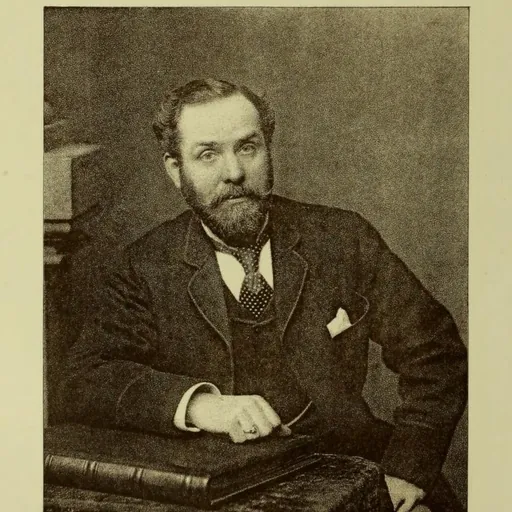
About Charles J. Phipps
Lived 1835 – 1897 (aged 62). Charles J. Phipps was a British architect.
Charles John Phipps (25 March 1835 – 25 May 1897) was an English architect known for more than forty theatres he designed in the latter half of the nineteenth century.
He began his own practice in his native Bath in 1857, designing buildings and furniture in the Gothic Revival style. In 1862 he gained his first theatre commission, the Theatre Royal, Bath, which generally retaining the Georgian character of the original theatre on the site. He moved to London in 1868, where he designed a variety of non-theatrical buildings, including the Royal Institute of British Architects’ own premises.
Four of his West End theatres survive: the Vaudeville, the Lyric, the Garrick and Her (now His) Majesty's. Eight others have been rebuilt in the twentieth century (including the Savoy and Sadler's Wells) or demolished (including the Gaiety and Daly's).
In the British provinces Phipps's theatres have fared better, with the prominent exception of the Theatre Royal, Exeter, which burned down in 1887 with large loss of life. Nine others have been destroyed by fire or bombs, rebuilt or demolished, but eight have survived, including the Theatres Royal at Bath, Brighton, Glasgow and Nottingham and theatres in Aberdeen, Eastbourne, Edinburgh and Northampton. Of his surviving theatres, all but one are Listed buildings – officially designated as of particular architectural or historic interest deserving special protection.
Life and career Early years Phipps was born in Lansdown, Bath in Somerset, the eldest of the three children of John Rashleigh Phipps and his second wife, Elizabeth Ruth Neate. |group=n
After a sketching tour on the Continent, Phipps established his own practice in Bath in 1857, producing designs for buildings and furniture in the Gothic Revival style of George Godwin and William Burges.
In 1862 Phipps gained his first theatre commission – a replacement of the old Theatre Royal, Bath, which had been gutted by fire. He came first in a competition to rebuild the theatre, and created the new house around the shell of the old, making use of the walls that remained, and generally retaining the Georgian character of George Dance the Younger's original building. As a 1901 biographer put it, this "marked the direction of a future career, at variance both with the wishes of his parents, who disapproved of theatres, and with his training, which was Gothic and ecclesiastical".
Other non-theatre designs included Leinster Hall in Dublin for Michael Gunn (opened in 1886 and replaced in 1897), the Star and Garter Hotel at Richmond (demolished in 1919) and the Savoy Victorian Turkish baths, the first in London to be lit by electricity. Phipps was chosen to design the Royal Institute of British Architects’ own premises at 9 Conduit Street. The building is still there, although no longer occupied by the institute. Nonetheless it was as a theatre architect that he became best known.
Theatres Phipps more often designed theatres for straight drama, rather than music halls – the latter boomed later in the century and became associated with younger architects including Frank Matcham and W. G. R. Sprague.
Phipps's other provincial theatres fared better, and were established as far north as Aberdeen and as far west as Dublin.
Notes, references and sources
Don’t just read it —
keep it.
Full-length biographies made to live with: read them, listen on the way to work, watch them tonight.
- E-book
- Audio
- Video
Instant download · yours to keep · every purchase keeps this site free
Important facts
People in Charles J. Phipps's life
Named in this biography and alive at the same time



Related people
Same field, nearest in time


Contemporaries
People whose lives overlapped Charles J. Phipps's





Frequently asked questions
Who was Charles J. Phipps?
English architect (1835–1897)
When was Charles J. Phipps born?
Charles J. Phipps was born on 25 March 1835 in Lansdown.
When did Charles J. Phipps die?
Charles J. Phipps died on 25 May 1897 in London.
What was Charles J. Phipps's occupation?
Charles J. Phipps was an architect.
What nationality was Charles J. Phipps?
Charles J. Phipps was British.
Sources & further reading
· Wikipedia: Charles J. Phipps
Cite this page
APA: Biography.guide. (2026). Charles J. Phipps. https://biography.guide/charles-j-phipps/
MLA: "Charles J. Phipps." Biography.guide, https://biography.guide/charles-j-phipps/.
Chicago: "Charles J. Phipps." Biography.guide. https://biography.guide/charles-j-phipps/.
Data last updated: 2026-09-21 · Spot an error? Report a correction.
Portrait: Wikimedia Commons · author & licence
Page generated 2026-09-27 05:01 UTC