
About Charles Holland
Lived 1908 – 1989 (aged 81). Charles Holland was a British sport cyclist.
Charles Holland (20 September 1908 – 15 December 1989) was a British road bicycle racer. He was one of the first two Britons to ride the Tour de France.
The early years Holland was one of four brothers from Aldridge, in the English Midlands, a brown-eyed, black-haired man who excelled at sport from his youth. He played cricket for a local side which included Dr. V. E. Milne, who also played cricket for Scotland and football for Aston Villa. Holland hoped to play cricket for Warwickshire and he had a soccer trial for Aston Villa.
His father belonged to Walsall Polytechnic Cycling Club, and held the Walsall–Matlock record. Holland's first bike was a 24in-wheel bicycle his father bought for his eldest brother, Walter, and which was handed down the family when it became too small. At 12 he went on his first cycle tour, to the Liverpool area, with his father. In 1927 he rode his first race, the Wyndham Novices 25-mile individual time trial. Using his brother Walter's bike, he came second in 1h 10min. His first victory was on 1 April 1928 in the Walsall Roads Club 10-mile event.
That year, Holland joined the Midland Cycling and Athletic Club. He tried track racing, but with less success than on the road. Riding a bicycle with a fixed wheel and no brakes is difficult but to do it shoulder-to-shoulder with other riders and on a curved grass track proved defying. He rode a sports day run by Metropolitan Carriage Works of Birmingham around a cricket ground in Washwood Heath. Everyone passed him in his first event, a handicap, and then again in the half-mile as those he passed in the straight raced by on the bends, where Holland couldn't control his bike sufficiently.
Olympic Games: Los Angeles 1932 The road race at Los Angeles was the last to be held as a time trial, a lone race against the watch over 100 km. For Britain, which since the 19th century had had nothing but timed races on the road, that made selection simpler. On the other hand, the British Olympic Committee decided, because of the cost of getting to Los Angeles that "no competitor who is unlikely to reach the semi-final or final of his event shall be taken... and that only the absolutely necessary officials shall be taken".
Holland was picked to ride with Frank Southall, Bill Harvell, Stan Butler and Ernie Johnson. They sailed from Southampton aboard the Empress of Britain.
Amid scenes of wild enthusiasm the team of seven cyclists left Waterloo for the first stage of their epic journey. The crowds, the mountains of luggage, the three big crates containing the machines, the hissing steam and the shrieking whistles, the bubbling joviality, all blended into one big picture that will be for ever memorable.
The winner of the road race was Attilo Pavesi of Italy. Southall finished sixth, Holland 15th, Butler 16th, Harvell 19th. The Great Britain team came fourth overall. Butler did not ride because he had fallen on tram lines during a stop in Toronto and been hit by a car.
Holland was also picked to ride on the track, in the team pursuit with Southall, Harvell and Johnson. The Italians - Marco Cimatti, Paolo Pedretti, Alberto Ghilardi and Nino Borsari - won again, with 4min 53sec, having set an Olympic record of 4min 52.9sec in the heats. France was second in 4min 55.7sec. and Britain third in 4min 56sec.
World championship Holland was selected to ride the world championship road race at Leipzig in 1934, to ride with Percy Stallard and Fred Ghilks. Their accompanying official from the National Cyclists' Union was from Herne Hill velodrome in south London and knew little of road-racing.
The circuit was nearly six miles round, to be covered 12 times. The marshalling was by Brownshirts. The race averaged 26 mph with one lap at nearly 30. Holland rode 60 of the 70 miles with three broken spokes. The rim of his wheel touched the forks on both sides. He could not stop and ask for help because "in those far-off days - no service vehicle. If you punctured, you changed it yourself. If you crashed or copped fourpenny one [another expression for a crash], then you got on with it!" said the cycling historian Chas Messenger.
Olympic Games: Berlin 1936 Holland rode the 1936 Summer Olympics in Berlin, selected for the 100 km road race and as reserve for the 4,000m team pursuit. Cycling was unimpressed by the team: "If these are our best men then they are unlikely to bring back any Olympic titles from Germany."
Holland did not win a medal but he believed it would have been different had his younger brothers, Alf and Jack, been chosen to ride with him. Alf was a reserve; Jack was the 25-mile national champion.
The 1936 Games were the so-called Hitler Olympics. Unlike most other Olympic Games to date, where the political aspects were subtle and nuanced, the Berlin Games were explicitly politicised.
The road race on the morning of August 8 began at the Avus car course, a circuit laid out on public roads to test cars. It then used a straight dual-carriageway through Berlin, a little over 12 miles long. From there the course crossed the narrow roads of the Forest of Grunewald before returning to the car track to finish. It was the first Olympic road race to be run with all the competitors starting together, rather than individually and at intervals against the watch. Sixty riders led at 81 km and fewer than 30 at 91 km, not because of hills or the speed - which was low - but because of narrow roads, punctures and crashes. Holland reached the finish and started the sprint for the finish 100m from the line. He finished less than a second behind the winner, Robert Charpentier of France, but outside the first three.
Guy Lapébie of France came second - discovering months later from the film of the finish that Charpentier had grabbed his jersey and tugged him back - and then Ernst Nievergelt from Switzerland. Holland finished fifth. His club magazine reported:
It must have been a nightmare kind of event and one in which only the strongest combinations could have kept a rider in the front bunch. Charlie could not gather his compatriots round him and from what we can understand he had to fight his way, elbowing, jostling and pushing to occupy a front position in that fierce affair. Very many riders came to grief, a happening that overtook most of the other British representatives; but Charles sailed through barging and bucking into the excited crowd and actually leading the field a few hundred yards from the finishing tape.
Holland regarded 1936 as the peak of his career. As well as the Olympics, he travelled to the Isle of Man to win the first massed-start road-race over the island's 37-mile Snaefell mountain course, on 18 June 1936. In a sprint finish to what was effectively the first Manx International road race, Holland beat Bill Messer (Marlboro AC) by a length with the Scot Jackie Bone third, the lap covered in 1 hour 42 minutes and 59 seconds, a speed of 22 mph.
The British Best All-Rounder 1936 culminated in Holland winning the British Best All-Rounder (BBAR) time-trial competition. The contest is based on speeds over 50 and 100 miles and for 12 hours. Holland was the first to average more than 22 mph. He had been third in 1933 and second in 1934 and 1935.
Bill Mills, editor of The Bicycle, described him as:
The best all-rounder, not in its narrow sense of best average in certain particular road events, but in its real sense of best at all types of cycling. Holland's record for the year includes successes at almost every possible type of racing: time trials, massed-starts, track racing, in fact the full programme in which every clubman likes to indulge. The specialist 'pot hunter' may confine himself to his little round of events at distances that he finds brings in the rewards, but the real clubman runs through the gamut of events, taking pleasure, if not prizes, in all and sundry. Of such a type is the dusky Midlander, taking all the sport can offer in his stride.
The Golden Book Charles Holland's achievements were celebrated in 1937 when Cycling Weekly awarded him his own page in the Golden Book of Cycling.
Six-day track race and Tour de France Holland turned professional in April 1937, 10 years after his first race. His first event was an 'Empire versus Foreigners' meeting at Herne Hill in south London. There should have been numerous races but Holland rode only two, a sprint which he lost and a team pursuit in which so many riders punctured that both teams had only one rider left in the race. Rain then ended the day.
Holland's objective was to ride the six-day race to be held on a velodrome constructed inside the Empire Pool, Wembley, in north London. He went to Belgium to train on the track at Liège. He was paired in the six-day with the Belgian, Roger Deneef, and what Holland described as a misunderstanding on how each should relay the other into the race led to Holland crashing several times in the first hours. On the second day, he crashed again, broke a collar bone and dropped out. A curiosity of the race was that the leading German rider, Toni Merkens, competed in a jersey bearing a large swastika, a hint at the future that went unnoticed at the time."
Holland broke the same collar bone in June when he tripped on a rabbit hole and had to miss riding with Continental stars on the motor-racing circuit at Crystal Palace, south London. That same year he entered the Tour de France, although the bone breaks had limited his training. In those days it was still possible to enter as an individual, although most places were saved for teams invited by the organiser, Henri Desgrange or his successor, Jacques Goddet, for whom 1937 was his first complete Tour de France as organiser. Holland said:
Two weeks before the race Holland read in Desgrange's newspaper, L'Auto, that he and another British entrant, Bill Burl, would not after all compete. With the help of staff at Cycling'''s office in Birmingham, he sent a telegram to Desgrange for clarification. Next day Desgrange replied: "Following your wire dated yesterday agree engagement if you agree yours - L'Auto." The condition was that Holland, Burl and a French-Canadian called Pierre Gachon should combine in a British Empire team. Burl broke his collar bone when he was knocked off of his bike by an over enthusiastic photographer on the second day. He was forced to retire. Holland rode 2,000 miles until a broken pump stranded him on the day to Luchon. He punctured behind the leaders on the Col de Port, fitted a new tyre and found the heat had warped the washer of his pump. He got the tyre to half-pressure but punctured twice more and ran out of tyres.
Public reaction
Holland and Burl had become the first British competitors in the Tour and Gachon the first Canadian. Since he was in the race far longer, it was who Holland attracted much affection among French fans, one of whom wrote from Lacelle in the Corrèze region:
My dear Holland, I am a French girl who likes very much her bicycle and who is very fond of « Tour de France ». So, I read « L'Auto » and I listen to « Radio-Luxembourg ». I have been very pleased to learn we would have an English « équipe » this year. First, I congratulate you for this: to run the « Tour de France » because I know it is not very important in England, your people prefers tennis, golf and so on, and however not one other competition permits as well as this, to measure courage. I think you have come with your own will and I say it is very well indeed. Unhappily, your friends have no had luck, and it is very bad for you too, because it must be so hard to stay alone, in a so hard performance. So I admire your « war » and all my best thoughts on the « Tour de France » are for you. Don't be sorry if you are not the first, it is impossible when one is alone.
Later Dauncey and Hare write: Nobody (in France at least) remembers the amateurs Charles Holland and Bill Burl, who both had to drop out, physically exhausted, certainly, but above all stunned by the misery to which they had so innocently [ imprudemment] committed themselves. For Holland, the apparent variability with which the rules were applied was more discouraging than the mountain passes and the distances. and is buried in the family grave at Aldridge. His great nephews Tom Holland and James Holland are both leading historians and media personalities.
Discovery of records Holland's daughters, Nina and Frances, say they grew up seeing their father's cups around the houses but had little idea of their significance. Frances said:
How famous our dad had been was brought home to us in 1962; I was 11 years old when we went with him to the Royal Albert Hall (British Best All-Rounder dinner and awards) where he was invited to tell the Story of the Yellow Jersey.
She and her sister sat in the royal box and watched a show starring the comedian Tommy Trinder, Tour de France winner Louison Bobet, Tour organiser Jacques Goddet and Brian Robinson, in 1958 the first British rider to win a stage of the Tour. Not for nearly half a century did they know that in the loft of their house they had a suitcase in which their father had kept his medals, photographs, and newspaper articles. There too were his Olympic and Tour de France jerseys, his racing caps, notes and correspondence from fans. Frances, a teacher, began writing a biography, Dancing Uphill, and Nina, a book publisher, published it.
There is little direct link between Holland and Robinson, although Holland's private entry is the more remarkable because it went against the fashion of the day. The National Cyclists' Union, which ran the sport in Britain, had opposed racing on the road since the 19th century, afraid that the police would intervene and that all cycling could be banned as a result. The position of cyclists on the road had not been established. The NCU had no interest in road racing and still less in the Tour de France. The magazine, Cycling, which had an influence stronger than at any time since, followed the NCU's line and barely covered the Tour.
The link between Holland and Robinson is further broken by the war, when the Tour de France was suspended, and by an administrative civil war that broke out in Britain at the same time. Frustrated by the NCU's ban on road racing, a group of enthusiasts led by Percy Stallard, formed the British League of Racing Cyclists (BLRC). The BLRC wanted nothing more than to put a team in the Tour de France but couldn't because only the NCU was recognised internationally. The battle between NCU and BLRC exhausted both bodies and only in their last years did both allow racing on the roads. It was that that led to a team being selected in 1955 and Robinson's becoming the first Briton to finish.
Don’t just read it —
keep it.
Full-length biographies made to live with: read them, listen on the way to work, watch them tonight.
- E-book
- Audio
- Video
Instant download · yours to keep · every purchase keeps this site free
Important facts
People in Charles Holland's life
Named in this biography and alive at the same time




Related people
Same field, nearest in time




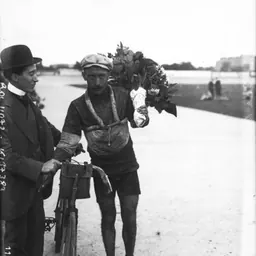
Contemporaries
People whose lives overlapped Charles Holland's


Frequently asked questions
Who was Charles Holland?
British road bicycle racer (1908–1989)
When was Charles Holland born?
Charles Holland was born on 20 September 1908 in Aldridge.
When did Charles Holland die?
Charles Holland died on 15 December 1989 in Aldridge.
What was Charles Holland's occupation?
Charles Holland was a sport cyclist.
What nationality was Charles Holland?
Charles Holland was British.
Sources & further reading
· DBpedia: Charles Holland (cyclist)
Cite this page
APA: Biography.guide. (2026). Charles Holland. https://biography.guide/charles-holland-sport-cyclist/
MLA: "Charles Holland." Biography.guide, https://biography.guide/charles-holland-sport-cyclist/.
Chicago: "Charles Holland." Biography.guide. https://biography.guide/charles-holland-sport-cyclist/.
Data last updated: 2026-09-20 · Spot an error? Report a correction.
Page generated 2026-09-27 05:25 UTC