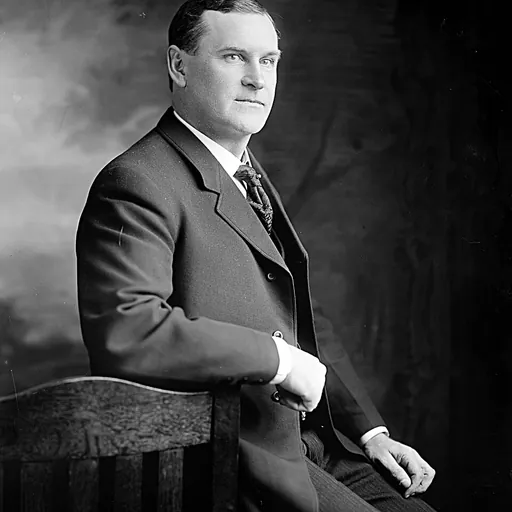
About Charles H. Weisse
Lived 1866 – 1919 (aged 52). Charles H. Weisse was an American politician and businessperson.
Charles Herman Weisse (October 24, 1866 – October 8, 1919) was a German American tanner, businessman, and Democratic politician from Sheboygan Falls, Wisconsin. He was a member of the United States House of Representatives for four terms, representing Wisconsin's 6th congressional district from 1903 to 1911. He also served three terms as president of the village of Sheboygan Falls.
Early life
Born near Sheboygan Falls, Wisconsin, Weisse attended the public schools and St. Paul Lutheran School. At age 14, he went to work at his father's tannery business, and, at age 22, he became a partner in the business, known as tanniers and furriers. His brothers were also partners in the company; Charles, as the eldest living brother, became president of the company after their father's death. During his life, the Weisse tannery was a major employer in Sheboygan Falls.
He served as village president of Sheboygan Falls, Wisconsin, from 1893 to 1896. He was treasurer of the school board from 1897 till 1900.
Political career In 1900, he made his first run for United States House of Representatives, challenging incumbent Republican Samuel S. Barney in what was then the 5th congressional district. Weisse ran on the Democratic Party ticket and received 41% of the vote in the general election, falling about 5,000 votes short of Barney. The next year, however, redistricting moved Weisse's home county, Sheboygan, into the 6th congressional district, along with Ozaukee, Washington, and Dodge counties.
Weisse ran again in the new district in 1902. He faced a contest for the Democratic nomination at the 6th congressional district convention. His chief opponents were former congressman Owen A. Wells of , James E. Malone of Dodge County, and Henry Blank of Washington. The convention deadlocked for three days, but on the 26th ballot, the chairman of the Dodge County delegation, Michael E. Burke, urged the delegates to come to a compromise; to demonstrate his sincerity he and the Dodge County delegates cast their votes for Weisse. After Burke spoke, all the other remaining convention delegates also cast their votes for Weisse, and he was nominated unanimously. In the general election, Weisse was a vocal critic of the Dingley Act tariffs, and pledged to seek adjustments. He prevailed in the general election with 52% of the vote over the incumbent secretary of state William Froehlich. Weisse carried every county in the district and became the only Democratic member of Wisconsin's congressional delegation to the 58th United States Congress. U.S. senators were still elected by the state legislature in 1910, so although Weisse received the Democratic nomination, Robert M. La Follette was easily re-elected by the overwhelmingly Republican 50th Wisconsin Legislature.
During his time in Congress, he also served as delegate from Wisconsin to the Democratic National Conventions in 1904 and 1908. During the 1908 Democratic National Convention, Weisse took a leading role in crafting the party platform. The Chicago Tribune described him efforts as "neither a radical nor a conservative, but endeavor[ing] to produce a platform upon which the whole Democratic party could go before the people." His investment enabled the paper to purchase new machinery and facilities to modernize the newspaper's production process.
On September 30, 1919, a catastrophic fire destroyed the entire factory in Sheboygan Falls, destroying an estimated $150,000 worth of property and inventory (about $5 million adjusted for inflation to 2024). After the fire, only one wall of the factory was left standing. Weisse participated in an inspection of the ruined building on October 8, 1919, with several of his employees. During the inspection, a strong gust of wind caused the remaining brick wall to collapse on the team. Weisse suffered a head wound and died within minutes. Two other men died, six were injured.
Don’t just read it —
keep it.
Full-length biographies made to live with: read them, listen on the way to work, watch them tonight.
- E-book
- Audio
- Video
Instant download · yours to keep · every purchase keeps this site free
Important facts
People in Charles H. Weisse's life
Named in this biography and alive at the same time

Related people
Same field, nearest in time




Contemporaries
People whose lives overlapped Charles H. Weisse's



Frequently asked questions
Who was Charles H. Weisse?
American politician (1866-1919)
When was Charles H. Weisse born?
Charles H. Weisse was born on 24 October 1866 in Sheboygan Falls.
When did Charles H. Weisse die?
Charles H. Weisse died on 8 October 1919 in Sheboygan Falls.
What was Charles H. Weisse's occupation?
Charles H. Weisse was a politician and businessperson.
What nationality was Charles H. Weisse?
Charles H. Weisse was American.
Sources & further reading
· Wikipedia: Charles H. Weisse
Cite this page
APA: Biography.guide. (2026). Charles H. Weisse. https://biography.guide/charles-h-weisse/
MLA: "Charles H. Weisse." Biography.guide, https://biography.guide/charles-h-weisse/.
Chicago: "Charles H. Weisse." Biography.guide. https://biography.guide/charles-h-weisse/.
Data last updated: 2026-09-23 · Spot an error? Report a correction.
Portrait: Wikimedia Commons · author & licence
Page generated 2026-09-27 05:07 UTC