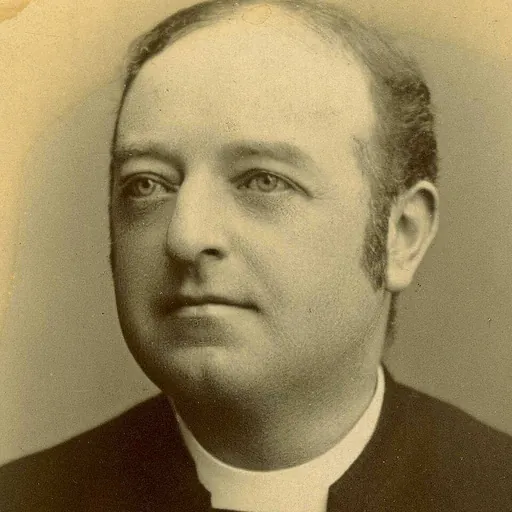
Charles Farrar Forster
Anglican priest
About Charles Farrar Forster
Lived 1848 – 1894 (aged 46). Charles Farrar Forster was a British curate.
Life Ancestors Charles' paternal grandfather Daniel Forster, an inspector of weights, was born in Otley, West Yorkshire in 1776, and died in 1844. He was buried on 30 December 1844 in the same town. His wife Bella, a school mistress and Charles' grandmother, was baptised in Otley in 1796, and died aged 78 in 1866 in Otley.
Their seventh child was Henry Highmore Forster, Charles' father, who was born on 14 October 1821 in Otley and baptised on 11 August 1823 at All Saints Church, Otley. In 1841 at the age of 15, Henry was a grocer, as was his older brother. Charles' mother was Martha Ann Farrar, who was born in 1825 in Halifax, West Yorkshire and died in Guisborough in North Yorkshire in 1897 aged 72. Henry and Martha married in 1846 in Halifax and had six children, of which Charles was the eldest. One of Charles' brothers was Edward Eustace Forster (1849–1916), chairman and managing director of printers Knight & Forster Ltd., of Leeds.
Charles and his wife
Charles Farrar Forster was born on 29 February 1848 in Knaresborough. On 6 October 1880, in Lockwood parish church, he married Mary Priestley, who was born in 1858 in Lockwood and was the eldest daughter of James Priestley, JP. In honour of this marriage, 438 workers at B. Vickerman & Son, a woollen mill in Huddersfield, were given a day out by special train from Berry Brow to Southport.
The 1891 Census shows them living at Pannal vicarage with one servant: Ellen Tupper, aged 46, from Wiltshire. He is aged 43, Mary is 33, and he is described as a clerk in holy orders.
Farrar had a weak heart. In July 1894, just before evening service at Beckwithshaw he had a "bad attack" in the church, and the service was postponed. His funeral at 3pm at Beckwithshaw Church on 1 September 1894 was brief: he was buried just half an hour later at 3.30pm at Harlow Hill Cemetery, Harrogate.
At Armitage Bridge, West Yorkshire on 30 September 1902 at the age of 44, Mary Forster née Priestley took a second husband, a widower who had been married twice before: Sir Thomas Brooke, baronet (31 May 1830 – 16 July 1908), of Armitage Bridge House, near Huddersfield, a Deputy Lieutenant and Justice of the Peace. Mary died on 12 March 1938, aged 80.
Work
Forster studied at St Bees Theological College. In 1873 or 1875 he was ordained deacon at Ripon. He was vicar until 1887. He became well known there and had many friends. In spite of having an acute form of heart disease, his parochial work did not go unnoticed. The Huddersfield & District Chronicle said: "indeed he raised the organisation of St Andrew's parish to such a pitch of perfection that it became noted throughout the borough for the efficiency and thoroughness of its church life." He was described as ". . . a most assiduous and energetic parish worker," and as "an able and interesting preacher." He was noted for "his forcible pulpit utterances and earnest parochial work in attracting and maintaining a large congregation, in addition to the various organisations which an efficiently worked parish always possesses." Due to being "handicapped very considerably" by his poor health he was assisted in the fulfilment of his duties "in the most hearty manner" by his wife. For Mary they brought a "chaste and artistic" lady's inlaid rosewood davenport. It carried the inscription: "Presented to Mrs C.F. Forster (on her leaving Huddersfield) by the congregation of St Andrew's Church, as a mark of their affection and esteem, March 1887." In their speeches of thanks, both Charles and Mary alluded to the great accord and friendship that they had experienced in the parish. This involved a very long procession, robed or uniformed, winding its way on foot to the tolling of muffled bells from Varley's house, Springfield, Newsome to the church of St John the Evangelist, Newsome. It was headed by eighty policemen, nine firemen, over forty members of Huddersfield Borough Council and several Freemasons. Next came two carriages bearing priests and doctors, then the hearse flanked by walking bearers from the mill of Vickerman & Sons. About eight carriages containing chief mourners and local VIPs followed the hearse; then came many more VIPs on foot, including local politicians, and six private carriages containing more VIPs followed these. All along the road house-blinds were closed as the hearse drew near. When the procession passed by the mills, machinery stopped, flags dropped to half-mast and the workers lined the route, heads bowed. The surpliced choir met the procession at the church lychgate. Forster was waiting in the church to attend the service, being too infirm to take part in the procession.
After Forster died, he was well-remembered at St Andrews: he ministered in season and out of season according to his strength and power . . . labouring patiently and diligently as an able preacher, a vigorous organiser, a wise manager of the schools, a painstaking parish priest, and in all things approved himself to be a Man of God. In those days this church was crowded to overflowing, for many came from far to hear his wise and loving words. Huddersfield Chronicle, 18 September 1894 The Church Times published an In Memoriam for Charles:Mr Forster had for some years suffered a painful and distressing malady which he bore, however, with remarkable fortitude . . . A man of strong will, sound judgement and prompt decision, he influenced to no slight extent the Church life in Huddersfield while vicar of St Andrew's in that town; where he will ever be remembered for the definiteness of his teaching, the heartiness and reverence which characterised the services of his church, and for the well organised and successful day and Sunday schools connected therewith. Huddersfield Chronicle, 18 September 1894 He was nominated to the living of £200 per annum and the promise of a future vicarage by Dr Williams of Moor Park; his preferment was announced on 7 January 1887 and he was licensed to the post by the Bishop of Ripon on 17 March 1887. He was a fellow of the Royal Geographical Society and was one of many members of that society to be innocently duped by the Society of Science, Letters and Art, London. He was a member of the Pannal School Board, and he concerned himself with the welfare of the Church.
Forster took an interest in clerical matters. On the afternoon of 11 April 1889, he attended a large Anglican church meeting at Harrogate Church Institute, headed by the Earl of Harewood, the Bishop of Ripon, the Bishop of Penrith, Mr Joseph Dent Dent of Ribston Hall, and a large contingent of local clergy. The stated subject of the meeting was the reorganisation of the Ripon Diocesan Societies, but the content was a move by the Bishop of Ripon for funds to support pensions for retired clergy, nine-tenths of whom did not have independent means. The meeting enthusiastically supported this motion. Sadly, Forster was not to live long enough to benefit from this improvement of the clerical lot. He supported the Church Institute which in turn supported the clergy, and he attended the annual bazaar, a three-day occasion in aid of its building fund.
Forster served in Beckwithshaw for just seven years, and died on 28 August 1894. His funeral and interment took place on 1 September. In Beckwithshaw, "in all absence of gloom" the church was crowded at the funeral service, while in the village blinds were drawn and "signs of marked sorrow were visible on every hand." However the existing inscription as of 2014 is as follows:"In memory of Charles Farrar Forster, priest. First vicar of the adjoining parish of Beckwithshaw 1887 to 1894. Passed to rest on the 28th day of August 1894 aged 46. My presence shall go with thee and I will give thee rest. This cross was erected by the members of his congregation."
On the evening of Sunday 9 September 1894 a memorial service was held for Forster at St Andrew's Church, Huddersfield. There was a large congregation. The organist, H. J. Wood, ARCO, played the voluntary Cantilene Pastorale by Guilmant. There were psalms and hymns, and lessons were read by the vicar, W. F. Shaw. The choir sang an anthem which was followed by a sermon from the vicar. The congregation stood while the organist played the Dead March from Saul. The closing voluntary was Guilmant's Funeral March.
In July 2005, over a hundred years after Forster's death, his great-nephew visited Beckwithshaw Church, showing that he is still remembered by his family.
Don’t just read it —
keep it.
Full-length biographies made to live with: read them, listen on the way to work, watch them tonight.
- E-book
- Audio
- Video
Instant download · yours to keep · every purchase keeps this site free
Important facts
People in Charles Farrar Forster's life
Named in this biography and alive at the same time


Related people
Same field, nearest in time



Contemporaries
People whose lives overlapped Charles Farrar Forster's





Frequently asked questions
Who was Charles Farrar Forster?
Anglican priest
When was Charles Farrar Forster born?
Charles Farrar Forster was born on 29 February 1848 in Knaresborough.
When did Charles Farrar Forster die?
Charles Farrar Forster died on 28 August 1894 in Bournemouth.
What was Charles Farrar Forster's occupation?
Charles Farrar Forster was a curate.
What nationality was Charles Farrar Forster?
Charles Farrar Forster was British.
Sources & further reading
· Wikipedia: Charles Farrar Forster
· DBpedia: Charles Farrar Forster
Cite this page
APA: Biography.guide. (2026). Charles Farrar Forster. https://biography.guide/charles-farrar-forster/
MLA: "Charles Farrar Forster." Biography.guide, https://biography.guide/charles-farrar-forster/.
Chicago: "Charles Farrar Forster." Biography.guide. https://biography.guide/charles-farrar-forster/.
Data last updated: 2026-09-22 · Spot an error? Report a correction.
Portrait: Wikimedia Commons · author & licence
Page generated 2026-09-27 05:01 UTC