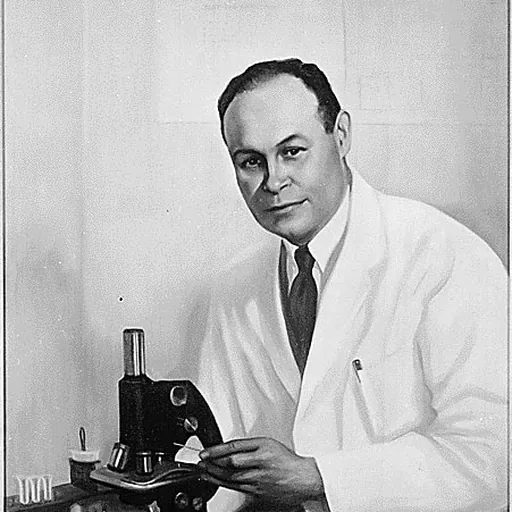
Charles Drew
American surgeon and medical researcher
About Charles Drew
Lived 1904 – 1950 (aged 45). Charles Drew was an American physician, surgeon and university teacher, known for Blood banks and Blood transfusion.
Charles Richard Drew (June 3, 1904 – April 1, 1950) was an American surgeon and medical researcher. He researched in the field of blood transfusions, developing improved techniques for blood storage, and applied his expert knowledge to developing large-scale blood banks early in World War II. This allowed medics to save thousands of Allied forces' lives during the war. As the most prominent African American in the field, Drew protested against the practice of racial segregation in the donation of blood, as it lacked scientific foundation, and resigned his position with the American Red Cross, which maintained the policy until 1950.
Early life and education
Drew was born in 1904 into an African-American middle-class family in Washington, D.C. and his mother, Nora Burrell, trained as a teacher. From 1920 until his marriage in 1939, Drew's permanent address was in Arlington County, Virginia, although he graduated from Washington's Dunbar High School in 1922 and resided elsewhere during that period of time.
Drew won an athletics scholarship to Amherst College in Massachusetts, where he played on the football as well as the track and field team, and later graduated in 1926.
For his medical career Drew applied to Howard University, Harvard Medical School and later McGill University.
It was during this stage in his medical journey that Drew worked with John Beattie, who was conducting research regarding the potential correlations between blood transfusions and shock therapy. Shock occurs as the amount of blood in the body rapidly declines which can be due to a variety of factors such as a wound or lack of fluids (dehydration). As the body goes into shock, both blood pressure and body temperature decrease which then causes a lack of blood flow and a loss of oxygen in the body's tissues and cells. Eventually, it became clear that transfusions were the solution to treating victims of shock, but at the time there was no successful method of transportation or mass storage of blood, leaving transfusions to be extremely limited to location. He then joined Freedman's Hospital, a federally operated facility associated with Howard University, as an instructor in surgery and an assistant surgeon. In 1938, Drew began graduate work at Columbia University in New York City on the award of a two-year Rockefeller fellowship in surgery. He then began postgraduate work, earning his Doctor of Science at Surgery at Columbia University. He spent time doing research at Columbia's Presbyterian Hospital and wrote a doctoral thesis, "Banked Blood: A Study on Blood Preservation," based on an exhaustive study of blood preservation techniques. This thesis earned him his Doctor of Science in Medicine degree in 1940, becoming the first African American to do so. The District of Columbia chapter of the American Medical Association allowed only white doctors to join, consequently "... Drew died without ever being accepted for membership in the AMA."
Blood for Britain In late 1940, before the U.S. entered World War II and just after earning his doctorate, Drew was recruited by John Scudder to help set up and administer an early prototype program for blood storage and preservation. Here Drew was able to apply his thesis to aid in the blood preservation and transportation. He was to collect, test, and transport large quantities of blood plasma for distribution in the United Kingdom. Drew understood that plasma extraction from blood required both centrifugation and liquid extraction. Each extraction was conducted under controlled conditions to eliminate risk of contamination. Air concealment, ultraviolet light and Merthiolate were all used to mitigate the possibility of plasma contamination. The blood bank supplied blood to the U.S. Army and Navy, who initially rejected the blood of African-Americans and later accepted it only if it were stored separately from that of Whites.
Academic achievements In 1941, Drew's distinction in his profession was recognized when he became the first African-American surgeon selected to serve as an examiner on the American Board of Surgery.
Drew had a lengthy research and teaching career, returning to Freedman's Hospital and Howard University as a surgeon and professor of medicine in 1942. He was awarded the Spingarn Medal by the NAACP in 1944 for his work on the British and American projects. He was given an honorary doctor of science degree, first by Virginia State College in 1945 then by Amherst in 1947. They had three daughters and a son.
Death
Beginning in 1939, Drew traveled to Tuskegee, Alabama, to attend the annual free clinic at the John A. Andrew Memorial Hospital. For the 1950 Tuskegee clinic, Drew drove along with three other black physicians. Drew was driving around 8 a.m. on April 1. Still fatigued from spending the night before in the operating theater, he lost control of the vehicle. After careening into a field, the car somersaulted three times. The three other physicians sustained minor injuries. Drew was trapped with severe wounds; his foot had become wedged beneath the brake pedal.
When reached by emergency technicians, he was in shock and barely alive due to severe leg injuries. Drew was taken to Alamance General Hospital in Burlington, North Carolina. He was pronounced dead a half hour after he first received medical attention. Drew's funeral was held on April 5, 1950, at the Nineteenth Street Baptist Church in Washington, D.C.
Despite a popular myth to the contrary, once repeated on an episode ("Dear Dad... Three") of the hit TV series M*A*S*H and in the novels Carrion Comfort, The 480, and The Human Stain, Drew's death was not the result of his having been refused hospital access because of his race. According to John Ford, one of the passengers in Drew's car, Drew's injuries were so severe that virtually nothing could have been done to save him. Ford added that a blood transfusion might have actually killed Drew sooner. This myth spread, however, because it was not then uncommon for black people to be refused treatment because there were not enough "Negro beds" available or the nearest hospital only serviced whites.
Legacy
In 1976, the National Park Service designated the Charles Richard Drew House in Arlington County, Virginia, as a National Historic Landmark in response to a nomination by the Afro-American Bicentennial Corporation. USNS Charles Drew, a dry cargo ship of the United States Navy Parc Charles-Drew, in Le Sud-Ouest, Montreal, Quebec, Canada In 2002, scholar Molefi Kete Asante listed Drew as one of the 100 Greatest African Americans.
Numerous schools and health-related facilities, as well as other institutions, have been named in honor of Drew, including the Martin Luther King Jr./Drew Medical Center in Los Angeles.
Medical and higher education In 1966, the Charles R. Drew Postgraduate Medical School was incorporated in California and was named in his honor. This later became the Charles R. Drew University of Medicine and Science. Charles Drew Health Center, Omaha, Nebraska Charles Drew Science Enrichment Laboratory, Michigan State University, East Lansing, Michigan Charles Drew Health Foundation, East Palo Alto, California, 1960s–2000, was the community's only clinic for decades. Charles Drew Community Health Center, located in Burlington, NC near the site of the old Alamance County hospital. Charles Drew Pre-Health Society, University of Rochester Charles R Drew Wellness Center in Columbia, South Carolina Dr. Charles Drew Red Cross Blood and Platelet Donation Center in Washington D.C. Charles R. Drew Hall, an all-male freshman dorm at Howard University, Washington D.C. Charles Drew Memorial Cultural House, residence at Amherst College, his alma mater Charles Drew Premedical Society at Columbia University, New York
K-12 schools Mural of Doctor Charles R. Drew at the Charles Richard Drew Educational Campus / Intermediate School in the Bronx, NY Charles R. Drew Middle School & Magnet school for the gifted, opened 1966 Los Angeles Unified School District Charles R. Drew Middle School Charles R. Drew Middle School Lincoln, Alabama operated by Talladega County Schools Charles R. Drew Junior High School, Detroit, Michigan Dr. Charles R. Drew Science Magnet School, Buffalo, NY Charles R. Drew Elementary School, Miami Beach and Pompano Beach, Florida Bluford Drew Jemison S.T.E.M Academy, Baltimore (closed in 2013) Bluford Drew Jemison STEM Academy West, a Middle/High School in Baltimore, Maryland Dr. Charles R. Drew Elementary School, Colesville, Maryland Charles Drew Elementary School, Washington, DC Charles R. Drew Elementary School, Arlington, Virginia Dr. Charles Drew Elementary School, New Orleans, LA Charles R. Drew Charter School opened in August 2000 as the first charter school in Atlanta, Georgia Dr. Charles Drew Academy, Ecorse, Michigan Drew Academy, Houston, Texas Aldine ISD Charles R. Drew Intermediate School, Crosby, Texas Dr. Charles Drew Elementary School, San Francisco, Ca. Charles Richard Drew Intermediate School / Charles Richard Drew Educational Campus, Bronx, New York
Don’t just read it —
keep it.
Full-length biographies made to live with: read them, listen on the way to work, watch them tonight.
- E-book
- Audio
- Video
Instant download · yours to keep · every purchase keeps this site free
Important facts
People in Charles Drew's life
Named in this biography and alive at the same time






Related people
Same field, nearest in time


Contemporaries
People whose lives overlapped Charles Drew's


Frequently asked questions
Who was Charles Drew?
American surgeon and medical researcher (1904–1950)
When was Charles Drew born?
Charles Drew was born on 3 June 1904 in Washington, D.C..
When did Charles Drew die?
Charles Drew died on 1 April 1950 in Burlington, North Carolina.
What was Charles Drew's occupation?
Charles Drew was a physician, surgeon and university teacher.
What was Charles Drew known for?
Charles Drew was known for Blood banks and Blood transfusion.
What nationality was Charles Drew?
Charles Drew was American.
Sources & further reading
Cite this page
APA: Biography.guide. (2026). Charles Drew. https://biography.guide/charles-drew-physician/
MLA: "Charles Drew." Biography.guide, https://biography.guide/charles-drew-physician/.
Chicago: "Charles Drew." Biography.guide. https://biography.guide/charles-drew-physician/.
Data last updated: 2026-09-22 · Spot an error? Report a correction.
Portrait: Wikimedia Commons · author & licence
Page generated 2026-09-27 05:03 UTC