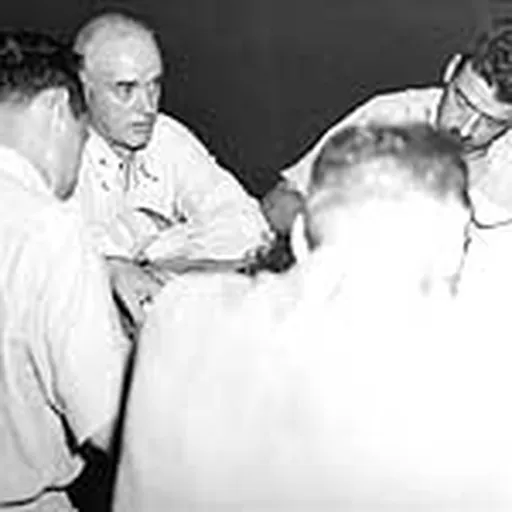
About Charles B. McVay III
Lived 1898 – 1968 (aged 70). Charles B. McVay III was an American military officer.
Charles Butler McVay III (August 31, 1898 – November 6, 1968) was an American naval officer and the commanding officer of the cruiser which was lost in action in 1945, resulting in a significant loss of life. Of all captains in the history of the United States Navy, he is the only one subjected to court-martial for losing a ship sunk by an act of war, despite the fact that he was on a top secret mission maintaining radio silence.
The testimony of Mochitsura Hashimoto, the Japanese commander who sank his ship, also seemed to exonerate him. His father, Charles Butler McVay Jr. (1868–1949), commanded the tender during the cruise of the Great White Fleet (1907–1909), was an admiral in the United States Navy during World War I, and served as Commander-in-Chief of the Asiatic Fleet in the early 1930s.
Charles III was a 1920 graduate of the United States Naval Academy at Annapolis, Maryland. Before taking command of Indianapolis in November 1944, McVay was chairman of the Joint Intelligence Committee of the Combined Chiefs of Staff in Washington, D.C., the Allies' highest intelligence unit. Earlier in World War II, he was awarded the Silver Star for displaying courage under fire.
McVay led the ship through the invasion of Iwo Jima, then the bombardment of Okinawa in the spring of 1945, during which Indianapolis anti-aircraft guns shot down seven enemy planes before the ship was struck by a kamikaze on March 31. The strike inflicted heavy casualties, including eight dead, and penetrated the ship's hull. McVay returned the ship safely to Mare Island in California for repairs.
Sinking of Indianapolis Later that year, Indianapolis received orders to carry parts and nuclear material to Tinian to be used in the atomic bombs which were soon to be dropped on Hiroshima and Nagasaki. After delivery, the ship was en route to report for further duty off Okinawa.
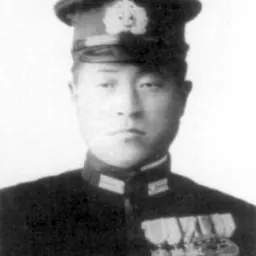
Early on July 30, 1945, Indianapolis was attacked by the under Commander Mochitsura Hashimoto. Hashimoto launched six torpedoes and hit Indianapolis twice. The first removed over forty feet of her bow, the second hit the starboard side below the bridge. Indianapolis immediately took a fifteen degree list, capsized and sank within 12 minutes. Of the crew of 1,195 men, 879 died, in one of the greatest disasters in US naval history.
Delayed rescue About 300 of the 1,196 men on board either died in the initial attack or were trapped belowdecks and drowned when compartments were sealed to prevent sinking. The remainder of the crew, about 900 men, abandoned ship. Some were left floating in the water, many without lifeboats, until the rescue of 316 survivors was completed four days later. Because of Navy protocol regarding secret missions, the ship was not reported "overdue". Rescue came only after survivors were spotted by pilot Lieutenant Wilber (Chuck) Gwinn and co-pilot Lieutenant Warren Colwell on a routine patrol flight. Of those who did abandon ship, most casualties were due to injuries sustained aboard the ship, dehydration, exhaustion, drinking salt water and shark attacks. The seas had been moderate, but visibility was not good. Indianapolis had been steaming at . When the ship did not reach Leyte on the 31st, as scheduled, no report was made that she was overdue. This omission was officially recorded later as "due to a misunderstanding of the Movement Report System".
Court-martial McVay was wounded but survived, and was among those rescued. He repeatedly asked the Navy why it took four days to rescue his men but never received an answer. The Navy long claimed that SOS messages were never received because the ship was operating under a policy of radio silence; declassified records show that three SOS messages were received separately. None were acted upon because one commander was drunk, another thought it was a Japanese ruse, and the third had given orders not to be disturbed.
After a Navy Court of Inquiry recommended that McVay be court-martialed for the loss of Indianapolis, Admiral Chester Nimitz disagreed and instead issued the captain a letter of reprimand. Admiral Ernest King overturned Nimitz's decision and recommended a court-martial, which Secretary of the Navy James Forrestal later convened. McVay was charged with failing to zigzag and failure to order abandon ship in a timely manner. He was convicted on the former. Knowledge of Japanese submarines in the area was withheld from the court and from McVay, prior to sailing. The court sentenced McVay to lose 100 numbers in his temporary rank of Captain and 100 numbers in his permanent rank of Commander. However, in 1946, at the behest of Admiral Nimitz who had become Chief of Naval Operations, Secretary of the Navy Forrestal remitted McVay's sentence and restored him to duty.
Hashimoto, the Japanese submarine commander, was on record as describing visibility at the time as fair, which is corroborated by the fact that he was able to target and sink Indianapolis in the first place. He also testified that zigzagging would not have made a difference, as he would have still sunk Indianapolis due to being in such a good position to do so. American submarine experts testified that "zigzagging" was a technique of negligible value in eluding enemy submarines. Hashimoto also testified to this effect. Despite that testimony, the court held McVay responsible for failing to zigzag.
An additional point of controversy is evidence that the admirals in the United States Navy held some responsibility for placing the ship in harm's way. McVay requested a destroyer escort for Indianapolis, but his request was denied because the priority for destroyers at the time was escorting transports to Okinawa and picking up aircrew downed in B-29 raids on Japan. McVay was the only captain to be court-martialed for the loss of his ship. It was speculated that he had been a fall guy for the Navy. The conviction effectively ended McVay's career as he lost seniority, although the sentence was overturned by Secretary James Forrestal owing to McVay's bravery prior to the sinking, and McVay was finally promoted to rear admiral when he retired from the navy in 1949, although he apparently never got over his treatment.
In his book Abandon Ship, author Richard F. Newcomb posits a motive for Admiral King's ordering McVay's court-martial. According to Captain McVay III's father, Admiral Charles B. McVay Jr., "'King never forgot a grudge". King had been a junior officer under the command of McVay's father when King and other officers snuck some women aboard a ship. Admiral McVay had a letter of reprimand placed in King's record for that. "Now," he raged, "King's used [my son] to get back at me."
Suicide On November 6, 1968, McVay took his own life by shooting himself at his home in Litchfield, Connecticut. He used a Colt pistol, an Officer's Model Target 38 Special. It was manufactured in 1906 and was not issued to the U.S. Navy despite what the name could lead some to believe, according to the USS Indianapolis Survivors Organization. This weapon has been referred to in some sources as McVay's service pistol, which it was not. Another myth regarding McVay's death, that he was holding in his hand a toy sailor he had received as a boy for a good luck charm, is also false. Police reports obtained by the Legacy Organization do not mention this nor show any other objects in the pictures aside from his pistol. Though a note was not left, McVay was known by those close to him to have suffered from loneliness, particularly after losing his wife to cancer in 1961. McVay also struggled throughout his life from the impact of vitriolic letters and phone calls he periodically received from grief-stricken relatives of dead crewmen who served aboard Indianapolis.
Exoneration survivors organized, and many spent years attempting to clear their skipper's name. Many people, from McVay's sons Charles Butler McVay IV (1925–2012) and James "Kimo" Wilder McVay (1927–2001) Scott, who later became an officer in the US Navy, stated that of the more than forty survivors he heard back from early in his project, "all felt that their captain was court martialed unjustly."
In October 2000, the United States Congress passed a Sense of Congress resolution that McVay's record should reflect that "he is exonerated for the loss of the USS Indianapolis." President Bill Clinton also signed the resolution. Commander Mochitsura Hashimoto died five days before the exoneration (on October 25).
In May 2001, Secretary of the Navy Gordon R. England ordered Captain William Toti, former commanding officer of , to enter the Sense of Congress resolution into McVay's official Navy personnel record.
Awards and decorations
Silver StarBronze Star MedalPurple HeartNavy Unit CommendationNavy Expeditionary MedalWorld War I Victory MedalChina Service MedalAmerican Defense Service Medalw/ Fleet claspAmerican Campaign MedalEuropean-African-Middle Eastern Campaign Medalw/ " bronze starAsiatic-Pacific Campaign Medalw/ three " bronze starsWorld War II Victory Medal
In popular culture
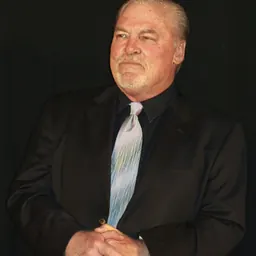
In 1978, the events surrounding McVay's court-martial were dramatized in The Failure to ZigZag by playwright John B. Ferzacca. McVay has been portrayed by Stacy Keach in the 1991 made-for-television movie Mission of the Shark: The Saga of the U.S.S. Indianapolis and Nicolas Cage in the 2016 film USS Indianapolis: Men of Courage. Also in 2016, USS Indianapolis: The Legacy was released. It is an in-depth film where the survivors tell the story of what happened and they speak about the aftermath of the tragic event. In 2019, PBS released a 90-minute documentary titled USS Indianapolis: The Final Chapter.
Captain McVay appears in the Jaws prequel novel "The Book of Quint" by Ryan Dacko.
Don’t just read it —
keep it.
Full-length biographies made to live with: read them, listen on the way to work, watch them tonight.
- E-book
- Audio
- Video
Instant download · yours to keep · every purchase keeps this site free
Important facts
People in Charles B. McVay III's life
Named in this biography and alive at the same time






Related people
Same field, nearest in time


Contemporaries
People whose lives overlapped Charles B. McVay III's


Frequently asked questions
Who was Charles B. McVay III?
United States Navy officer (1898–1968)
When was Charles B. McVay III born?
Charles B. McVay III was born on 30 July 1898 in Ephrata.
When did Charles B. McVay III die?
Charles B. McVay III died on 6 November 1968 in Litchfield.
What was Charles B. McVay III's occupation?
Charles B. McVay III was a military officer.
What nationality was Charles B. McVay III?
Charles B. McVay III was American.
Sources & further reading
· Wikipedia: Charles B. McVay III
· DBpedia: Charles B. McVay III
Cite this page
APA: Biography.guide. (2026). Charles B. McVay III. https://biography.guide/charles-b-mcvay-iii/
MLA: "Charles B. McVay III." Biography.guide, https://biography.guide/charles-b-mcvay-iii/.
Chicago: "Charles B. McVay III." Biography.guide. https://biography.guide/charles-b-mcvay-iii/.
Data last updated: 2026-09-23 · Spot an error? Report a correction.
Portrait: Wikimedia Commons · author & licence
Page generated 2026-09-27 05:07 UTC