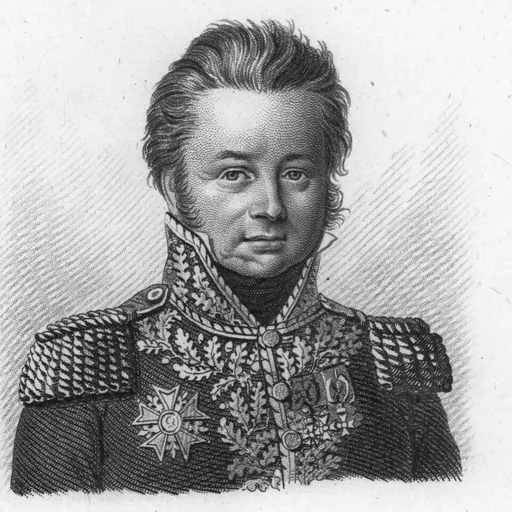
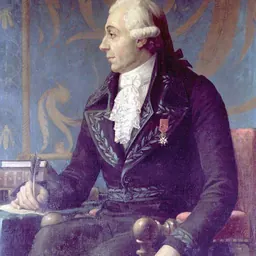
Charles Antoine Morand
General of the French army during the French Revolutionary Wars and Napoleonic Wars
About Charles Antoine Morand
Lived 1771 – 1835 (aged 64). Charles Antoine Morand was a French politician and military personnel.
Early career and French Revolutionary Wars Morand was born in Pontarlier, Doubs, on 4 June 1771 the son of lawyer Alexis François Morand (1747–1829). He trained to join his father's law practice, qualifying as a lawyer at the Ecole de Droit in Besançon in 1791. However, inspired by the National Convention's call to arms, he volunteered for the army, joining the Doubs volunteers on 9 August 1792.
Elected as captain by his comrades, by the time his battalion reached the Army of the Rhine on 5 September 1792 Morand was in command with a rank of lieutenant colonel. The following year they were transferred to the Army of the North, where Morand distinguished himself at Hondschoote and Wattignies. After fighting at Fleurus, they were moved again to Bernadotte's 10th division of Jourdan's Army of the Sambre and Meuse. On 18 September 1794 his battalion lead the assault to cross the Ourthe at Aywaille in one of the finest regimental actions of the campaign. He was also conspicuous at the battle of Aldenhoven on 2 October.
Napoleonic Wars alt=Map with blue lines showing the French advance against the Allied center, symbolized with red lines. IV Corp's decisive attack on the Allied center in the battle of Austerlitz was led by Morand's brigade. Back in France, after some leave, Morand was made commandant of the Department of Morbihan on 19 March 1802 before being called to Marshal Soult's camp at Saint-Omer on 30 October 1803. When the Grande Armée marched for Austria in August 1805, he commanded the first brigade in Saint-Hilaire's first division of Soult's IV Corps. He was present at the battle of Donauwörth and the remainder of the Ulm campaign, culminating in the capitulation of General Mack. The couple were married in a civil service on 10 January 1810, with Davout and Savary as witnesses, and in a religious service four days later at the Church of the Holy Cross in the presence of Prince Poniatowski. Napoleon sent the newlyweds a gift of jewellery and 30,000 gold francs. Matters came to a head in November 1810 when, by accident or design, Morand wrote directly to Minister of War Clarke instead of corresponding via Davout. Davout delivered a sharp rebuke in response, and Morand wrote again to Clarke threatening to resign if he was not transferred to a different commander. Napoleon refused to allow such a transfer and settled the affair, but the two men were never again on good terms.
The Battle of Moscow, 1822 by Louis-François Lejeune. Morand appears in the bottom center of the painting, having his wounded jaw bandaged whilst his brother Leopold (a battalion commander in the 17th Line) dies at his feet. They had to put aside their differences during the French invasion of Russia, when Morand's division formed part of Davout's renumbered I Corps. Crossing the Niemen on 24 June 1812, he fought at Smolensk and had his jaw smashed by a shell splinter at the Battle of Borodino.
Morand's fortunes improved following the July Revolution, and he was recalled to the colours as commander of the 6th Military Division at Besançon on 4 August 1830. He was made a Grand Commander of the Legion of Honour on 13 October 1830, and a Peer of France on 11 October 1832. He died of a stroke in Paris on 2 September 1835, and was buried at Père Lachaise Cemetery.
Family Charles and Emilie (who died on 11 November 1868 in Paris) had the following children:
Louise (1809–1862) Napoléon (1811–1852) Emilie (1812–?) Louis Charles Alphonse (1813–1905) Emile (1817–1828) Amédée (1819–1855) Euphroisine (1821–1828) Jeanne Estelle (1824–1837) Louis Charles Auguste (1826–1870), Général de brigade, ADC to Napoleon III, mortally wounded at the Battle of Beaumont Paul Louis Marie (1828–1897)
Don’t just read it —
keep it.
Full-length biographies made to live with: read them, listen on the way to work, watch them tonight.
- E-book
- Audio
- Video
Instant download · yours to keep · every purchase keeps this site free
Important facts
People in Charles Antoine Morand's life
Named in this biography and alive at the same time
Related people
Same field, nearest in time



Contemporaries
People whose lives overlapped Charles Antoine Morand's



Frequently asked questions
Who was Charles Antoine Morand?
general of the French army during the French Revolutionary Wars and Napoleonic Wars (1771-1835)
When was Charles Antoine Morand born?
Charles Antoine Morand was born on 4 June 1771 in Pontarlier.
When did Charles Antoine Morand die?
Charles Antoine Morand died on 2 September 1835 in Paris.
What was Charles Antoine Morand's occupation?
Charles Antoine Morand was a politician and military personnel.
What nationality was Charles Antoine Morand?
Charles Antoine Morand was French.
Sources & further reading
· Wikipedia: Charles Antoine Morand
· DBpedia: Charles Antoine Morand
Cite this page
APA: Biography.guide. (2026). Charles Antoine Morand. https://biography.guide/charles-antoine-morand/
MLA: "Charles Antoine Morand." Biography.guide, https://biography.guide/charles-antoine-morand/.
Chicago: "Charles Antoine Morand." Biography.guide. https://biography.guide/charles-antoine-morand/.
Data last updated: 2026-09-22 · Spot an error? Report a correction.
Portrait: Wikimedia Commons · author & licence
Page generated 2026-09-27 05:04 UTC