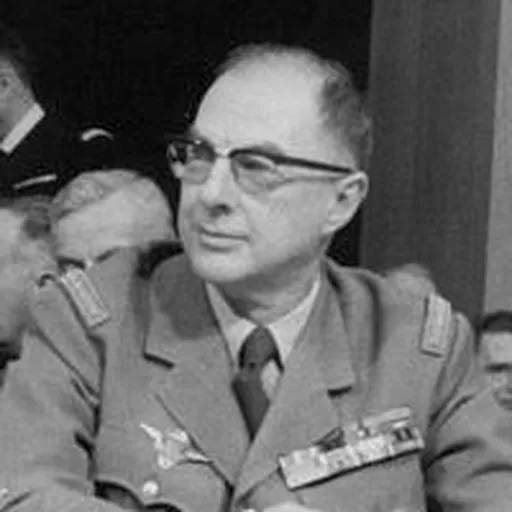
Charles Ailleret
French general
About Charles Ailleret
Lived 1907 – 1968 (aged 60). Charles Ailleret was a French military personnel, french resistance fighter and military commander.
Charles Ailleret (26 March 1907 – 9 March 1968) was a general of the French Army and chief of staff of the French Armed Forces. He joined the French Army in 1928 and was mustered out in 1942 following the defeat of the Army in 1940. During the Second World War he was a resistance fighter and a deportee, returning to army service in 1945. Rising quickly through the upper ranks, he was a strong supporter of French president Charles de Gaulle, supporting de Gaulle during the Algerian War and opposing the rebellious OAS. He was also seen as the architect of chemical weapons in the Algerian War. He was Chief of Staff of the French Armed Forces from 1962 to 1968, during which time he oversaw the French withdrawal from the NATO integrated command structure, while negotiating military cooperation contingency agreements. Ailleret was instrumental in the development of the French nuclear weapons program, overseeing the first French nuclear test in 1960, and authoring many articles outlining a French nuclear national defense strategy. He was killed along with family members in an airplane crash at La Réunion during a tour of French territories and allies in 1968.
Early life and World War II career Charles Louis Marcel Ailleret was born 26 March 1907 in Gassicourt (Seine-et-Oise), now a district of Mantes-la-Jolie.
Ailleret entered the École Polytechnique in 1926 and graduated into the artillery in 1928, joining the 32nd Artillery Regiment as a second lieutenant. In 1930 he was promoted to lieutenant and assigned to the Artillery Staff at the École supérieure technique de l’artillerie. In 1934 he was assigned to the army's Powder Commission. Ailleret was promoted to captain in 1936 and assigned to the Inspector General of Artillery (IGA). In 1938 he joined the 2nd Mountain Artillery Regiment in Chambéry, but returned to the IGA in 1939. In 1940, Ailleret was serving in the remnant French army under the Vichy government on the staff of the inspector general. In this capacity, he was a member of the French delegation to the talian Armistice Commission. In 1949 he joined the Army Technical Section.
Ailleret was a strong advocate for the acquisition of nuclear weapons by France. In January 1952 he was appointed head of a "Special Weapons Command," in charge of research into nuclear, biological and chemical warfare research. In 1953 Ailleret was appointed to coordinate military applications at the French Atomic Energy Commission (CEA). In this position he was part of the inner circle that conducted the research to develop a nuclear weapon. He was promoted to Brigadier General in 1956 and placed in command of "special weapons" (i.e., nuclear weapons). He opposed the rebel Organisation armée secrète (OAS) army faction in March 1962. The Battle of Bab El Oued between French regular forces and the OAS occurred during Ailleret's command, as well as the 1962 Isly massacre, in which poorly trained Army conscripts fired on Pieds-noirs (Algerian-born Europeans). Alleret then participated, with Christian Fouchet, High Commissioner in Algeria, in the transitional authority at the time of independence.
Army command Ailleret was appointed Chief of the Defence Staff on July 16, 1962 and returned to Paris. Ailleret was known as a decisive officer who could be harshly critical. However, Ailleret maintained close contact with American military leadership, resulting in the 1967 Ailleret-Lemnitzer agreements describing contingencies for military cooperation between French and NATO forces in the event of a Warsaw Pact invasion of Western Europe.
Death
On March 9, 1968, after an inspection tour in the Indian Ocean, Ailleret died, along with his wife and daughter and sixteen other people, in the Sainte-Marie Douglas DC-6 crash.
Publications Histoire de l'Armement, Presses Universitaires France (1948) L’art de la guerre et la technique, Lavauzelle (1950) L’aventure atomique française – Comment naquit la force de frappe, Grasset, Paris, 1968 Général du contingent – En Algérie, 1960-1962, Grasset, Paris
Don’t just read it —
keep it.
Full-length biographies made to live with: read them, listen on the way to work, watch them tonight.
- E-book
- Audio
- Video
Instant download · yours to keep · every purchase keeps this site free
Important facts
People in Charles Ailleret's life
Named in this biography and alive at the same time

Related people
Same field, nearest in time




Contemporaries
People whose lives overlapped Charles Ailleret's



Frequently asked questions
Who was Charles Ailleret?
French general (1907–1968)
When was Charles Ailleret born?
Charles Ailleret was born on 27 March 1907 in Mantes-la-Jolie.
When did Charles Ailleret die?
Charles Ailleret died on 9 March 1968 in Sainte-Marie.
What was Charles Ailleret's occupation?
Charles Ailleret was a military personnel, french resistance fighter and military commander.
What nationality was Charles Ailleret?
Charles Ailleret was French.
Sources & further reading
Cite this page
APA: Biography.guide. (2026). Charles Ailleret. https://biography.guide/charles-ailleret/
MLA: "Charles Ailleret." Biography.guide, https://biography.guide/charles-ailleret/.
Chicago: "Charles Ailleret." Biography.guide. https://biography.guide/charles-ailleret/.
Data last updated: 2026-09-22 · Spot an error? Report a correction.
Portrait: Wikimedia Commons · author & licence
Page generated 2026-09-27 05:01 UTC