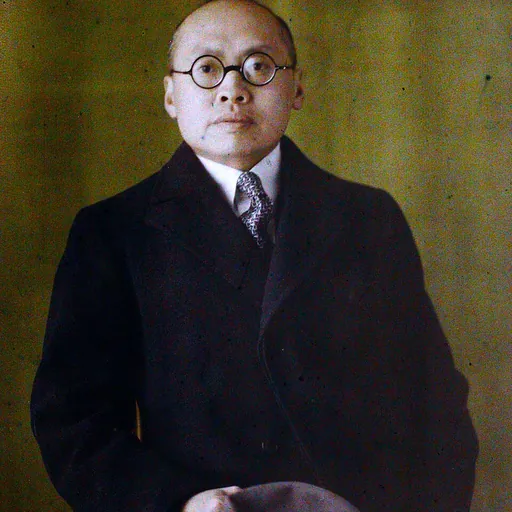
About Chang Kia-ngau
Lived 1889 – 1979 (aged 89). Chang Kia-ngau was a Chinese and American banker, economist and politician.
Chang Kia-ngau (; November 13, 1889 – October 13, 1979), courtesy name Gōngquán , was a Chinese banker, politician, and scholar. He was an influential figure in the history of modern Chinese central bank.
Biography Chang was born in 1889 in Jiading outside of Shanghai. His grandfather was an official and his father a doctor, so he and his siblings enjoyed educational opportunities not available to most of their countrymen. Chang studied finance at Tokyo's Keiō University.
While his brother, Carsun Chang distinguished himself in the world of politics, Chang Kia-ngau became a leading figure in modern Chinese banking.
Chang Kia-ngau was a supporter of reform in China and started his public service career in 1910 as editor-in-chief of the Official Gazette published by the Ministry of Communications. In 1913 he started his banking career assistant manager of the Bank of China in Shanghai.
When he was at the Shanghai branch, Chang refused a request by Yuan Shikai to stop redeeming banknotes for silver. The move was meant to secure silver deposits for Yuan's use, but would have undermined confidence in the new currency, so Chang disregarded the order and was instrumental in the bank's separation from the Beiyang government's control.
In the 1920s, Chang rose through the Bank of China's leadership in Shanghai. By 1923, the Bank of China was almost exclusively owned by private, Shanghai-based shareholders, and during the next decade, it became the largest bank, by far, in Republican China.
Under Chang's leadership, the Bank of China resisted the Kuomintang government's pressure to return to government control and to purchase government bonds which would contribute to ever-growing deficits. In 1928, T. V. Soong tried quite aggressively to assert control over the bank, but Chang and the directors resisted, so Soong created the Central Bank of China. Chang agreed to finance the new central bank's creation in exchange for a measure of independence and a charter to serve as the country's international exchange bank. Chang's interest was the development of the country, particularly railroad and other infrastructure development, even if such projects were not particularly profitable for the bank.
As longtime manager of the Bank of China, Chang attempted to prevent the bank from being politically controlled. Chang recommended that the Central Bank of China be made a reserve bank capable of independently regulating the money supply without political interference. In 1935, he was removed from office prior to the currency reform in which the fiat currency fabi replaced the silver standard and was replaced by T.V. Soong.
From 1935, Chang served as Minister of Railroads and then Minister of Transportation.
During much of the Sino-Japanese War, Chang served as Minister of Communications, accompanying the central government from Nanjing to Chongqing. After mid-1943, he was in the U.S. frequently promoting aid to the Republic of China and at the negotiations of post-war arrangements, including aviation rights. He wrote a book on railroad development which was published in the U.S. at a time when interest in China was high. After the War, he was appointed Economic Commissioner for Manchuria, and his diaries from this period were also published in the U.S.
After his departure from China, Chang moved to the US and was a senior research fellow at the Hoover Institution at Stanford University. He died on October 13, 1979, in Palo Alto, California. His wife, Chang Pihya, died in Palo Alto on May 17, 1997.
Works The Inflationary Spiral
Don’t just read it —
keep it.
Full-length biographies made to live with: read them, listen on the way to work, watch them tonight.
- E-book
- Audio
- Video
Instant download · yours to keep · every purchase keeps this site free
Important facts
People in Chang Kia-ngau's life
Named in this biography and alive at the same time


Related people
Same field, nearest in time

Contemporaries
People whose lives overlapped Chang Kia-ngau's




Frequently asked questions
Who was Chang Kia-ngau?
Chinese politician (1889-1979)
When was Chang Kia-ngau born?
Chang Kia-ngau was born on 21 October 1889 in Jiading County.
When did Chang Kia-ngau die?
Chang Kia-ngau died on 13 October 1979 in Palo Alto.
What was Chang Kia-ngau's occupation?
Chang Kia-ngau was a banker, economist and politician.
What nationality was Chang Kia-ngau?
Chang Kia-ngau was Chinese and American.
Sources & further reading
Cite this page
APA: Biography.guide. (2026). Chang Kia-ngau. https://biography.guide/chang-kia-ngau/
MLA: "Chang Kia-ngau." Biography.guide, https://biography.guide/chang-kia-ngau/.
Chicago: "Chang Kia-ngau." Biography.guide. https://biography.guide/chang-kia-ngau/.
Data last updated: 2026-09-22 · Spot an error? Report a correction.
Portrait: Wikimedia Commons · author & licence
Page generated 2026-09-27 05:03 UTC