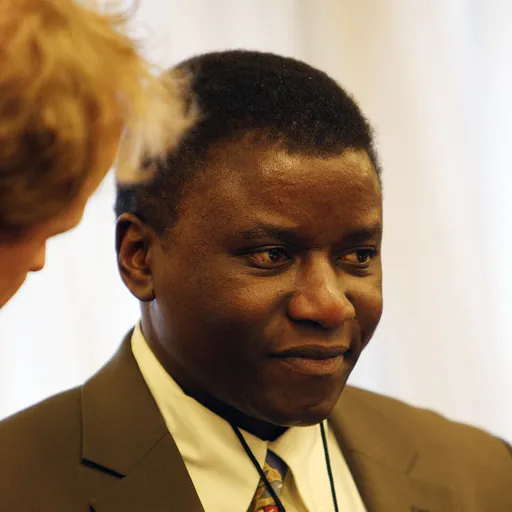
About Chaloka Beyani
Born 1959. Chaloka Beyani is a Zambian jurist.
Chaloka Beyani is a Zambian lawyer and legal scholar. He is the Special Adviser on the Prevention of Genocide to the Secretary-General of the United Nations and an Under-Secretary-General of the United Nations. He was formerly an associate professor of international law at the London School of Economics and Political Science (LSE). He has worked and published extensively in the fields of international human rights law, international criminal law and international humanitarian law, as well as on issues relating to humanitarian assistance and population displacements, in particular internal displacement. In 2023 Beyani was nominated by Zambia for election to the International Court of Justice (ICJ). The Netherlands co-nominated Beyani. Zambia had previously put Beyani forth for the 2017 International Court of Justice judges election, but withdrew his name prior to the candidate selection process. If elected, he would have been the first Zambian judge at the ICJ. After five rounds of voting in the Security Council and one round of voting in the General Assembly, Beyani was not elected.
Beyani is a recognized international and United Nations expert on internally displaced persons (IDPs), population transfers, the rights-based approach to development, climate change, sexual and reproductive health, mercenaries and private military companies, making treaties and making constitutions.
Early life and education Beyani was born in Chalimbana and grew up in Sinakoba, Zambia in 1959.
He received an LL.B. degree in 1982 and an LL.M. degree in 1984, both from the University of Zambia.
In 1988, Beyani matriculated at St Cross College of the University of Oxford, to study for a Doctor of Philosophy (D.Phil.) in international law. He later transferred to Wolfson College. His doctoral supervisor was Professor Sir Ian Brownlie, Chichele Professor of Public International Law at All Souls College. He received his D.Phil. degree in 1992.
His D.Phil. thesis was entitled “Restrictions on internal freedom of movement and residence in international law”. A revised version was later published by Oxford University Press. It is considered a “ground-breaking monograph”.
Beyani has received research grants from the Association of Commonwealth Universities (Academic Fellowship) 1988-1991, the Ford Foundation (1991-1992), the Nuffield Foundation (1990 and 1992) and the Shaler Adams Foundation 1995. published by Cambridge University Press on behalf of SOAS University of London and of the International Journal of Refugee Law and, until 2020, of the Journal of International Humanitarian Legal Studies.
Beyani was a member of the San Remo International Institute of Humanitarian Law 2009-2025.
He was a member of PeaceRep, an international research consortium led by Edinburgh Law School until 2025.
He was a nonresident senior fellow in the Brookings-LSE Project on Internal Displacement at the Brookings Institution.
Legal consulting Beyani has acted as a legal advisor, consultant and expert to a number of UN entities, including the Office of the High Commissioner for Human Rights, the Office of the High Commissioner for Refugees (UNHCR), the World Health Organization, the United Nations Population Fund and the United Nations Development Fund for Women, and to the European Union (EU), the Commonwealth Secretariat and the African Union (AU). on the Principle of Universal Jurisdiction. which was endorsed by the UN's World Summit of 2005.
As Legal Adviser to the International Conference on the Great Lakes Region, Beyani drafted and negotiated the 2006 Great Lakes Pact on Peace, Stability and Development, including the first legally binding treaty on protection for and assistance to IDPs.
Human rights work In August 2025, United Nations Secretary-General António Guterres appointed Beyani to the Office of the Special Adviser on the Prevention of Genocide (OSAPG),
Beyani was appointed United Nations Special Rapporteur on the Human Rights of Internally Displaced Persons by the UN Human Rights Council in 2010. He served until 2016.
He was Chairperson of the Coordination Committee of Special Procedures of the UN Office of the High Commissioner for Human Rights (OHCHR) from 2013-2014.
In 2018, the South Sudan government requested Beyani to provide guidance on key tasks related to the Kampala Convention: assisting in the ratification process, drafting necessary national legislation for implementation, creating a framework for the protection and assistance of IDPs and establishing provisions for sustainable solutions. In June 2019, South Sudan adopted this draft legislation as the Protection and Assistance to Internally Displaced Persons Act 2019. for the United Nations Secretary General’s High-Level Panel on Internal Displacement. The group presented a number of reports, from 2021 to 2023. In 2024, the International Criminal Court announced six arrest warrants based on the work Beyani and the investigative team had done.
Beyani was a member of the UNHCR's IDP Protection Expert Group (IPEG).
Beyani conducted UNHCR-sponsored IDP-related national consultations in Armenia in December 2024 to assist Armenia’s efforts to draft laws to protect and assist IDPs in accordance with international standards and best practices.
In 2024, the African Union Commission’s Department of Political Affairs, Peace and Security (AUC-DPAPS), with the Centre for the Study of Violence and Reconciliation (CSVR) and supported by the European Union, appointed a Reference Group on Transitional Justice in Africa. Beyani was appointed a member of the Reference Group for the period 1 August 2024 to 31 July 2027.
He was a member of the UK Foreign Secretary’s Advisory Group on Human Rights 2010-2025. 'The Politics of International Law: Transformation of the Guiding Principles on Internal Displacement from Soft Law into Hard Law, Vol. 102 (2008), Proceedings of the ASIL Annual Meeting, pp. 194–198 'Recent Developments in the African Human Rights System 2004-2006', Vol. 7, Issue 3 (2007), Human Rights Law Review, pp. 582–608 'Recent Developments: The Elaboration of a Legal Framework for the Protection of Internally Displaced Persons in Africa' Vol. 50, Issue 2 (2006), Journal of African Law, pp. 187–197 'Governance and Human Rights in the SADC Region', Vol. 3, No. 1 (2004), Journal of African Elections, pp. 62–80 'International Legal Criteria for the Separation of Members of Armed Forces, Armed Bands and Militia from Refugees in the Territories of Host States', Vol. 12, Issue suppl. 1 (2000), International Journal of Refugee Law, pp. 251–271 'State Responsibility for the Prevention and Resolution of Forced Population Displacements in International Law', Vol. 7, Special Issue, Summer (1995), International Journal of Refugee Law, pp. 130–147 'The Needs of Refugee Women: A Human-Rights Perspective', Vol. 3, No. 2 (1995), Gender and Development, pp. 29–35
Chapters in books 'Reconstituting the universal: human rights as a regional idea', in Conor Gearty and Costas Douzinas (eds.), The Cambridge Companion to Human Rights Law (Cambridge University Press, 2012) 'The Role of Human Rights Bodies in Protecting Refugees', in Anne Bayefsky (ed.), Human Rights and Refuges, Internally Displaced Persons and Migrant Workers (Kluwer, 2006) 'The Legal Premises for the International Protection of Human Rights', in Guy S. Goodwin-Gill and Stefan Talmon (eds.), The Reality of International Law: Essays in Honour of Ian Brownlie (Oxford University Press, 1999) 'Toward a More Effective Guarantee of Women’s Rights in the African Human Rights System', in Rebecca J. Cook (ed.), Human Rights of Women: National and International Perspectives (University of Pennsylvania Press, 1994)
Organizations Beyani was formerly a member of the Board of the International Centre for the Protection of Human Rights (INTERIGHTS), the Open Society Justice Initiative and the African Book Trust, and the Council of Oxfam and Minority Rights Group International (MRG).
Don’t just read it —
keep it.
Full-length biographies made to live with: read them, listen on the way to work, watch them tonight.
- E-book
- Audio
- Video
Instant download · yours to keep · every purchase keeps this site free
Important facts
People in Chaloka Beyani's life
Named in this biography and alive at the same time



Related people
Same field, nearest in time

Contemporaries
People whose lives overlapped Chaloka Beyani's




Frequently asked questions
Who is Chaloka Beyani?
professor from Zambia
When was Chaloka Beyani born?
Chaloka Beyani was born on 13 August 1959.
What is Chaloka Beyani's occupation?
Chaloka Beyani is a jurist.
What nationality is Chaloka Beyani?
Chaloka Beyani is Zambian.
Sources & further reading
Cite this page
APA: Biography.guide. (2026). Chaloka Beyani. https://biography.guide/chaloka-beyani/
MLA: "Chaloka Beyani." Biography.guide, https://biography.guide/chaloka-beyani/.
Chicago: "Chaloka Beyani." Biography.guide. https://biography.guide/chaloka-beyani/.
Data last updated: 2026-09-22 · Spot an error? Report a correction.
Portrait: Wikimedia Commons · author & licence
Page generated 2026-09-27 05:03 UTC