
About Chad "Corntassel" Smith
Born 1950. Chad "Corntassel" Smith is an American lawyer and traditional leader or chief.
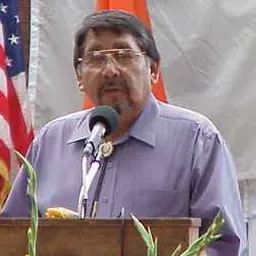
Chadwick "Corntassel" Smith (, derived from Cherokee word for "Corntassel", or ); born December 17, 1950) is a Cherokee Nation politician and attorney who served as Principal Chief of the Cherokee Nation. He was first elected in 1999. Smith was re-elected to a second term as Chief in 2003 and a third term in June 2007 with 59% of the vote. He was defeated in his attempt to get elected to a fourth term in office by Bill John Baker 54% to 46% in the 2011 election and he lost again to Baker in 2015, receiving 28% of the vote.
Early life and education Chad Smith was born in Pontiac, Michigan, where his father had gone for work. His parents were Nelson Smith, a Cherokee, and Pauline Smith, (western European ancestry), making Chad Smith 1/2 Cherokee by blood.
Professional life
From 1979 to 1980, Smith served a consultant in Indian Law and Tribal Management to the Cherokee Nation's Tribal Operations. From 1982 to 1986, he served as Assistant District Attorney in Creek County, Oklahoma. Smith served as Principal Chief of the Cherokee Nation, the second largest Indian tribe in the United States with more than 285,000 citizens.
Before becoming Principal Chief, Smith taught Indian law at Dartmouth College, Northeastern State University and Rogers State University. He served two previous Cherokee Nation chiefs as Director of Tribal Planning, Legal Historian, Cherokee Nation Prosecutor, Director of Justice and Advisor to the Tribal Tax Commission. He also successfully operated his own law practice, served Tulsa County as an assistant public defender and worked as an assistant district attorney in Creek County.
Political career
Smith completed his third 4-year term as Principal Chief of the Cherokee Nation in 2011. The Principal Chief is the head of the executive branch of the tribal government. The position is responsible for the execution of the laws of the Cherokee Nation, establishment of tribal policy, and delegation of authority for the day-to-day operations of the tribe. Before his election, Smith served under two Cherokee Nation chiefs as Director of Tribal Planning, Legal Historian, Attorney, Cherokee Nation Prosecutor, Director of Justice and adviser to the tribal tax commission.
Smith was elected Principal Chief on July 24, 1999, defeating the incumbent Principal Chief Joe Byrd in a runoff election. Byrd's first term was marked with tension and constitutional crisis issues. Smith received 7,204 votes (56.48%) to Byrd's 5,552 votes (43.52%). During his first term, Hastings Shade, a Cherokee traditionalist, language teacher, artist, and author, served as deputy chief.
Smith was re-elected to subsequent terms in 2003 and 2007, with Joe Grayson as deputy chief, who is a bilingual, full-blood community organizer and military veteran.
In 2006, Smith supported amending the constitution of the Cherokee Nation to restrict citizenship to those having "Indian blood". This action expelled about 2,800 people from the tribe who were known as the Cherokee freedmen, as they were descended from people who had been enslaved by Cherokees rather than being Cherokee by blood. Smith argued that since the Cherokee were a sovereign nation, they could establish their own rules for qualification of citizenship. The action was contrary to a post–Civil War treaty that said the Nation had given full citizenship rights to the formerly enslaved people, and was disputed in both U.S. federal courts and Cherokee Nation courts. The mission of ITEC is to protect the health of Native Americans, their natural resources, and their environment as it relates to air, land, and water. To accomplish this mission, ITEC provides technical support, training and environmental services in a variety of environmental disciplines. There are 39 ITEC member tribes in Oklahoma, New Mexico, and Texas.
In February 2021, the Supreme Court of the Cherokee Nation rejected the citizenship restriction that had been passed at the instigation of Smith, saying "The 'by blood' language found within the Cherokee Nation Constitution, and any laws which flow from that language, is illegal, obsolete, and repugnant to the ideal of liberty. These words insult and degrade the descendants of the Freedman much like the Jim Crow laws found lingering on the books in Southern states some fifty-seven years after the passage of the 1964 Civil Rights Act." A six-member jury unanimously awarded his client, tribal whistleblower David Comingdeer, $615,000 after finding the Cherokee Nation had violated Comingdeer's freedom of speech and created intolerable working conditions that led to his constructive discharge. Smith argued that Comingdeer had been retaliated against for reporting the tribe's mismanagement of a federal firefighting grant that employed 25 tribal members.
Attorney General, Pawnee Nation of Oklahoma (2020–2024) From February 2020 to June 2024, Smith served as Attorney General of the Pawnee Nation of Oklahoma. In that role, he provided legal counsel to the Pawnee Business Council on governance, litigation, gaming, Indian child welfare, and election law. The Pawnee Nation's President publicly commended Smith's "fine legal work" in Whiteshirt v. Election Commission , in which the Pawnee Nation Supreme Court upheld a tribal recall election result that Smith defended.
Director of the Tribal Justice Project, UC Davis School of Law (2020–2021) In August 2020, Smith was appointed Director of the Tribal Justice Project at the University of California, Davis School of Law (King Hall). UC Davis Law announced his appointment as part of its 2020–21 faculty additions, noting that the project sought to enhance tribal sovereignty through training for tribal judges and court personnel and by establishing an intertribal appellate court at the law school. Smith held the directorship until October 2021.
Lecturer, California State University San Marcos (2024) In fall 2024 (August–December), Smith served as a Lecturer at California State University San Marcos, where he taught an introductory course in Federal Indian Law to undergraduate students.
In-House Attorney, Winnebago Tribe of Nebraska (2025–present) Beginning in June 2025, Smith has served as In-House Attorney for the Winnebago Tribe of Nebraska, advising the tribal governing council on governance, litigation, environmental matters, gaming, Indian child welfare, and leasing issues. His appointment with the Tribe is confirmed in a December 2025 U.S. Environmental Protection Agency filing that lists him as the Tribe's in-house attorney.
Works
Cherokee Nation: Proceed Undaunted (2025) In January 2025, Smith published Cherokee Nation: Proceed Undaunted through Amazon Publishing. The 733-page work is described as a legal commentary on the Cherokee Nation's constitutional history, chronicling the Nation's development from its first written constitution in 1827 through modern amendments, including key events such as the Trail of Tears, the Treaty of New Echota, and the 2021 Nash case. Drawing on his experience as a constitutional law attorney and former Principal Chief, Smith analyzes episodes of corruption and governance failure as a case study in tribal nation building.
The Language of Life (2026) In early 2026, Smith published The Language of Life: Inspiring Stories About Rescue Dogs Rescuing Humans through Amazon Publishing. The work is a collection of interconnected stories exploring how rescue dogs emotionally and physically rescue human beings, framed through the life of a veterinarian named Arch. The book draws on Cherokee teachings that at the beginning of time all living beings shared a universal language rooted in respect, balance, and reciprocity. The book was highlighted by the Cherokee 411 community publication.
Family Smith is married to Bobbie Gail Smith, a full-blooded Cherokee from the Rocky Mountain community of Adair County, Oklahoma.
Don’t just read it —
keep it.
Full-length biographies made to live with: read them, listen on the way to work, watch them tonight.
- E-book
- Audio
- Video
Instant download · yours to keep · every purchase keeps this site free
Important facts
People in Chad "Corntassel" Smith's life
Named in this biography and alive at the same time






Related people
Same field, nearest in time

Contemporaries
People whose lives overlapped Chad "Corntassel" Smith's



Frequently asked questions
Who is Chad "Corntassel" Smith?
American lawyer and politician
When was Chad "Corntassel" Smith born?
Chad "Corntassel" Smith was born on 17 December 1950 in Pontiac.
What is Chad "Corntassel" Smith's occupation?
Chad "Corntassel" Smith is a lawyer and traditional leader or chief.
What nationality is Chad "Corntassel" Smith?
Chad "Corntassel" Smith is American.
Sources & further reading
· Wikipedia: Chad "Corntassel" Smith
· DBpedia: Chad Smith (politician)
Cite this page
APA: Biography.guide. (2026). Chad "Corntassel" Smith. https://biography.guide/chad-corntassel-smith/
MLA: "Chad "Corntassel" Smith." Biography.guide, https://biography.guide/chad-corntassel-smith/.
Chicago: "Chad "Corntassel" Smith." Biography.guide. https://biography.guide/chad-corntassel-smith/.
Data last updated: 2026-09-20 · Spot an error? Report a correction.
Page generated 2026-09-27 05:32 UTC