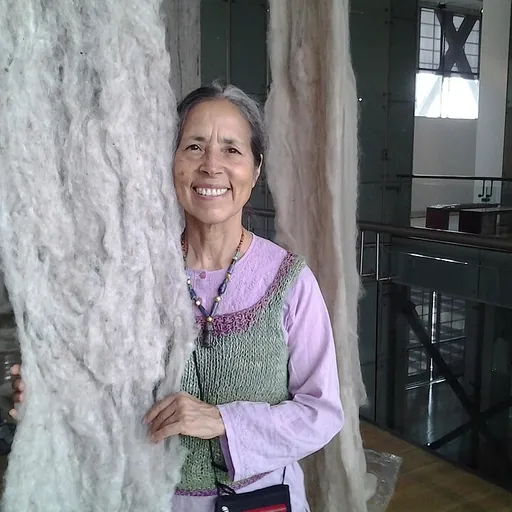
Cecilia Vicuña
Chilean poet, artist and filmmaker (born 1948)
About Cecilia Vicuña
Born 1948. Cecilia Vicuña is a Chilean poet, performing artist, film director, painter, teacher and writer.
Cecilia Vicuña (born 1948) is a Chilean poet and artist based in New York and Santiago, Chile.
Her work is noted for themes of language, memory, dissolution, extinction and exile. Critics also note the relevance of her work to the politics of ecological destruction, cultural homogenization, and economic disparity, particularly the way in which such phenomena disenfranchise the already powerless. Her commitment to feminist forms and methodologies is considered to be a unifying theme across her diverse body of work, among which her fibre art quipus, knotted or unknotted strings, palabrarmas and precarios, made from natural, delicate materials, stand out. Her practice has been specifically linked to the term eco-feminism.
Cecilia Vicuña was distinguished with Premio Velázquez de Artes Plásticas 2019, Spain's most prominent art award and given out by the Spanish Ministry of Culture to an artist based in the country or from the Ibero-American Community of Nations. The jury statement said that she is receiving the award for her "outstanding work as a poet, visual artist and activist" and her "multidimensional art that interacts with the earth, written language, and weaving.". The same year she was an invited guest artist to the physics laboratory CERN.
Early life and education Cecilia Vicuña was born in Santiago de Chile in 1948 and raised in La Florida, in the Maipo valley. Vicuña is the granddaughter of Carlos Vicuña Fuentes, and the niece of , Rosa Vicuña, Teresa Vicuña and Eliana Navarro. Vicuña is the cousin of the photographer Leonora Vicuña.
From 1957 to 1964, she learned English at St Gabriel's English School and made large abstract paintings at her first studio built by her father in their garden. In 1966, she attended architecture school at the University of Chile in Santiago but switched to the fine arts school. In 1967 she founded the "Tribu No" and the Mexican magazine El Corno Emplumado published her first poem. Her first poem was published when she was 18.
She received her MFA from the University of Chile in 1971 and moved to London with a British Council Award in 1972 to attend the Slade School of Fine Art. In 1973 she went into exile in London following the death of President Salvador Allende and the 1973 Chilean coup d'état led by General Augusto Pinochet, she remained in London.
Career
While exiled in London, Vicuña largely focused on political activism, demonstrating in peaceful protests against fascism and human rights violations in Chile and other countries. She is a founding member of Artists for Democracy and organized the Arts Festival for Democracy in Chile at the Royal College of Art in 1974.
In 1975, Vicuña left London and moved to Bogotá, Colombia to conduct independent research into indigenous art and culture. She traveled throughout the country, Venezuela and Brazil. In Bogotá she was invited by Teatro La Candelaria and Corporación Colombiana de Teatro to create stage designs. In 1980, Vicuña moved to New York City
In 2018, Vicuña became the Princeton University Art Museum's 2018 Sarah Lee Elson International Artist-in-Residence. As part of her residency, Vicuña performed with Colombian pianist Ricardo Gallo.
In 2022, The Solomon R. Guggenheim Museum hosted Vicuña's first solo exhibition in a major New York museum. At the age of 74, Cecilia Vicuña presented Spin Spin Triangulene, an exhibition which showcases a wide array of paintings that span the artists career, site-specific quipu installations and films. Vicuña's commission Brain Forest Quipu for the Turbine Hall building at Tate Modern was unveiled to the public in 2022.
In 2024, the Pérez Art Museum Miami organized the one-person exhibition of her installation Quipu Gut (2017), acquired by the museum in 2019. Quipu Gut is part of Vicuña's quipu body of work that responds to Andean native worldviews and feminist aesthetics in relation to earth work. Commissioned by and exhibited at Documenta 14, Kassel. Quipu Gut expands on Quipu Menstrual (2006) and Quipu Womb (2017).
Performance Cecilia Vicuña Vicuña was the founder of Tribu No and author of the No Manifesto, that created art actions in Santiago de Chile from 1967 to 1972.
In 1979, while living in Bogotá, Vicuña performed El Vaso de Leche (The Glass of Milk) in which she gathered an audience and spilled a glass of white paint to protest the deaths of an estimated 1,920 children due to contaminated milk. The company responsible had mixed fillers like paint into the milk to maximize their profits.
She performs her poetry internationally, frequently in conjunction with exhibitions or art installations, and documents her performances in videos and on the Vicuña audio page at Pennsound, and in the 2012 collection Spit Temple: The Selected Performances of Cecilia Vicuna which includes transcriptions, commentary, and audience commentaries.
Publications Vicuña has written and published twenty two books The Precarious/Precario (1983), Cloud Net (2000), Instan (2002) and Spit Temple (2010), a collection of her oral performances. In 1966, for one of her most experimental books, El Diario Estúpido, Vicuña wrote 7,000 words a day, recording her emotions and experiences. which the Washington Post called "magisterial."
Poetry Saborami. Cullompton, United Kingdom: Beau Geste Press, 1973. Siete Poemas. Bogotá, Colombia: Ediciones Centro Colombo Americano, 1979. Precario/Precarious. New York, NY: Tanam Press, 1983. Luxumei o El Traspié de la Doctrina. Mexico City, Mexico: Los Libros del Fakir #33, Editorial Oasis, 1983. PALABRARmas. Buenos Aires, Argentina: Ediciones El Imaginero, 1984. Samara. Valle del Cauca, Colombia: Ediciones Embalaje del Museo Rayo, 1986. La Wik'uña. Santiago, Chile: Francisco Zegers Editor, 1990. Unravelling Words & the Weaving of Water. Minneapolis, MN: Graywolf Press, 1992. PALABRARmas/ WURWAPPINschaw. Edinburgh, Scotland: Morning Star Publications, 1994. La realidad es una línea. Kortrijk, Belgium: Kanaal Art Foundation, 1994. Word & Thread. Edinburgh, Scotland: Morning Star Publications, 1996. The Precarious: The Art & Poetry of Cecilia Vicuña / QUIPOem. Middletown, CT: Wesleyan University Press, 1997. cloud-net. New York, NY: Art in General, 1999. El Templo. New York, NY: Situations, 2001. Instan. Berkeley, CA: Kelsey St. Press, 2002. i tu. Buenos Aires, Argentina. Tsé-Tsé, 2004. Palabrarmas. Santiago, Chile: RIL Editores, 2005. Sabor A Mí. Santiago, Chile: Ediciones Universidad Diego Portales, 2007. V. Lima, Peru: tRope, 2009. Soy Yos: Antología, 1966-2006. Santiago, Chile: Lom Ediciones, 2011. Saborami. Philadelphia, PA: ChainLinks, 2011. Chanccani Quipu. New York, NY: Granary Books, 2012. Spit Temple. Brooklyn, NY: Ugly Duckling Press, 2012. Slow Down Fast, A Toda Raja, Berlin:Errant Bodies Press: DOORMATS8, 2019.
Selected essays
"The Coup came to kill what I loved," in Spare Rib, #28, London 1974. "Para Contribuir a la Memoria," in La Bicicleta, #24, Santiago de Chile, 1982. "Quatro Donne in Latinoamerica," Anno V, #13, Roma, Italia, 1984. "The No, at the Latinoamerica Despierta Conference," Massachusetts College of Art, Boston, 1989. (Published as "Transcript of Remarks" in Being America, by Rachel Weiss, White Pine Press, New York, 1991.) "The Invention of Poverty," in America the Bride of the Sun, Royal Museum, Amberesm Belgium, 1992. "The Third Stone," in The Guardian, London, Nov. 26, 1996. "Poetry and string theory, a conversation with James O'Hern," Riffing on Strings, edited by Sean Miller & Shveta Verma, Scriblerus Press, 2008. "Organizar la ensonacion, en Artists for Democracy: El Archivo de Cecilia Vicuna," Museo de la Memoria y los Derechos Humanos, Museo National de Bellas Artes, Santiago, Chile, 2014.
Edited volumes Martin Adan, The Cardboard House. Minneapolis, MN: Graywolf Press (The Palabra Sur Series of Latin American Literature), 1988. Rosario Castellanos, The Selected Poems of Rosario Castellanos. Minneapolis, MN: Graywolf Press, 1988. Adolfo Bioy Casares, A Plan for Escape. Minneapolis, MN: Graywolf Press (The Palabra Sur Series of Latin American Literature), 1988. Vicente Huidobro, Altazor. Minneapolis, MN: Graywolf Press (The Palabra Sur Series of Latin American Literature), 1988. Ül: Four Mapuche Poets. Pittsburgh, PA: Latin American Review Press, 1998. The Oxford Book of Latin American Poetry. New York, NY: Oxford University Press, 2009.
Visual art Quipus Vicuña has become increasingly recognized for her works featuring raw wool and other fibers, dyed crimson and suspended or draped overhead. Vicuña referred to her first quipu as the "quipu that remembers nothing," it was an empty cord as well as her first precario.
Objects Vicuña creates "precarious works" characterized by her use of materials that are often fragile, worn by the elements and/or biodegradable: a return to the environment.
Films Vicuña has an extensive filmography, having created documentaries, video poems and site specific video installations. In 1980 she made the film ¿Qué es para Usted la Poesía/ What is Poetry to you? while in Bogotá, Colombia, the work is now part of the collection of the Museum of Modern Art. In 2010 her film Kon Kon was released, it follows Vicuña to Con Con Chile where the sea is dying and an ancient tradition is being destroyed. Vicuña has had a long collaboration with American filmmaker Robert Kolodny, with whom she has created dozens of films with. Some of Vicuña and Kolodny's collaborations include La Noche de la Especies, a video animation based on a myriad of drawings and poems by Vicuña, Disappeared Quipu which appeared as the video portion of the show by the same name at the Brooklyn Museum and MFA Boston in 2018 and Death of the Pollinators which tells the story of the death of the Earth's pollinating insects and originally screened as part of Insectageddon at the High Line in New York City.
Installations Vicuña's installations often consist of large wool strands of various colors and textures. In her Cloud-Net installation series, she utilized the wool of the sacred wild Andean vicuña animal (linked to her by name) in large-scale warp and weft weavings incorporated into rural and urban environments. This installation in particular linked Vicuña to the Feminist Art Movement's Pattern and Decoration Movement. In her solo exhibition at the Museum of Fine Arts Boston, she combined the use of these wool installations with projection technology and sound systems to create an immersive and atmospheric experience for museum visitors.
Paintings Vicuña made numerous paintings in the late 1960s and early 1970s. Many of these paintings make reference to 16th-Century indigenous artists who included their own cultural influences within their paintings of angels and saints for the Catholic Church. In Vicuña's paintings, religious icons are replaced by personal, political, and literary figures such as Karl Marx, Lenin, Salvador Allende, Ho Chi Minh, and members of her own family. In 2018, the Solomon R. Guggenheim Museum, New York acquired the 1972 portrait of Karl Marx from her Heroes of the Revolution series.
Later, in 1981, Vicuña performed Parti si Pasión (Share – Yes – Passion) in New York, where she wrote "Parti si Pasión" in the colors of the American and Chilean flags on the road to the World Trade Center. The name of this work is a dissection of the word "participation." Vicuña calls this deconstruction of language palabrarmas, translating to "armswords." This is a combination of the Spanish word "armas" (arms, weapons) and "palabra" (words). Her work is also displayed in the Cerrillos National Center for Contemporary Art near where she grew up. Alongside her quipus, paintings, poetry, and films, there is also documentation of the work she has done with activist groups like Chile's La Tribu, Artists for Democracy in London, and the Heresies Collective.
In 2017, her work was included in both the Athens and the Kassel sites of documenta 14. In 2017, the Contemporary Arts Center New Orleans originated a traveling exhibition entitled Cecilia Vicuña: About To Happen. This exhibit was both a "lament and love letter to the sea", featuring washed up debris shaped into sculptures. In 2018 the exhibition, "Cecilia Vicuña: Disappeared Quipu," was shown at the Brooklyn Museum (May 18–November 25, 2018) as well as the Museum of Fine Arts Boston (October 20, 2018 – January 21, 2019). In 2019, the Institute of Contemporary Art at the University of Pennsylvania held the first major solo exhibition of Vicuña's work. Also in 2019 her first retrospective, Seehearing the Enlightened Failure was shown at Witte de With Center for Contemporary Art, Rotterdam, Netherlands.
In 2025, the Smithsonian American Art Museum displayed Cecilia Vicuña: Quipu Viscera, a work it acquired in 2023.
Selected solo exhibitions 1971 Cecília Vicuña: Pinturas, poemas y explicaciones, Museo Nacional de Bellas Artes, Santiago 1990 Cecília Vicuña: Precarious, Exit Gallery, New York 1992 Cecília Vicuña: El Ande Futuro, Berkeley Art Museum and Pacific Film Archive, Berkeley 2009 Cecília Vicuña/Water Writing: Anthological Exhibition, 1966–2009, Institute for Women & Ar, Kasset, Rutgers University, New Brunswick, NJ 2014 Artists for Democracy: El archivo de Cecilia Vicuña, Museo Nacional de Bellas Artes; Museo de la Memoria y los Derechos Humanos, Santiago 2018 Cecilia Vicuña: Disappeared Quipu, Brooklyn Museum and Museum of Fine Arts, Boston 2019 Seehearing the Enlightened Failure. Cecilia Vicuña, a retrospective exhibition, Witte de With Center for Contemporary Art, Rotterdam, Netherlands 2022 Cecília Vicuña: Spin Spin Triangulene, Solomon R. Guggenheim Museum, May 27-September 5, 2022 2023 Cecilia Vicuña: Brain Forest Quipu, Turbine Hall, Tate Modern, London, October 11, 2022–April 16, 2023
Awards and honors
2025 Roswitha Haftmann Prize 2025 Former President of Ecuador Rosalía Arteaga of the Glocal Women Foundation named Cecilia Vicuña "Woman of the Year 2025" along with other cultural figures including Nuria Morgado, Giannina Braschi, and Carmen Boullosa. 2023 National Prize for Plastic Arts in Chile 2022 Golden Lion for Lifetime Achievement of the Biennale Arte.
2019 Premio Velázquez de Artes Plásticas 2019. Spanish Ministry of Culture. Spain. 2019 Herb Alpert Award for Visual Art. United States Artist, USA Fellow of Visual Art, United States Artists, Chicago, IL. 2018 Achievement Award, The Cisneros Fontanals Foundation, CIFO Princeton University Art Museum’s 2018 Sarah Lee Elson International Artist-in- Residence., Princeton, NJ. 2017 Invited to Documenta 14, Athens, Kassell, Spring—Summer. 2014 SLAS Spring 2014 Scholar in Residence at The Department of Humanities and Media Studies at Pratt Institute, New York. 2013 Runner Up 2013 PEN Award for Poetry in Translation for Spit Temple, Selected Performances of Cecilia Vicuña, edited by Rosa Alcalá. 2011 Sello de Excelencia, Consejo de las Artes y la Cultura de Chile The Intangible Heritage Fondart Award for her project "Tugar Tugar Salir a Buscar el Sentido Perdido", conducted in Caleu, Chile. 2005 Phipps Chair in Contemporary Poetry, University of Denver, CO. 2004 MacDowell Colony Fellowship, Peterborough, NH. 2002 Hedda Sterne Foundation Residency, Springs, New York Pennies from Heaven Fund Award, Community Trust of New York, NY. 2001 Valparaiso Foundation Residency, Mojacar, Spain. 1999 The Anonymous Was A Woman Award, New York. 1997 The Andy Warhol Foundation Award for QUIPOem. 1996 The Fund for Poetry Award, New York. 1995 The Fund for Poetry Award, New York. 1995 Lee Krasner Jackson Pollock Award, New York. 1992 Arts International Award, Lila Wallace Reader's Digest Fund. 1991 Bellagio Residency, Rockefeller Foundation, Italy. 1988 Invited to the Art Olympiad, Seoul by the Guggenheim Museum of New York (declined). 1985 Human Rights Exile Award, Fund for Free Expression, New York. 1983 LINE II Award for Precario/Precarious, New York. 1972 British Council Scholarship in the United Kingdom.
Don’t just read it —
keep it.
Full-length biographies made to live with: read them, listen on the way to work, watch them tonight.
- E-book
- Audio
- Video
Instant download · yours to keep · every purchase keeps this site free
Important facts
People in Cecilia Vicuña's life
Named in this biography and alive at the same time





Related people
Same field, nearest in time
Contemporaries
People whose lives overlapped Cecilia Vicuña's

Frequently asked questions
Who is Cecilia Vicuña?
Chilean poet, artist and filmmaker (born 1948)
When was Cecilia Vicuña born?
Cecilia Vicuña was born on 22 July 1948 in Santiago.
What is Cecilia Vicuña's occupation?
Cecilia Vicuña is a poet, performing artist, film director, painter, teacher and writer.
What nationality is Cecilia Vicuña?
Cecilia Vicuña is Chilean.
Sources & further reading
Cite this page
APA: Biography.guide. (2026). Cecilia Vicuña. https://biography.guide/cecilia-vicuna/
MLA: "Cecilia Vicuña." Biography.guide, https://biography.guide/cecilia-vicuna/.
Chicago: "Cecilia Vicuña." Biography.guide. https://biography.guide/cecilia-vicuna/.
Data last updated: 2026-09-20 · Spot an error? Report a correction.
Page generated 2026-09-27 05:10 UTC