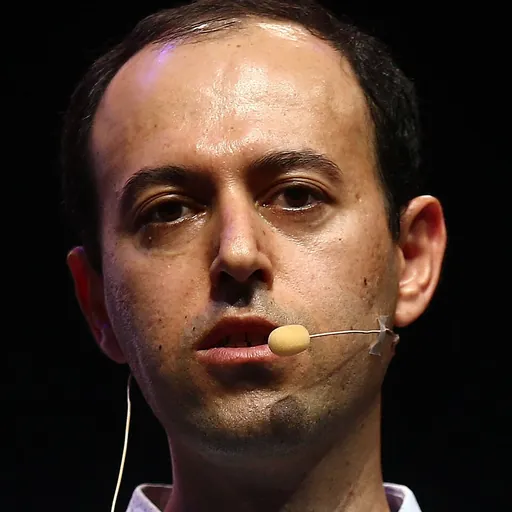
About Caucher Birkar
Born 1978. Caucher Birkar is an Iranian and British mathematician.
Caucher Birkar (; born Fereydoun Derakhshani (، ); July 1978) is a UK-based Iranian Kurdish and British mathematician (born in Iran) and a professor at Tsinghua University. He is also an Honorary Professor at the University of Nottingham.
Birkar is an important contributor to modern birational geometry. In 2010 he received the Leverhulme Prize in mathematics and statistics for his contributions to algebraic geometry, and in 2016, shared the AMS Moore Prize for the article "Existence of minimal models for varieties of log general type". He was awarded the Fields Medal in 2018, "for his proof of boundedness of Fano varieties and contributions to the minimal model program". In his office at the university, Birkar has two photographs of Alexander Grothendieck, his favorite mathematician, who like Birkar, was a refugee and Fields medalist. This can be a reflection of his name change to Caucher Birkar which roughly translates into ”the Migrating Mathematician”.
Early life and education Birkar is a Kurd, born in 1978 in Marivan County, Kurdistan province, Iran, on a subsistence farm, and raised during the Iran-Iraq War. He had five siblings, and, shortly after, while still studying in the university, relocated to the UK as a refugee and asked for political asylum. In 2001–2004 Birkar was a PhD student at the University of Nottingham. In 2003 he was awarded the Cecil King Travel Scholarship by the London Mathematical Society as the most promising PhD student. Upon emigrating to the UK he changed his name to Caucher Birkar, which means "migrant mathematician" in Kurdish.
Research and career
Together with Paolo Cascini, Christopher Hacon and James McKernan, Birkar settled several conjectures including existence of log flips, finite generation of log canonical rings, and existence of minimal models for varieties of log general type, building upon earlier work of Vyacheslav Shokurov and of Hacon and McKernan.
In the setting of log canonical singularities, he proved existence of log flips along with key cases of the minimal model and abundance conjectures. (This was also proved independently by Hacon and Chenyang Xu.)
In a different direction, he studied the old problem of Iitaka on effectivity of Iitaka fibrations induced by pluri-canonical systems on varieties of non-negative Kodaira dimension. The problem consists of two halves: one related to general fibres of the fibration and one related to the base of the fibration. Birkar and Zhang co-solved the second half of the problem, hence essentially reducing Iitaka's problem to the special case of Kodaira dimension zero.
In more recent work, Birkar studied Fano varieties and singularities of linear systems. He has solved several fundamental problems such as Shokurov's conjecture on boundedness of complements, and the Borisov–Alexeev–Borisov conjecture on boundedness of Fano varieties. In 2018, Birkar was given the Fields Medal for his work on Fano varieties and other contributions to the minimal model problem. Birkar's Fields Medal was stolen on the same day it was awarded to him. In a special ceremony at ICM 2018, Birkar was presented with a replacement medal, leading to quips he was the first person to receive the Fields Medal twice.
Birkar is also active in the field of birational geometry over fields of positive characteristic. His work together with work of Hacon-Xu nearly completes the minimal model program for 3-folds over fields of characteristic at least 7.
In 2021, Birkar joined Tsinghua University as a tenured professor. In 2025, he was elected as a foreign academician of the Chinese Academy of Sciences.
Awards and honours 2010 Leverhulme Prize in mathematics and statistics for "his outstanding contributions to fundamental research in algebraic geometry" 2010 Prize of the Fondation Sciences Mathématiques de Paris 2016 AMS Moore Prize 2018 Fields Medal
Don’t just read it —
keep it.
Full-length biographies made to live with: read them, listen on the way to work, watch them tonight.
- E-book
- Audio
- Video
Instant download · yours to keep · every purchase keeps this site free
Important facts
People in Caucher Birkar's life
Named in this biography and alive at the same time




Related people
Same field, nearest in time


Contemporaries
People whose lives overlapped Caucher Birkar's




Frequently asked questions
Who is Caucher Birkar?
Kurdish mathematician
When was Caucher Birkar born?
Caucher Birkar was born in 1978 in Marivan.
What is Caucher Birkar's occupation?
Caucher Birkar is a mathematician.
What nationality is Caucher Birkar?
Caucher Birkar is Iranian and British.
Sources & further reading
Cite this page
APA: Biography.guide. (2026). Caucher Birkar. https://biography.guide/caucher-birkar/
MLA: "Caucher Birkar." Biography.guide, https://biography.guide/caucher-birkar/.
Chicago: "Caucher Birkar." Biography.guide. https://biography.guide/caucher-birkar/.
Data last updated: 2026-09-22 · Spot an error? Report a correction.
Portrait: Wikimedia Commons · author & licence
Page generated 2026-09-27 05:03 UTC