
About Catherine Mawer
Lived 1803 – 1877 (aged 73–74). Catherine Mawer was a British sculptor and stonemason.
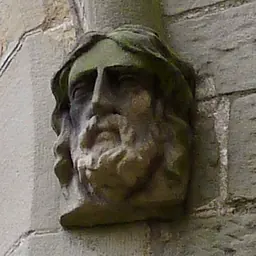
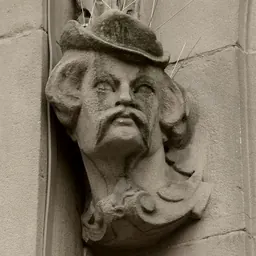
Catherine Mawer (1803 - 11 April 1877) was an architectural sculptor who worked alongside her husband Robert Mawer, then following his death in 1854 she ran the family stone yard as a master sculptor at Great George Street, Leeds, West Yorkshire, England, until 1859. The other master sculptor in her 1854–1859 company, which was known as Mrs Mawer, was her nephew William Ingle who supervised the stone yard and onsite works from 1854. Her apprentices were Matthew Taylor, Benjamin Payler, and her son Charles Mawer. All the apprentices later had independent careers as sculptors. After her son came of age in 1870, she continued working alongside Charles and her nephew William in the partnership Mawer and Ingle at the same address. Catherine was a founder member of the Mawer Group, which comprised all of the above Leeds architectural sculptors. During her lifetime, the Mawer group produced some strongly lifelike and often unflattering portraits, full of movement, including portraits of men with overhanging moustaches and cavernous mouths. These portraits continued after the deaths of Robert Mawer and William Ingle, but stopped appearing at her death in 1877. It is therefore reasonable to conclude that this style of work was her own.
Personal life Catherine Mawer's father was Anthony Scriven, alehouse keeper, and her mother was Elizabeth Scriven (1767 – 2 December 1841). Catherine was born in Bilton, Harrogate in 1803, and baptised in Knaresborough on 27 February 1804. She had a sister Mary Ann Scriven (d. Tadcaster 15 March 1861). Catherine married Robert Mawer at Ripley, West Riding of Yorkshire on 15 May 1837. She was the mother of Charles Mawer, who was present at her death. At her death she left effects worth less than £1,500.
Career
She worked as a top sculptor alongside her husband Robert Mawer. She was a partner in Mawer & Ingle, but she does not describe herself as a stone carver in the 1861 and 1871 Censuses, although her son does so. She is credited by the Leeds Intelligencer for her Caen stone carving in 1857, however, The case sheds some light on the conditions of work for apprentices at the stone carving works: "On Saturday (19 February 1856), at the Leeds Court House, Mrs Mawer, widew of the late Mr Mawer, stone-mason, near the new Town-hall, summoned one of her apprentices to show cause why he did not obey her lawful command to go into the country to work. Mr. Horsfall appeared for Mrs Mawer, and Mr. Ferns for the apprentice. The case was brought into Court for the purpose of deciding the legality of the apprentice's claim for 2s. (equivalent to £9.68 in 2016) a week for expenses when from home performing his employer's work. It appeared that Mrs Mawer paid him 8s. (equivalent to £38.72 in 2016) These plaques are affixed to Moorlands House in Albion Street and 30 Park Place, both in Leeds.
Catherine Mawer's name is one of those featured on the sculpture Ribbons, unveiled in 2024.
Works by Catherine Mawer
Mawer memorial, Woodhouse, after 1854
This memorial to Robert and Catherine Mawer, in the churchyard of the Church of St Mark, St Marks Road, Woodhouse, Leeds, is Grade II listed. The sculptor is not recorded, however when Robert died, Charles at age 16 was in the early stages of his apprenticeship, and this is a mature work, so it was probably executed by Catherine. It was created before Catherine's death, because her memorial was added after Robert's, in a bolder and slightly different hand. There are additional inscriptions on the gravestone, to Catherine's mother and sister, Elizabeth and Mary Ann Scriven (died 1841 and 1861 respectively). Between 1987 when the monument was listed, and 2015 when it was photographed by Geograph, the urn and the heads of the two angels were removed. Historic England describes the monument thus, as of 1987: "Ashlar and carved stone. Shaped podium, a stepped circular console-bracketed base supports 2 almost human-size angels who are draping the inscribed column (surmounted by an urn) with a garland of flowers. Half the urn has split away." consecrated on 13 January 1826, and closed in 2001. It was bought by Gateway Church in 2008, and reopened on 5 June 2014. Catherine Mawer was responsible for the Susannah Blesard tomb in 1856. architects, Leeds, and the whole has been executed by Mr. Mawer (sic) of this town, and is a work which will bear close inspection."(Leeds Intelligencer, 18 October 1856)
Former St Mark's, Low Moor, Bradford, 1855−1857
This is a Grade II listed building on Huddersfield Road, Low Moor, Bradford, designed by Mallinson & Healey, in Early Decorated style with an 80-foot spire. The stone carving throughout the church was executed by Catherine Mawer. The foundation stone was laid on 19 November 1855, and the building was consecrated on 11 March 1857 by the Bishop of Ripon. In 2011 an application was made to turn part of the graveyard into a car park.
In 1857 the Leeds Intelligencer and Bradford Observer said: ... The pulpit, which is placed at the North side of the chancel arch, is octagonal, each side bearing a trefoil, which carries a four-foiled circle ... The chancel arch is of three orders, the moulding resting upon deeply carved capitals and shafts ... The roof of the nave is composed of arched ribs which run down the walls and rest upon carved stone brackets. The roofs of the transepts and chancel vary in construction, whilst the four meeting at the intersection are formed of arched braces, resting upon carved stone corbels." (Leeds Intelligencer, 14 March 1857)
New Hall for Halifax Mechanics Institution, 1855−1857
This is a Grade II* listed building in Crossley Street opposite the Town Hall, Halifax. It is now known as Marlborough Hall. It has carved corbels on the ground floor, which once held lamps. The first floor has arched windows with carved tympanums, and massive columns between, which are topped with Corinthian capitals. It was designed by Lockwood & Mawson. Tenders were accepted on 11 April 1855, including: "Ornamental masonry work: Mrs Mawer, £125.00."
In 1857 the Leeds Intelligencer said: It stands on Savile Road, Thornhill Lees, Dewsbury, and was designed in the Early Decorated style by Mallinson & Healey, of Bradford. It was consecrated on Wednesday 23 June 1858. All the stone carving was executed by Catherine Mawer. It contains many windows by William Wailes on the north and east side of the chancel, in the tower, and at the east end of the aisles. However it is now an Anglo-Catholic church.
In 1858 the Leeds Intelligencer said:
Town Hall, Leeds, 1853-1858
This is a Grade I listed building. It was designed by Cuthbert Brodrick and the foundation stone was laid on 14 August 1853. It was opened by Queen Victoria and Prince Albert on 7 September 1858. However Robert Mawer was working on the "large keystones carved with Mythical heads" or "giant masks", Thomas Whiteley, the stonemason associated with Robert Mawer, also worked on the building; he was not a sculptor. The carvings are in Rawdon Hill millstone grit. In 1860 the memorial was "placed on the south west pillar of the central tower of the parish church", and the Leeds Mercury commented: (Leeds Mercury 22 March 1860)
In the same year, the Yorkshire Gazette reported: (Yorkshire Gazette 24 March 1860)
St Peter, Barton-upon-Humber, restoration 1859
This is a Grade I listed building; part of the tower dates from the 10th century, and other parts of the building are 13th and 14th century. The building was restored internally, with "sundry alterations to the tower and roof," by Cuthbert Brodrick and reopened in 1859. The Hull Packet gave this description in 1859: The font is, we understand, the gift of the vicar. The carving has been done at Leeds, by Messrs. Mawer, from sketches by the architect." (Hull Packet, 3 June 1859)
St Stephen's Church, Bowling Old Lane, 1859–1860
This is a Grade II listed building. The church in Newton Street, West Bowling, Bradford, was designed by Mallinson and Healey of Bradford. The foundation stone was laid on 2 July 1859, and the building was consecrated on Tuesday 24 April 1860 by the Bishop of Ripon. This was one of seven churches for which Charles Hardy was a major benefactor. This building of 611 sittings had a nave with aisles, a chancel with a hexagonal apse, and a tower with belfry at the north-west corner. The 27-inch bell was of cast steel, by Naylor and Vickers of Sheffield. Over the main entrance, which was via a recessed doorway on the north side, was the inscription: "Blessed is that man that maketh the Lord his trust" (Psalm 40:4). There were four dormer windows on each side of the nave roof instead of a clerestory. The first incumbent was the Rev. T.A. Stowell M.A., who was previously the curate of Bolton, in Calverley.
The Leeds Intelligencer reported:
Don’t just read it —
keep it.
Full-length biographies made to live with: read them, listen on the way to work, watch them tonight.
- E-book
- Audio
- Video
Instant download · yours to keep · every purchase keeps this site free
Important facts
Family & relationships
People in Catherine Mawer's life
Named in this biography and alive at the same time




Related people
Same field, nearest in time



Contemporaries
People whose lives overlapped Catherine Mawer's






Frequently asked questions
Who was Catherine Mawer?
English architectural sculptor
When was Catherine Mawer born?
Catherine Mawer was born in 1803 in Bilton.
When did Catherine Mawer die?
Catherine Mawer died on 11 April 1877 in Leeds.
What was Catherine Mawer's occupation?
Catherine Mawer was a sculptor and stonemason.
What nationality was Catherine Mawer?
Catherine Mawer was British.
Sources & further reading
Cite this page
APA: Biography.guide. (2026). Catherine Mawer. https://biography.guide/catherine-mawer/
MLA: "Catherine Mawer." Biography.guide, https://biography.guide/catherine-mawer/.
Chicago: "Catherine Mawer." Biography.guide. https://biography.guide/catherine-mawer/.
Data last updated: 2026-09-20 · Spot an error? Report a correction.
Page generated 2026-09-27 05:33 UTC