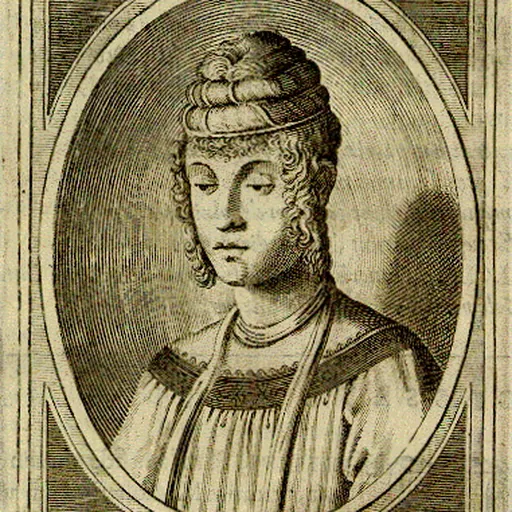
About Cassandra Fedele
Lived 1465 – 1558 (aged 92–93). Cassandra Fedele was an Italian writer.
Cassandra Fedele (c. 1465 – 1558 CE) was an Italian humanist writer. She has been called the most renowned woman scholar in Italy during the last decades of the Quattrocento. In 1487, at twenty-two years of age, she achieved success in Italy and abroad when she delivered a Latin speech in praise of the arts and sciences at her cousin's graduation at Padua. Her speech, Oratio pro Bertucio Lamberto, was published in Modena, Venice (1488), and Nuremberg (1489). From 1487 to 1497, she exchanged letters with prominent humanists and nobles throughout Spain and Italy.
Fame Fedele achieved fame through her writing and oratorical abilities. In addition to the 123 letters and 3 orations published in Padua in 1636, it is believed that she also wrote Latin poetry. She participated with influential humanists in public debates on philosophical and theological issues and was asked to speak in front of the doge Agostino Barbarigo and the Venetian Senate on the subject of higher education for women. In a letter to Lorenzo de' Medici, Angelo Poliziano praised her for her excellence in both Latin and Italian and for her beauty.
Later life Fedele's success was short-lived. The climax of her scholarly activity occurred between the ages of twenty-two and thirty-three, just before her marriage at age thirty-four (1499). After she married, and for almost sixty years, she wrote few letters and was invited only once, in 1556, to deliver a public address in honour of the Queen of Poland, Bona Sforza, who came to Venice. Some historians argue that Fedele abandoned her intellectual pursuits when she got married, as was the case for most learned women of her day who married and assumed full-time management of an entire household. Fedele may have also been discouraged by strong social forces that opposed the scholarly participation of married women. In a letter to Alessandra Scala, who wrote Fedele asking whether she should get married or devote her life to study, Fedele encouraged her to "choose the path for which nature has suited you" (translation in Robin 31).
In 1520, on Fedele's return from Crete with her physician husband, Giammaria Mapelli, she lost all her belongings in a shipwreck. Her husband died later that year, leaving her a widow, childless, and in financial difficulty. Fedele wrote to Leone X asking for help in 1521, but he did not reply to her letter. She tried again in 1547 and wrote to Paolo III, who responded by giving her a position as the prioress of an orphanage at the church of San Domenico di Castello in Venice, where she resided until her death. Fedele may have also struggled with health problems. Before her marriage, she complained of an illness that was depleting her strength and making it difficult to concentrate on reading and writing for any length of time.
Works "Cassandra Fedele: (a) Alessandra Scala to Cassandra; (b) Cassandra to Alessandra." Translated and edited by Margaret L. King and Albert Rabil, Jr. Her Immaculate Hand: Selected Works by and about the Women Humanists of Quattrocento Italy. Binghamton, N.Y.: Medieval and Renaissance Texts and Studies, 1983, 87-88. Cassandra Fedele: Letters and Orations. Edited and translated by Diana Robin. Chicago: University of Chicago Press, 2000. "Cassandra Fedele: Oration for Bertucio Lamberto, Receiving the Honors of the Liberal Arts." Translated and edited by Margaret L. King and Albert Rabil, Jr. Her Immaculate Hand: Selected Works by and about the Women Humanists of Quattrocento Italy. Binghamton, N.Y.: Medieval and Renaissance Texts and Studies, 1983, 69-73. "Cassandra Fedele: Oration in praise of letters." Translated and edited by Margaret L. King and Albert Rabil, Jr. Her Immaculate Hand: Selected Works by and about the Women Humanists of Quattrocento Italy. Binghamton, N.Y.: Medieval and Renaissance Texts and Studies, 1983, 74-77. "Cassandra Fedele: Oration to the Ruler of Venice, Francesco Venerio, on the arrival of the Queen of Poland." Translated and edited by Margaret L. King and Albert Rabil, Jr. Her Immaculate Hand: Selected Works by and about the Women Humanists of Quattrocento Italy. Binghamton, N.Y.: Medieval and Renaissance Texts and Studies, 1983, 48-50.
Oratio pro Bertucio Lamberto. Modena, 1487; Venice, 1488; Nuremberg, 1489.
Don’t just read it —
keep it.
Full-length biographies made to live with: read them, listen on the way to work, watch them tonight.
- E-book
- Audio
- Video
Instant download · yours to keep · every purchase keeps this site free
Important facts
People in Cassandra Fedele's life
Named in this biography and alive at the same time


Related people
Same field, nearest in time

Contemporaries
People whose lives overlapped Cassandra Fedele's



Frequently asked questions
Who was Cassandra Fedele?
Italian author
When was Cassandra Fedele born?
Cassandra Fedele was born in 1465 in Venice.
When did Cassandra Fedele die?
Cassandra Fedele died on 24 March 1558 in Venice.
What was Cassandra Fedele's occupation?
Cassandra Fedele was a writer.
What nationality was Cassandra Fedele?
Cassandra Fedele was Italian.
Sources & further reading
Cite this page
APA: Biography.guide. (2026). Cassandra Fedele. https://biography.guide/cassandra-fedele/
MLA: "Cassandra Fedele." Biography.guide, https://biography.guide/cassandra-fedele/.
Chicago: "Cassandra Fedele." Biography.guide. https://biography.guide/cassandra-fedele/.
Data last updated: 2026-09-21 · Spot an error? Report a correction.
Portrait: Wikimedia Commons · author & licence
Page generated 2026-09-27 04:59 UTC