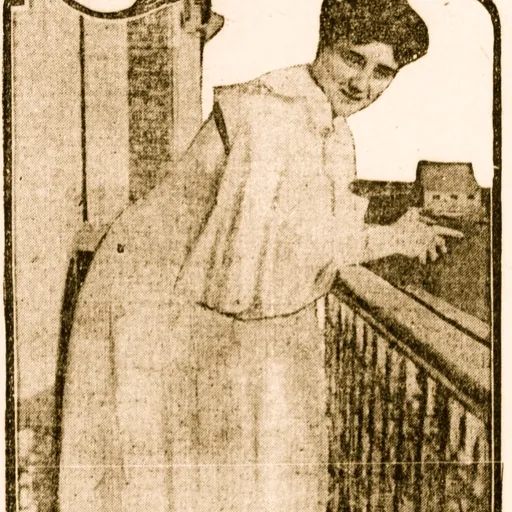
About Caroline Lacroix
Lived 1883 – 1948 (aged 64). Caroline Lacroix was a French and Belgian aristocrat.
Blanche Zélia Joséphine Delacroix, better known as Caroline Lacroix (; 13 May 1883 – 12 February 1948), was the most prominent and notorious of the mistresses of King Leopold II of Belgium.
Delacroix, who was of French origin, met the king in Paris as a young girl, when she was only 16 and he was 65. At that time, she earned her living from prostitution. They soon embarked upon a relationship that was to last until his death in 1909. Leopold lavished upon her large sums of money, estates, gifts, and a noble title, baronne de Vaughan (Baroness Vaughan). Because of these presents, Caroline was deeply unpopular both among the Belgian people and internationally, as Leopold became increasingly criticized for his greed-induced actions in the Congo Free State, his own personal colony. As Caroline largely profited from the king's income from the colony, she became known as La reine du Congo ("The Queen of the Congo").
She and Leopold married in a religious ceremony five days before his death, though their failure to perform a civil ceremony rendered the marriage void under Belgian law. After the king's death, it was soon discovered that he had left Caroline numerous properties, items of high material value, Congolese bonds, and other valuable sources of income – all of which turned her into a multimillionaire. For years, the Belgian government and Leopold's three estranged daughters attempted to recover some of this wealth, with their success varying depending on the case. Caroline died on 12 February 1948 in Cambo-les-Bains, France.
Early life There remains a small degree of mystery concerning Caroline's early life. One account states that her father, Jules Delacroix, was a janitor of the French Legation at Bucharest. As a young woman, she was the mistress of Antoine-Emmanuel Durrieux, a former officer in the French army.
Relationship with Leopold II
Reaction in the press
The Belgian king no longer stoops to prostitution, like his associates, in wild bursts of sensuality and lasciviousness: prostitution climbs to meet the King. — Le Peuple, a Belgian newspaper The young mistress became known as la reine du Congo because the great wealth she accumulated from Leopold came from the Congo Free State.
Leopold spent vast sums of money on gifts and estates for his young mistress, presenting for instance the Villa Leopolda to Caroline in 1902. She frequently traveled to Paris to visit her dress- and hat-maker, once bragging that she spent three million francs on dresses at a single store on one occasion. Caroline once complained to Leopold that the evening express train back to Brussels gave her little time to shop, causing Leopold to arrange it so that the train would leave an hour later. Taking Caroline with him everywhere, the king spent much of his time outside Belgium on his various properties throughout Western Europe, and was much resented by the Belgian people as a result. Caroline also stayed at Chateau de Larmoy, which Leopold had rented for her; he acquired the French Chateau de Balaincourt as well as a villa in Brussels, where Caroline had no scruples in appearing in public. Caroline was described as having been above average in height, "plump but graceful, with a beautiful complexion and skin", with masses of chestnut hair; in character, she was "haughty, sharp, irritable" and ill-educated, and insisted on being treated with respect or else one would have to face the king's displeasure. She was also said to be in possession of "vivid conversational powers" and "dazzling youthfulness". Caroline was well-used to Leopold's "quirks", such as his extreme hypochondria. For instance, when she needed free time for herself, she coughed and pretended to have a cold. She used this "weapon" to keep scheming female rivals from gaining favor with the king as well, telling Leopold that they had colds. Five days before his death, on 12 December 1909, King Leopold married Caroline in a religious ceremony performed by his personal chaplain. The marriage caused a great scandal in Belgium, as its citizens were shocked that the Church had not only sanctioned it, but also allowed Caroline to remain at his bedside, even when the priest was present. Despite their marriage, Caroline had to hide out of sight whenever a visitor arrived to see the king, though she stayed by his side otherwise. Princesses Louise and Stéphanie also traveled to Brussels for a hoped-for reconciliation with their father and changes to the king's will, but Leopold turned them away. Hochschild speculates that it is likely the king said this or something similar, as he was well-aware how much his daughters and the public loathed her, particularly when they discovered just how much he had left her and their sons. Because of their parents' legally invalid marriage, their two sons were still deemed illegitimate. Had Leopold married in a legal civil ceremony, the boy could have indeed inherited the throne, because all classes were equal under the Belgian constitution, and thus their marriage would not have been considered morganatic. In 1910, the two boys were adopted by Antoine Durrieux, whom Caroline married soon after Leopold's death.
Leopold was devoted to his sons, and much of the wealth Caroline inherited went to the two; she once reportedly boasted that because she was able to marry the king, her sons were in better standings than Charles Beauclerk, 1st Duke of St Albans, the illegitimate son of Nell Gwyn and Charles II of England. Because of these gifts, Caroline was loathed by the Belgian public; on one occasion, her carriage was stoned on the streets of Brussels.
Later years Leopold gave his mistress vast sums of money by investing large sums in her name or confiding in trustees for her benefit. One 1912 source for instance reported that out of the king's estimated estate of $65,000,000, Caroline received $7,000,000, while others stressed still higher numbers, and that the majority of it came from Congo shares.
Legal suits Princesses Stéphanie and Louise, who attempted to gain back their father's wealth from Caroline.
The old king's estrangement from his three daughters from his first marriage (Princesses Louise, Stéphanie, and Clémentine) spurred Leopold to keep or give as much wealth away as possible in order to disinherit the girls. After his death, the three princesses sued his estate for several million francs, although this was only a very small portion compared with the fortune he accumulated. A trust of $10,000,000 the king had placed in Caroline and their two sons' names became a target of the princesses; they and the Belgian government argued that the trust formed part of Leopold's private estate, and thus all three girls and the government had a right to their share, as its funds had derived from the Congo Free State.
Second marriage, divorce and death An extremely rich widow (Leopold's gifts left her a multimillionaire), Caroline continued to appear in newspapers long after Leopold's death. She married Antoine Durrieux (1865–1917), her former love and pimp, in 1910, seven months after the king's death. He was formerly a non-commissioned officer in the French army, and served as her chief agent at the time of Leopold's death, helping her collect the necessary papers to secure her inherited fortune. She never remarried. Caroline's younger son died in 1914, but the elder lived a long, quiet life on his inherited wealth, dying in 1984. in it, she stated she had loved and was faithful to the king, and that he had loved her and their two sons. Caroline died on 12 February 1948 in Cambo-les-Bains, Pyrénées-Atlantiques in southern France.
Don’t just read it —
keep it.
Full-length biographies made to live with: read them, listen on the way to work, watch them tonight.
- E-book
- Audio
- Video
Instant download · yours to keep · every purchase keeps this site free
Important facts
Family & relationships
Related people
Same field, nearest in time


Contemporaries
People whose lives overlapped Caroline Lacroix's



Frequently asked questions
Who was Caroline Lacroix?
Royal mistress (1883–1948)
When was Caroline Lacroix born?
Caroline Lacroix was born on 13 May 1883 in Bucharest.
When did Caroline Lacroix die?
Caroline Lacroix died on 12 February 1948 in Cambo-les-Bains.
What was Caroline Lacroix's occupation?
Caroline Lacroix was an aristocrat.
What nationality was Caroline Lacroix?
Caroline Lacroix was French and Belgian.
Sources & further reading
Cite this page
APA: Biography.guide. (2026). Caroline Lacroix. https://biography.guide/caroline-lacroix/
MLA: "Caroline Lacroix." Biography.guide, https://biography.guide/caroline-lacroix/.
Chicago: "Caroline Lacroix." Biography.guide. https://biography.guide/caroline-lacroix/.
Data last updated: 2026-09-20 · Spot an error? Report a correction.
Portrait: Wikimedia Commons · author & licence
Page generated 2026-09-27 04:58 UTC