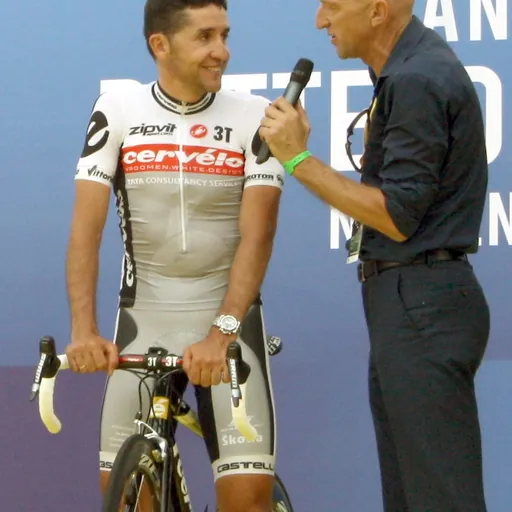
About Carlos Sastre
Born 1975. Carlos Sastre is a Spanish sport cyclist.
Biography When Sastre was young, professional cyclist Francisco Ignacio San Román lived in his parents' house during military service. Sastre was at first coached by his father, until he became an amateur. Sastre finished 2 minutes 32 seconds ahead of team captain Tyler Hamilton on the stage.
Before the 2004 season, Carlos Sastre and teammate Ivan Basso trained extensively to improve their individual time trial skills, making them better all-round riders. They went to Boston to train on MIT's wind tunnel. This helped Sastre improve his Vuelta a España performance, ranking 6th in the overall classification, as well as 8th in the 2004 Tour de France.
Tour 2005: Sastre during the stage 20 individual time trial. In the 2005 Tour de France he was a domestique for Ivan Basso, and 21st in the overall classification. However, as the captain of Team CSC's 2005 Vuelta a España campaign, Sastre finally reached the podium of a Grand Tour, finishing in third place behind Denis Menchov and initial winner Roberto Heras. Heras was later disqualified due to a positive EPO test, making Sastre the de facto second placed rider of the competition. After the Vuelta a España, he extended his contract with Team CSC for another year. In May 2006 he signed a new contract which expired after the 2008 season.
2006 Before the 2006 Giro d'Italia in May, Sastre decided to ride the Giro d'Italia to help Ivan Basso to win, indicating that he would ride all three Grand Tours; the Giro and Tour in support of Basso and the Vuelta as team captain. In the Giro, Sastre's pace on select mountain stages helped Basso win the overall classification. Sastre finished 43rd in the GC of the 2006 Giro.
Days before the 2006 Tour de France started in July, Team CSC suspended Ivan Basso as his name was brought up in the Operación Puerto doping case. This meant Sastre became the CSC team captain at the 2006 Tour. Even though his main focus for the season had been the 2006 Vuelta a España in September, this Tour was a great opportunity for Sastre to prove himself as a Tour GC contender. Through the mountain stages, Sastre proved himself the strongest mountain rider in the peloton, beating Floyd Landis by one minute and 59 seconds and Andreas Klöden by two and a half minutes on mountain climbs. Sastre was placed well on stage 15, and came in 2nd on both stage 16 and 17, where he closed the gap to the then yellow jersey Óscar Pereiro. Before the penultimate stage of the Tour, the stage 19 individual time trial, Sastre was the second placed rider overall, trailing race leader Óscar Pereiro by 14 seconds. However, on the final time trial, which stretched 57 kilometres between Le Creusot and Montceau-les-Mines, Sastre finished 20th, losing several minutes to Pereiro, eventual overall winner Floyd Landis and Andreas Klöden, who took third place overall. Sastre thus finished the 2006 Tour in 4th place. Floyd Landis has since been stripped of this title, making Sastre 3rd in the 2006 Tour de France.
When he finished the 2006 Vuelta 4th overall, Sastre, who also rode the Giro d'Italia and Tour de France in 2006, became one of few riders to finish all three Grand Tours in one year.
2007 In the 2007 Tour de France, Sastre finished 4th overall, 7'08" behind race winner Alberto Contador. He finished 2nd overall in the 2007 Vuelta a España, 3'31" behind race winner Denis Menchov.
2008 Tour de France
Coming into the 2008 Tour de France, Sastre was considered one of the favorites to win the race along with Australian Cadel Evans of Team , Spaniard Alejandro Valverde of and Russian Denis Menchov of . He also faced competition within his own team from brothers Andy and Fränk Schleck, despite officially being the leader of .
Sastre had a quiet, understated opening to the tour. After a lacklustre opening time-trial, he remained relatively restrained in the opening mountain stages in the Pyrenees and opted to stay defensive and follow the wheel of his main rivals. This allowed his CSC teammate Fränk Schleck to claim the yellow jersey at the finish to stage 15 at Prato Nevoso. However, on the crucial 17th stage, Sastre showed his class and mountain climbing prowess, attacking at the bottom of the final climb of the day, Alpe d'Huez, finishing 2 minutes and 15 seconds ahead of Evans, Sastre, knowing that a slender lead over a strong time-trialist like Evans may not have been enough to secure overall victory going into the penultimate stage, sought to gain an advantage of at least a couple of minutes over his closest rivals.
Following his victorious Stage 17 attack, Sastre took a lead of 1 minute and 24 seconds over teammate Fränk Schleck into the final time trial, although, more crucially, he had a further 10 seconds advantage over Evans, a man considered to be a more accomplished time trialist, who was widely expected to overcome the deficit and leapfrog Sastre into first place. However, Sastre managed to hold onto his lead in the time trial, finishing the Tour with a 58-second lead.
Sastre and CSC could not agree on a new contract, so Sastre left the team at the end of the year.
After the Tour, Sastre ended up focusing on the Vuelta a España looking to double his victories. He later finished 3rd overall.
2009 Sastre joined the new for the 2009 season. He won the high mountain Stage 16 of the 2009 Giro d'Italia, which had been called the Giro's queen stage, after seven hours and twelve minutes. His decisive attack saw him break free from a group of general classification contenders to get to the summit of Monte Petrano just under half a minute faster than the group he left. After seeming off his form in Stage 17 of that race, Sastre rebounded with another solo ride to victory in Stage 19 to Mount Vesuvius. He then completed the Giro with a solid ride in the final time-trial around Rome to hold off Ivan Basso and finished 2nd overall.
In the 2009 Tour de France, Sastre attempted to defend his title but had a quiet year finishing 16th overall.
2010 In 2010, Sastre raced all three Grand Tours, finishing 8th in the Giro, 20th in the Tour and 7th in the Vuelta.
He announced that he would join Geox-TMC for the 2011 season.
2011 In the 2011 Vuelta a España Sastre himself finished 20th overall, but helped his teammate Juan José Cobo, who was later, in 2019, considered ineligible for results due to the use of performance-enhancing drugs in the period between 2009 and 2011, claim the overall title ahead of Chris Froome. Chris Froome was later recognised as the 2011 champion. Bradley Wiggins was promoted to second place, and Bauke Mollema promoted to third.
Shortly afterwards, he announced his retirement, bringing an end to a professional career spanning 15 years.
Career achievements Major results Source:
1997 3rd Overall Vuelta a Navarra 10th Overall Grand Prix Guillaume Tell 1999 4th GP Villafranca de Ordizia 8th Overall Vuelta a Castilla y León 10th Subida a Urkiola 2000 2nd Subida al Naranco 4th Overall Escalada a Montjuïc 4th Clásica a los Puertos de Guadarrama 4th Memorial Manuel Galera 8th Overall Vuelta a España
10th Overall Vuelta a Castilla y León 2001 9th Overall Tirreno–Adriatico 9th Overall Vuelta a Burgos 1st Stage 3 2002 5th Overall Tour de Romandie 5th Züri-Metzgete 10th Overall Tour de France 2003 6th Overall Tour de Romandie 9th Overall Tour de France 1st Stage 13 2004 4th Classique des Alpes 6th Overall Vuelta a España 8th Overall Tour de France 2005 2nd Overall Escalada a Montjuïc 1st Stage 1a 3rd Overall Vuelta a España 6th Giro dell'Emilia 2006 1st Klasika Primavera 1st Stage 5 (TTT) Giro d'Italia 3rd Overall Tour de France 1st Stage 17 4th Overall Vuelta a España 1st Stage 1 (TTT)
5th Overall Escalada a Montjuïc 7th LuK Challenge (with Christian Müller 2007 2nd Overall Vuelta a España 3rd Overall Escalada a Montjuïc 4th Overall Tour de France 7th Clásica de San Sebastián 2008
1st Stage 17 3rd Overall Vuelta a España 9th Overall Vuelta a Murcia 2009 2nd Overall Giro d'Italia 1st Stages 16 & 19 2010 3rd Clásica de San Sebastián 7th Overall Vuelta a España 8th Overall Giro d'Italia 2011 3rd Overall Tour of Austria 6th Overall Tour of Slovenia
Grand Tour general classification results timeline
+ Legend — Did not compete DNF Did not finish
Don’t just read it —
keep it.
Full-length biographies made to live with: read them, listen on the way to work, watch them tonight.
- E-book
- Audio
- Video
Instant download · yours to keep · every purchase keeps this site free
Important facts
People in Carlos Sastre's life
Named in this biography and alive at the same time

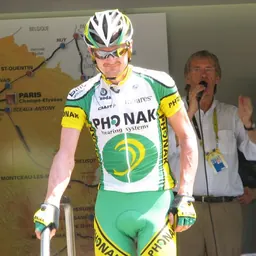

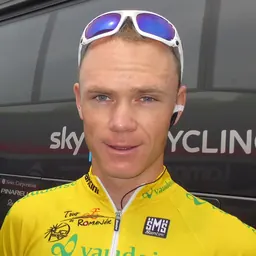
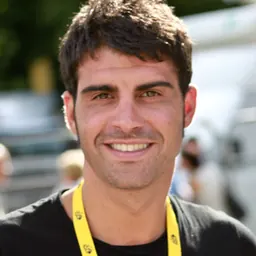
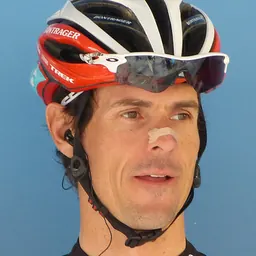
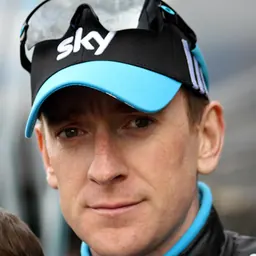

Related people
Same field, nearest in time


Contemporaries
People whose lives overlapped Carlos Sastre's


Frequently asked questions
Who is Carlos Sastre?
road bicycle racer
When was Carlos Sastre born?
Carlos Sastre was born on 22 April 1975 in Leganés.
What is Carlos Sastre's occupation?
Carlos Sastre is a sport cyclist.
What nationality is Carlos Sastre?
Carlos Sastre is Spanish.
Sources & further reading
Cite this page
APA: Biography.guide. (2026). Carlos Sastre. https://biography.guide/carlos-sastre/
MLA: "Carlos Sastre." Biography.guide, https://biography.guide/carlos-sastre/.
Chicago: "Carlos Sastre." Biography.guide. https://biography.guide/carlos-sastre/.
Data last updated: 2026-09-20 · Spot an error? Report a correction.
Page generated 2026-09-27 05:09 UTC