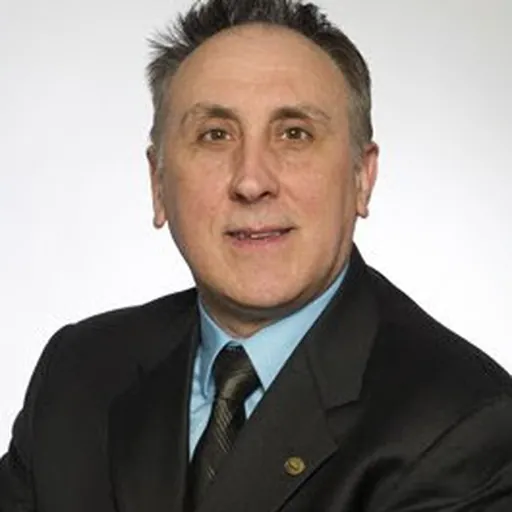
About Carlos Lousto
Carlos Lousto was an Argentine astrophysicist, mathematician and researcher.
Carlos O. Lousto is an Argentine-American astrophysicist and Distinguished Professor in the School of Mathematical Sciences at Rochester Institute of Technology (RIT). He is known for his contributions to numerical relativity and the simulation of binary black hole mergers, work that played a role in the interpretation of the first direct detection of gravitational waves by LIGO in 2015.
Education and early career
Lousto holds two doctoral degrees: one in astronomy from the National University of La Plata, completed in 1987, in which he studied accretion disks around black holes and the internal structure of neutron stars; and one in physics from the University of Buenos Aires, completed in 1992, focusing on quantum field theory in curved spacetime. He received an Alexander von Humboldt Foundation fellowship in 1993.
Lousto joined RIT in 2007 as a founding member of the Center for Computational Relativity and Gravitation (CCRG), where he serves as co-director. In 2023, he was named Distinguished Professor, the highest academic title at RIT.
Research
Lousto's research spans black hole perturbation theory, numerical relativity, and gravitational wave astronomy. He has authored or co-authored approximately 300 scientific publications, with research funded by the National Science Foundation and NASA. This method was subsequently used to interpret signals detected by LIGO, including the first direct observation of gravitational waves in September 2015. He and collaborator James Healy also discovered the "flip-flopping" behavior of black hole spins in binary systems.
Extreme mass ratio simulations
Lousto has pushed the boundaries of numerical relativity by simulating binary black holes with mass ratios up to 128:1, a record in the field. These simulations are important for informing the design of next-generation gravitational wave detectors such as the Laser Interferometer Space Antenna (LISA).
Supercomputing
To support his simulation work, Lousto designed several dedicated supercomputer clusters, including the Funes cluster at the University of Texas at Brownsville and the NewHorizon, BlueSky, and GreenPrairies clusters at RIT. 2012 – Elected Fellow of the American Physical Society, cited for contributions at the interface between perturbation theory and numerical relativity 2016 – Special Breakthrough Prize in Fundamental Physics, shared with the LIGO collaboration 2019 – Edward A. Bouchet Award from the American Physical Society 2023 – Distinguished Professor, Rochester Institute of Technology 2024 – RAICES Award from the Argentine government's Secretariat of Innovation, Science, and Technology
Selected publications
Don’t just read it —
keep it.
Full-length biographies made to live with: read them, listen on the way to work, watch them tonight.
- E-book
- Audio
- Video
Instant download · yours to keep · every purchase keeps this site free
Important facts
Related people
Same field, nearest in time




Frequently asked questions
Who was Carlos Lousto?
Argentinian astrophysicist
When was Carlos Lousto born?
Carlos Lousto was born in Buenos Aires.
What was Carlos Lousto's occupation?
Carlos Lousto was an astrophysicist, mathematician and researcher.
What nationality was Carlos Lousto?
Carlos Lousto was Argentine.
Sources & further reading
Cite this page
APA: Biography.guide. (2026). Carlos Lousto. https://biography.guide/carlos-lousto/
MLA: "Carlos Lousto." Biography.guide, https://biography.guide/carlos-lousto/.
Chicago: "Carlos Lousto." Biography.guide. https://biography.guide/carlos-lousto/.
Data last updated: 2026-09-23 · Spot an error? Report a correction.
Portrait: Wikimedia Commons · author & licence
Page generated 2026-09-27 05:06 UTC