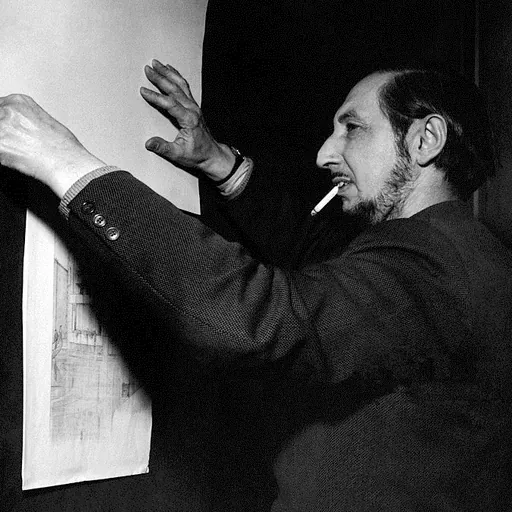
About Carlo Scarpa
Lived 1906 – 1978 (aged 72). Carlo Scarpa was an Italian architect, designer, professor and glass artist.
Carlo Scarpa (2 June 1906 – 28 November 1978) was an Italian architect and designer. He was influenced by the materials, landscape, and history of Venetian culture, as well as those of Japan. Scarpa translated his interests in history, regionalism, invention, and techniques of artistry and craftsmanship into glass and furniture design.
Biography Scarpa was born in Venice on 2 June 1906. Much of his early childhood was spent in Vicenza, where his family relocated when he was two years old. After his mother's death when he was 13, he moved with his father and brother back to Venice. Carlo attended the Academy of Fine Arts, where he focused on architectural studies. After graduating from the academy with the title of Professor of Architecture, he apprenticed with the architect Francesco Rinaldo. Scarpa married Rinaldo's niece, Nini Lazzari (Onorina Lazzari).
However, due to his refusal to sit the pro forma architecture licensing exam administered by the Italian government, he was not permitted to use the professional title "" or practice architecture without associating with a licensed architect. Clients, associates, and artisans sometimes referred to him as "".
Scarpa taught drawing and interior decoration at the Istituto universitario di architettura di Venezia from the late 1940s until his death. Scarpa was Mario Botta's thesis adviser along with ; the latter was the director of the Fondazione Querini Stampalia when Scarpa completed his renovation and garden for that institution.
While most of his built work is located in the Veneto region, he designed landscapes, gardens, and buildings for other regions of Italy as well as Canada, the United States, Saudi Arabia, France, and Switzerland. His name has 11 letters and this number is used repeatedly in his architecture.
In 1978, while in Sendai, Japan, Scarpa fell down a flight of concrete stairs. He died of his injuries on 28 November 1978 after ten days in hospital. He was buried standing up and wrapped in linen sheets in the style of a medieval knight, in an isolated exterior corner of the L-shaped Brion tomb designed by him in Altivole.
One of his last projects, the Villa Palazzetto in Monselice, was left incomplete at the time of his death, and was altered in October 2006 by his son, Tobia Scarpa. Considered one of his most ambitious landscape and garden projects, it was executed for Aldo Businaro, the representative for Cassina who was responsible for Scarpa's first trip to Japan. Businaro died in August 2006, a few months before the completion of the new stairs at the Villa Palazzetto, which were built to commemorate Scarpa's centenary.
In 1984, the Italian composer Luigi Nono dedicated a composition for orchestra to Scarpa in micro-intervals, A Carlo Scarpa, Architetto, Ai suoi infiniti possibili.
Design career Museo di Castelvecchio in Verona. Photo by Paolo Monti, 1982 (Fondo Paolo Monti, BEIC). Scarpa was a designer as well as an architect. At the beginning of his career, he collaborated with glassmakers in Murano. He designed jars and chandeliers for MVM Cappellin & Co. and Venini. His designs for Venini have sold for high prices at auction, including a 1940 vase that sold at Christie's in 2012 for around $309,000, and another vase, found in a thrift store, which sold for $107,100 in 2023.
In 2013, the Metropolitan Museum of Art exhibited Venetian Glass by Carlo Scarpa: The Venini Company, 1932–1947, featuring the designs and techniques he created for the Venini factory. “Their collaboration was put on display at important international showcases such as the Milan Triennale and Venice Biennale in Italy during the 1930s and 1940s.”
The exhibition was reviewed by critic and curator William Warmus in Glass Quarterly in 2013 who wrote that "The exhibition originated in Venice, curated by Marino Barovier, and was brought to the Metropolitan Museum by Sheena Wagstaff, Chair of Modern and Contemporary Art, and curated by Nicholas Cullinan, who is a big fan of Scarpa’s architecture. It occupies the entire ground floor of the octagonal shape Lehmann wing...As we look at the objects in this show, we need to ask ourselves: what did Scarpa want to say to us? My impression is that Scarpa was there to calm the waters of Venetian excess, to take the Venini culture and add to it by subtracting from it, if you will. He was also there to honor tradition. Thoughtful curatorial alignments help guide and focus us so we can see these traits.For example, a long case displays a group of Scarpa fused mosaic (murine) vessels, and another nearby shows ancient Roman murrines, a legacy from the past that influenced Scarpa." The full article is available here: https://www.warmus.org/carlo-scarpa.
Scarpa also joined the industrial design world in the 1960s after meeting . Scarpa became the president of the eponymous company, Gavina. The Doge table (1968) and the Cornaro sofa (1973) are his most famous.
Notable works
Gallerie dell'Accademia, Venice, Italy Padiglione del libro d'arte, Giardini di Castello, La Biennale, Venice, 1950–1952 Palazzo Abatellis: La Galleria Di Sicilia, Palermo, 1953–1954 Palazzo Ca'Foscari, Venice, Italy, 1935–1956 Venezuelan Pavilion, La Biennale, Venice, Italy, 1954–1956 Veritti House, Udine, Italy, 1955–1961 Museo Canova di Possagno, Italy, 1955–1957 Museo di Castelvecchio, Verona, Italy, 1956–1964 Negozio Olivetti, piazza S. Marco, Venezia, Italy, 1957–1958 Ex Negozio Gavina, Bologna, 1962 Fondazione Querini Stampalia, Venice, 1961–1963 Casa Tabarelli, Cornaiano Girlan,1968 Brion Tomb and Sanctuary, at San Vito d'Altivole, Italy, 1969–1978 Banca Popolare di Verona, Italy, 1973–1978 Villa Ottolehngi, Verona, 1974–1978 Restauración del Museo de Castelvecchio en Verona / Carlo Scarpa
Don’t just read it —
keep it.
Full-length biographies made to live with: read them, listen on the way to work, watch them tonight.
- E-book
- Audio
- Video
Instant download · yours to keep · every purchase keeps this site free
Important facts
People in Carlo Scarpa's life
Named in this biography and alive at the same time



Related people
Same field, nearest in time
Contemporaries
People whose lives overlapped Carlo Scarpa's

Frequently asked questions
Who was Carlo Scarpa?
Italian architect and designer (1906–1978)
When was Carlo Scarpa born?
Carlo Scarpa was born on 2 June 1906 in Venice.
When did Carlo Scarpa die?
Carlo Scarpa died on 28 November 1978 in Sendai.
What was Carlo Scarpa's occupation?
Carlo Scarpa was an architect, designer, professor and glass artist.
What nationality was Carlo Scarpa?
Carlo Scarpa was Italian.
Sources & further reading
Cite this page
APA: Biography.guide. (2026). Carlo Scarpa. https://biography.guide/carlo-scarpa/
MLA: "Carlo Scarpa." Biography.guide, https://biography.guide/carlo-scarpa/.
Chicago: "Carlo Scarpa." Biography.guide. https://biography.guide/carlo-scarpa/.
Data last updated: 2026-09-22 · Spot an error? Report a correction.
Portrait: Wikimedia Commons · author & licence
Page generated 2026-09-27 05:02 UTC