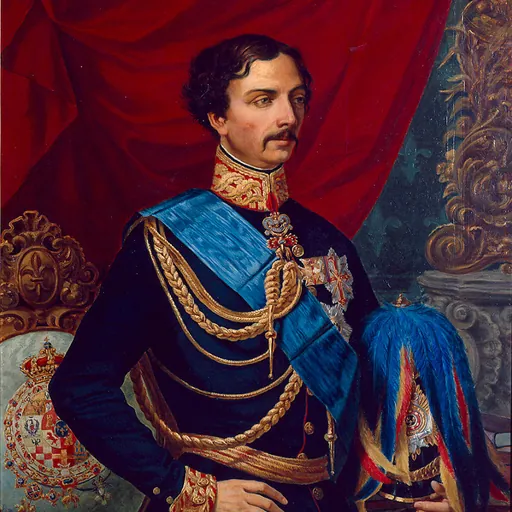
About Carlo III, Duke of Parma
Lived 1823 – 1854 (aged 31). Carlo III, Duke of Parma was a monarch.
Charles III (; 14 January 1823 – 27 March 1854) was the duke of Parma from 1849 to 1854.
He was the son of Duke Charles II of Parma and was educated in Saxony and Vienna. He grew up as a restless young man and traveled extensively while he was the hereditary prince of Lucca. For a time he served in the Piedmontese army with the rank of captain. In 1845, his father arranged his marriage with Princess Louise d'Artois, a wealthy heiress who gave him four children. In December 1847, at the death of Empress Marie Louise, his father became the reigning duke of Parma, but abdicated on 24 March 1849. Charles III became the duke of Parma, Piacenza and the Annexed States.
Charles III owed his throne to the support of Austrian troops. He placed Parma under martial law, inflicted heavy penalties on the members of the late provisional government, closed the university, and instituted a regular policy of persecution. His authoritarian policies made him unpopular. After reigning only five years, he was assassinated in March 1854.
Early life Charles III was born at the Villa delle Pianore near Lucca on 14 January 1823, the son of Charles Louis, Prince of Lucca, (later Duke of Lucca, and Duke of Parma) and his wife Princess Maria Teresa of Savoy (daughter of King Victor Emmanuel I of Sardinia). He was given the baptismal names Ferdinando Carlo Vittorio Giuseppe Maria Baldassarre.
Marriage and issue In 1845, as the duchy of Lucca was in great financial need, Ferdinando's father decided to marry him to a princess with a large dowry. The bride chosen was Princess Louise d'Artois (1819–1864), the only sister of the Legitimist pretender to the throne of France, the Comte de Chambord. She was the daughter of Charles Ferdinand, Duke of Berry and the granddaughter of King Charles X of France. Ferdinando Carlo, who was 22 years old at the time, was initially reluctant to marry her. She was four years older than him; she was his close relative; and he disliked the ideology of her entourage, the legitimist party. He would have rather waited three more years to marry, finding then a bride more of his liking. However, as his father threatened to cut his privy purse, leaving him completely destitute, Ferdinando ended up agreeing with the idea.
Ferdinando Carlo and Louise were cousins and they had known each other since they were children in Vienna. Their wedding took place on 10 November 1845 at Schloss Frohsdorff, Chambords's home in exile, near Lanzenkirchen in Austria, some 30 miles outside of Vienna. Their honeymoon took them to castle Urschendorff in Austria, and afterwards to England, a country where Ferdinand Carlo felt most at ease. The couple's married life was happy for some years. Their first child was born thirteen months after the wedding and three more children followed in quick succession: At this time he was described by a contemporary as "Tall and slim with an open and merry countenance, a light-hearted, light-headed, careless young man". a sister-in-law of the Austrian general governor of Trento. They met in Florence in February 1852, while Charles III was a guest of Leopold II, Grand Duke of Tuscany. In a semi-official visit to Queen Isabella II of Spain in December 1853, Charles III took his mistress with him, bringing about the final breakdown of his marriage. In mid February 1854, Charles III returned to Parma.
Assassination
On Sunday 26 March 1854, around 4:00 p.m, Charles left the Riserva Palace to take a walk on the streets of Parma, as he used to do every afternoon. He was accompanied only by an aide-de-camp, Count Bacinetti. During his walk, he saw his wife, Duchess Louise, who was sitting in a carriage, listening to an open-air concert in a square of Parma. They waved to each other politely. At 5:45 the Duke was returning to his palace; while he was passing by the church of Santa Lucia, he stopped for a moment to ask about the identity of a pretty girl whom he had just seen in an upper window across the street. He was making the inquiry and saluting two soldiers, who walked by him, when he was attacked from behind by two men who were trailing him. One of them knocked the Duke violently and stabbed him deep in the stomach with a triangular blade. Everything happened so fast that Charles initially did not realize what had just transpired and seconds later gasping he said, "My God, I'm done for. They have stabbed me". In the confusion, the two assailants escaped running in opposite directions and mixing with the crowd.
The wounded Duke fell on the ground in a pool of blood with the blade still in his stomach. He was lifted up, and held by his arms and legs. He was carried back to the palace. He made no complaints as his doctors treated his wound, which was deep. He asked if they thought his life was in danger. They lied assuring him that it was not and he passed out. In moments of lucidity, the Duke, realizing the seriousness of his condition repeated: "I am preparing myself for a long journey". The Duke received the last rites and was able to see his wife and their children for a last time. After atrocious suffering, which he endured bravely, he died the following evening, 27 March at 5:30 p.m. He was thirty-one years old.
Charles's body was buried in the Cappella della Macchia near Viareggio. His heart was placed in an urn in the crypt of the Sanctuary of Santa Maria della Steccata in Parma. The Duke's assailants, Ireneo Bochi and Antonio Carra, escaped prosecution. Both were briefly arrested, but as they looked very much alike, witnesses were confounded and their testimonies deemed unreliable. Count Bacinetti, the key witness, was not liked by Duchess Louise, who had him expelled from Parma. Bochi and Carra acted not for political reasons, but for financial gain. It was never clarified who paid them to kill the Duke.
Don’t just read it —
keep it.
Full-length biographies made to live with: read them, listen on the way to work, watch them tonight.
- E-book
- Audio
- Video
Instant download · yours to keep · every purchase keeps this site free
Important facts
People in Carlo III, Duke of Parma's life
Named in this biography and alive at the same time
Related people
Same field, nearest in time
Contemporaries
People whose lives overlapped Carlo III, Duke of Parma's



Frequently asked questions
Who was Carlo III, Duke of Parma?
Duke of Parma and Piacenza from 1849 to 1854
When was Carlo III, Duke of Parma born?
Carlo III, Duke of Parma was born on 14 January 1823 in Lucca.
When did Carlo III, Duke of Parma die?
Carlo III, Duke of Parma died on 27 March 1854 in Parma.
What was Carlo III, Duke of Parma's occupation?
Carlo III, Duke of Parma was a monarch.
What nationality was Carlo III, Duke of Parma?
Carlo III, Duke of Parma's recorded nationality: Duchy of Lucca, Duchy of Parma and Piacenza.
Sources & further reading
· Wikipedia: Carlo III, Duke of Parma
· DBpedia: Charles III of Parma
Cite this page
APA: Biography.guide. (2026). Carlo III, Duke of Parma. https://biography.guide/carlo-iii-duke-of-parma/
MLA: "Carlo III, Duke of Parma." Biography.guide, https://biography.guide/carlo-iii-duke-of-parma/.
Chicago: "Carlo III, Duke of Parma." Biography.guide. https://biography.guide/carlo-iii-duke-of-parma/.
Data last updated: 2026-09-28 · Spot an error? Report a correction.
Portrait: Wikimedia Commons · author & licence
Page generated 2026-10-04 12:54 UTC