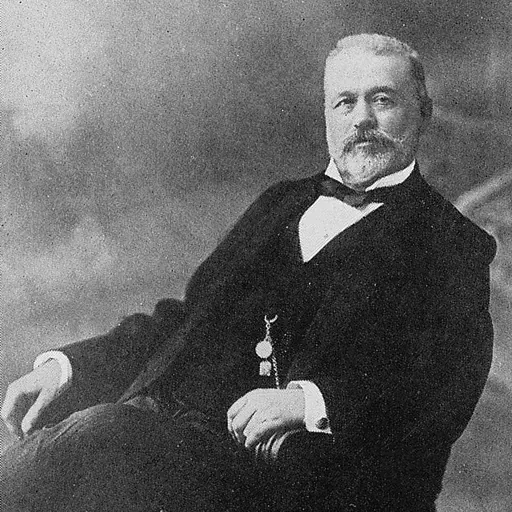
About Carlo Forlanini
Lived 1847 – 1918 (aged 70). Carlo Forlanini was an Italian physician, university teacher and politician.
Carlo Forlanini (11 June 1847 – 25 May 1918) was a medical doctor and professor at the Universities of Turin and Pavia. He was also the inventor of artificial pneumothorax, which was the primary treatment method of pulmonary tuberculosis for the first half of the 20th century and remained in use for severe cases of tuberculosis into the 1970s.
Early life Carlo Forlanini was born in Milan on 11 June 1847, the eldest of four brothers and one sister. His father, Giuseppe Forlanini, was a physician belonging to a bourgeosie family of Milan. He interrupted his medical studies in 1866 to serve under Garibaldi as part of Garibaldi's unification of Italy. Forlanini participated in the Battle of Monte Suello and the Bezzecca. After his return to Pavia he published his first scientific work in 1868 and became friends with Giulio Bizzozero and Camillo Golgi while studying under Paolo Mantegazza at the Mantegazza institute and ophthalmologist Antonio Quaglino. Aided by one of his brothers, Enrico, he designed and experimented with a number of devices and methods for treating tuberculosis. These included attempts to treat tuberculosis and similar diseases of the lungs with forced respiratory movement to increase blood flow to the lungs and improve the patient's air supply, though he found these methods unfruitful. However, something beneficial did emerge from these experiments and from his collaboration with Enrico; some of the world's first hyperbaric chambers. thumb Carlo Forlanini's hyperbaric chamber in the "Museo per la Storia dell'Università di Pavia", Pavia In the course of his work with tuberculosis patients, Forlanini observed a number of them experience spontaneous pneumothorax. These ruptures frequently led to the patients' deaths. Pus and air would flood the pleural cavity, which put pressure on the already struggling lungs in addition to exposing them to further infection. Forlanini, as a handful of previous physicians had, theorized that if pressure could be artificially applied to the lungs with air and without septic fluid, the lung could be allowed to rest, heal, and scar, thus eliminating the cavities formed and inhabited by tuberculosis in the affected lung. In 1882, he published an article describing this theory regarding artificial pneumothorax. Forlanini had an attractive personality, was a great conversationalist, and was cultured in music and art. He was very much the beloved physician to his hospital patients and was content to pursue his researches without desire for personal aggrandisement. His lifelong friend and fellow professor at the University of Pavia, Camillo Golgi, nominated him three times for the Nobel Prize in Medicine, remarking that the invention of pneumothorax was "of great benefit to humanity". However, the three years Golgi nominated Forlanini for the Prize (1915-1918) they were not being awarded at all. left Pneumo device - a diagram of the most essential parts of the deviceThe device used in the treatment, later referred to as "pneumo device", consisted of a hollow needle, a hydraulic pump and a pressure gauge, as well as two nitrogen reservoirs. However, despite all the nominations and efforts, he never received the Prize. The prize Jury voted in favour of other candidates because they deemed the PNX method as neither original nor brilliant enough to award him a Nobel Prize (the operation's high risks for the patiens posed as an important factor in the decision). Following his passing, his many pupils and admirers, both Italian and foreign, wished to create a suitable living memorial to their master. A research fund for the study of tuberculosis was founded in his name shortly after his death. Chiefly through the inspiration of his favorite pupil, Eugenio Morelli (1881-1968), the Carlo Forlanini Institute in Rome was founded in 1934. Morelli was the first director (1934-1945) and he was succeeded by his pupil Attilio Omedei- Zonini (1945–68), who was followed by a series of distinguished Italian physiologists. In order to contain the costs of health care, the company hospital S. Camillo-Forlanini decided to close the hospital Forlanini within December 31, 2008 and to transfer its assets and services to the S. Camillo. 1908 Apparati e tecnica operativa dello pneumotorace artificiale 1909 Cenni storici e critici sul pneumotorace artificiale nella tisi pulmonare. In: Cappelli, ed. Scritti di Forlanini. Bologna, 1928:1013 1912 Il pneumotorace artificiale nella cura della tisi pulmonare. Atti de VII Congresso Internazionale Contra la Tubercolosi. Vol 3 Rome, 182.
Don’t just read it —
keep it.
Full-length biographies made to live with: read them, listen on the way to work, watch them tonight.
- E-book
- Audio
- Video
Instant download · yours to keep · every purchase keeps this site free
Important facts
People in Carlo Forlanini's life
Named in this biography and alive at the same time


Related people
Same field, nearest in time




Contemporaries
People whose lives overlapped Carlo Forlanini's



Frequently asked questions
Who was Carlo Forlanini?
Italian physician (1847-1918)
When was Carlo Forlanini born?
Carlo Forlanini was born on 11 June 1847 in Milan.
When did Carlo Forlanini die?
Carlo Forlanini died on 25 May 1918 in Nervi.
What was Carlo Forlanini's occupation?
Carlo Forlanini was a physician, university teacher and politician.
What nationality was Carlo Forlanini?
Carlo Forlanini was Italian.
Sources & further reading
Cite this page
APA: Biography.guide. (2026). Carlo Forlanini. https://biography.guide/carlo-forlanini/
MLA: "Carlo Forlanini." Biography.guide, https://biography.guide/carlo-forlanini/.
Chicago: "Carlo Forlanini." Biography.guide. https://biography.guide/carlo-forlanini/.
Data last updated: 2026-09-21 · Spot an error? Report a correction.
Portrait: Wikimedia Commons · author & licence
Page generated 2026-09-27 05:00 UTC