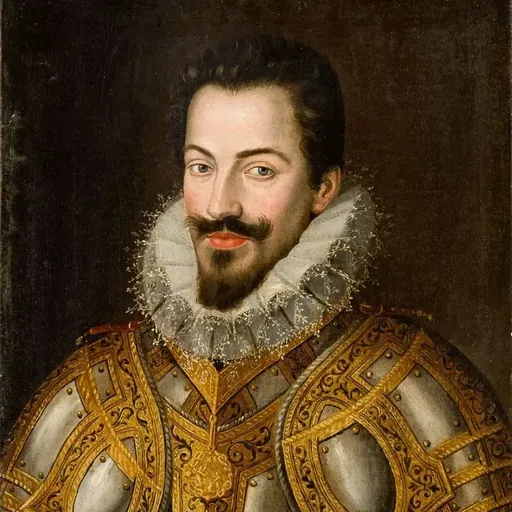
About Carlo Emanuele I, Duke of Savoy
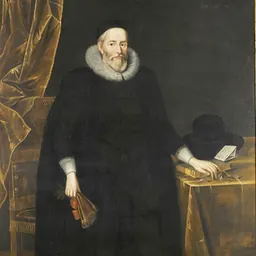
Lived 1562 – 1630 (aged 68). Carlo Emanuele I, Duke of Savoy was an Italian monarch.
Charles Emmanuel I (; 12 January 1562 – 26 July 1630), known as the Great and nicknamed (; "Hothead", a sobriquet attributed to his aggressive and rash military character), was the Duke of Savoy and ruler of the Savoyard states from 30 August 1580 until his death on 26 July 1630, nearly 50 years later. At the time of his death, he was the longest-reigning Savoyard monarch, a record later surpassed by his great-grandson Victor Amadeus II.
A bold and ambitious ruler, Charles Emmanuel sought to expand Savoyard influence throughout northern Italy during a period marked by the French wars of religion, the Thirty Years' War, and intense rivalry between France and Spain. He led multiple military campaigns – annexing Saluzzo, Trino and Alba but losing Pinerolo and some transalpine territories – and often played European powers against each other in complex diplomatic maneuvers. He was also a patron of the arts and a writer himself.
His campaigns against Spanish influence contributed to the emergence of early Italian nationalist sentiment in 17th-century poetry and political discourse.
Biography Charles Emmanuel as a boy with dwarf, portrait by Giacomo Vighi, c. 1572 Charles was born in the Castle of Rivoli in Piedmont, the only child of Emmanuel Philibert, Duke of Savoy and Margaret of France, Duchess of Berry. He succeeded his father as duke on 30 August 1580.
His father was a devout Catholic and advised Charles to follow in his footsteps:
My son, I urge you above all to be a true friend and devout servant of God and His holy Catholic religion, as were your ancestors. Never begin anything without first asking His favor and help, for while we men know little, that Majesty sees all and is eternal wisdom. So long as you rely on Him, you will be safe.
Well-educated and intelligent, Charles spoke Italian, French, Spanish, as well as Latin. He proved an able warrior although short and hunchbacked.
Conflict against France, Geneva and Swiss cantons In the autumn of 1588, taking advantage of the civil war weakening France, he occupied the Marquisate of Saluzzo, which was a French possession since 1548.
The new king, Henry IV, demanded the restitution of that land, but Charles Emmanuel refused, and war ensued. Geneva and Swiss cantons joined the French coalition. However, the offensive against Savoy was repelled (April 1589) and Bern signed a truce (October 1589). In 1590, Charles Emmanuel sent an expedition to Provence in the interests of the Catholic League, and followed it himself later, but the peace of 1593, by which Henry of Navarre was recognized as king of France, put an end to his ambitions.
On 1 August 1591, the Duke of Savoy appointed Tomás Fernández de Medrano as his Secretary of State and War, Medrano's expertise in diplomacy and military strategy would have greatly benefited the duchy's political and military endeavours. The broader conflict involving France and Spain ended with the Peace of Vervins (2 May 1598), which left the current but separate question of Saluzzo unsolved. After the Duke started talks with Spain, Henry threatened to return to war until, with the Treaty of Lyon (17 January 1601), Saluzzo went to Savoy in exchange for Bresse, Bugey, and Gex.
Having made peace with France, Charles Emmanuel attacked the city of Geneva. On 11 December that year, he led his troops to the city during the night and they surrounded the city walls by two in the morning. The Savoyard cuirassiers were ordered to dismount and climb the city walls in full armour as a shock tactic. However, the alarm was raised by a night watchman and Geneva's militia rose to meet the invaders. The attempted raid failed with 54 Savoyards killed and many more captured. Charles Emmanuel's army retreated in a panic and the Savoyard prisoners were executed. The heavy helmets worn by Charles Emmanuel's troops, with visors made in a stylized imitation of a human face, were known as "Savoyard" helmets after this notorious incident. A number of these suits of armour were captured by the Swiss and kept as trophies. The Geneva militia's successful defence of the city's walls is still celebrated as an act of heroism during the annual festival of L'Escalade. The treaty of St. Julien in July 1603 ended the conflict between Savoy and Geneva, with each side restoring occupied territories to the other.
Oration of the Duke
The Duke's Secretary of State and War, Tomás Fernández de Medrano, wrote an important political treatise titled Republica Mista, published in Madrid in 1602, which contains a rare and accurate record of the Duke of Savoy's oration during the French War of Religion. An excerpt reads:
If the lord has the authority to command his vassals, and the vassals are obliged to obey the lord in matters not against God, how much more so in matters that serve Him, glorify Him, and are for your own well-being? For over six hundred years, your ancestors have lived under mine, in Christian faith and obedience to the Catholic, Apostolic, and Roman Church, building temples and observing sacraments for our salvation. How can you abandon your noble and ancient lineage, the honor of your Catholic heritage, and the religion embraced by your ancestors? By aligning with heretics—those who, abandoning God’s Church, have chosen false associations—you now become adversaries of Christ and allies of Satan. There is but one true faith, one Church, and one shepherd: the Roman Pontiff. Do you not see that false religions have sown discord, creating factions and undermining both spiritual and temporal authority? A prince must protect the Catholic faith, for without a strong religion, no empire can remain powerful. Religion and arms united ensure the survival of a monarchy for ages. Let us remember: 'What is best must be honored by the best, and what rules must be served by the ruler.' Turn back to the true faith of your forebears and embrace the unity of Christ's Church, lest you lose the peace and salvation promised to those who remain faithful.
The sister of Louis XIII, Christine Marie, was married to Charles Emmanuel's son, Victor Amadeus in 1619.
Charles Emmanuel took part in the Valtellina War (1620–1626) on the side of the Grisons and France against Spain. He tried with French help to obtain access to the Mediterranean Sea at the expense of Genoa. After Spanish intervention, Genoa was relieved. Charles then successfully defended Verrua Savoia in a long siege by Spanish troops. The Valtellina conflict ended with another compromise: the Treaty of Monçon. The possession of Valtellina was confirmed to the Grisons, with the region keeping its religious autonomy.
Shifting alliances and death
When the French occupied Casale Monferrato during the War of the Mantuan Succession in 1628, Charles Emmanuel allied again with Spain. During the war, he annexed Trino and Alba to the Savoyard state. However, when Richelieu invaded Piedmont and conquered Susa, the duke changed sides again and returned to an alliance with France. Then, after Philip IV of Spain sent two invasion forces from Genoa and Como under Ambrogio Spinola, Charles Emmanuel declared himself neutral.
During the war, also in 1628 Giovanni Antonio Ansaldo, an agent of Charles Emmanuel, recruited and furnished with ample funds a group of Genoese conspirators led by Giulio Cesare Vachero who were to overthrow the Republic of Genoa and place the city under the protection of the Duchy of Savoy. The plot failed and Vachero and his accomplices were sentenced to death.
At about the same time that Tassoni was inspired to write the Filippiche, Fulvio Testi, a young poet at the court of the duke of Este, published a collection of poems dedicated to Charles Emmanuel. Not all the poems were of a patriotic nature, but those that were, clearly revealed the feelings Charles Emmanuel had stirred in freedom-loving Italians.
Don’t just read it —
keep it.
Full-length biographies made to live with: read them, listen on the way to work, watch them tonight.
- E-book
- Audio
- Video
Instant download · yours to keep · every purchase keeps this site free
Important facts
People in Carlo Emanuele I, Duke of Savoy's life
Named in this biography and alive at the same time

Related people
Same field, nearest in time
Contemporaries
People whose lives overlapped Carlo Emanuele I, Duke of Savoy's

Frequently asked questions
Who was Carlo Emanuele I, Duke of Savoy?
duke of Savoy
When was Carlo Emanuele I, Duke of Savoy born?
Carlo Emanuele I, Duke of Savoy was born on 12 January 1562 in Rivoli.
When did Carlo Emanuele I, Duke of Savoy die?
Carlo Emanuele I, Duke of Savoy died on 26 July 1630 in Savigliano.
What was Carlo Emanuele I, Duke of Savoy's occupation?
Carlo Emanuele I, Duke of Savoy was a monarch.
What nationality was Carlo Emanuele I, Duke of Savoy?
Carlo Emanuele I, Duke of Savoy was Italian.
Sources & further reading
· Wikipedia: Carlo Emanuele I, Duke of Savoy
Cite this page
APA: Biography.guide. (2026). Carlo Emanuele I, Duke of Savoy. https://biography.guide/carlo-emanuele-i-duke-of-savoy/
MLA: "Carlo Emanuele I, Duke of Savoy." Biography.guide, https://biography.guide/carlo-emanuele-i-duke-of-savoy/.
Chicago: "Carlo Emanuele I, Duke of Savoy." Biography.guide. https://biography.guide/carlo-emanuele-i-duke-of-savoy/.
Data last updated: 2026-09-24 · Spot an error? Report a correction.
Portrait: Wikimedia Commons · author & licence
Page generated 2026-10-04 09:14 UTC