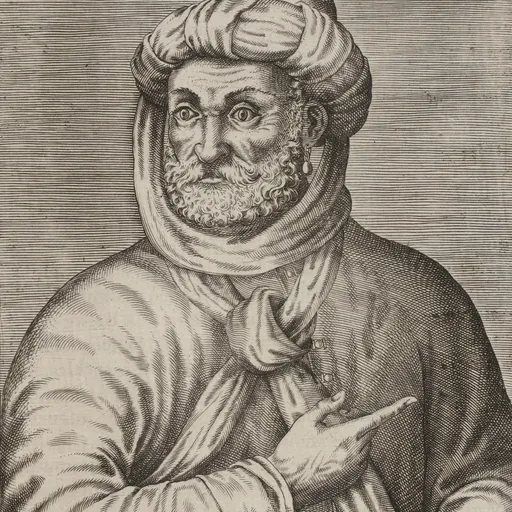
About Ahmad al-Mansur
Lived 1549 – 1603 (aged 53–54). Ahmad al-Mansur was a monarch, poet, writer and military leader.
Ahmad al-Mansur (; 1549 – 25 August 1603 ), also known as al-Dhahabī was the Saadi Sultan of Morocco from 1578 to his death in 1603, the sixth and most famous of all rulers of the Saadis. Ahmad al-Mansur was an important figure in both Europe and Africa in the sixteenth century. His powerful army and strategic location made him an important power player in the late Renaissance period. He has been described as "a man of profound Islamic learning, a lover of books, calligraphy and mathematics, as well as a connoisseur of mystical texts and a lover of scholarly discussions."
Early life Ahmad was the fifth son of Mohammed ash-Sheikh, who was the first Saadi sultan of Morocco. His mother was Lalla Masuda. After the murder of Mohammed in 1557 and the following struggle for power, two of his sons, Ahmad al-Mansur and Abd al-Malik, had to flee their elder brother Abdallah al-Ghalib (1557–1574), leave Morocco and stay abroad until 1576. The two brothers spent 17 years among the Ottomans between the Regency of Algiers and Constantinople, and benefited from Ottoman training and contacts with Ottoman culture. More generally, Ahmad al-Mansur "received an extensive education in Islamic religious and secular sciences, including theology, law, poetry, grammar, lexicography, exegesis, geometry, arithmetics, algebra, and astronomy."
Battle of Ksar el-Kebir In 1578, Ahmad's brother, Sultan Abu Marwan Abd al-Malik I, died in battle against the Portuguese army at Ksar-el-Kebir. Ahmad was named his brother's successor and began his reign amid newly won prestige and wealth from the ransom of Portuguese captives.
Reign (1578–1603) Al-Mansur began his reign by leveraging his dominant position with the vanquished Portuguese during prisoner ransom talks, thus collecting enough money to fill the Moroccan royal coffers. Shortly after, he commissioned the great architectural symbol of this new birth of Moroccan power, the El Badi Palace in Marrakesh, a huge and lavish riad-style palace which he used to receive ambassadors and to host celebrations. Construction began in December 1578 and was only finished in 1593 or 1594.
Eventually, the coffers began to run dry due to the great expense of supporting the military, extensive spy services, the palace and other urban building projects, a royal lifestyle and a propaganda campaign aimed at building support for his controversial claim to the Caliphate. In a letter dated 1 May 1601, he wrote that he also had ambitions to colonize the New World.
Relations with the Ottoman Empire
Al-Mansur had ambivalent relations with the Ottoman Empire. At the very start of his reign, he formally recognized the suzerainty of the Ottoman sultan, as Abd al-Malik had done, while still remaining independent in practice.
Unlike Abd al-Malik, who won his battle with Ottoman support, Ahmad al-Mansur triumphed at the Battle of Wadi al-Makhazin without any Ottoman aid. His growing suspicion that the Ottomans had tried to assassinate him, especially since the earliest rebellions were carried out by figures with Ottoman ties, combined with his conviction that he was the Ottomans’ equal rather than a subordinate and indeed the rightful leader of the Islamic world, caused al-Mansur to believe that the Ottomans had taken caliphal authority away from Prophet's family.
All of the above led him to quickly alienate the Ottomans after he favorably received the Spanish embassy in 1579, who brought him lavish gifts, and then reportedly trampled the symbol of Ottoman suzerainty before a Spanish embassy in 1581. As a result, he minted coins in his own name and had Friday prayers and the khutba delivered in his name instead of in the name of Murad III, the Ottoman sultan. In 1600 Ahmad al-Mansur sent his Secretary Abd el-Ouahed ben Messaoud (pictured) as ambassador of Morocco to the court of Queen Elizabeth I of England to negotiate an alliance against Spain. In response to the removal of his name from Friday prayers, Murad III began preparations for an attack on Morocco. After getting word of this, al-Mansur rushed to send an ambassador to Istanbul with sizeable gifts and the attack was cancelled. He paid a tribute of over 100,000 gold coins, agreed to show respect to the Ottoman sultan, and in return, was left alone. In 1583, the Saadian and Ottoman sultans even tentatively discussed a joint military operation against the Spanish in Oran. and issued propaganda that undermined the Ottoman sultan's claim as leader of all Muslims. Al-Mansur even felt confident enough after 1587 to drop his regular payments to Murad III. Despite the limits of his power, he officially proclaimed himself caliph in the later part of his reign, seeing himself as rival, rather than subordinate, of the Ottomans, and even as the rightful leader of the Muslim world. The annexed territories included Tuat, Jouda, Tamantit, Tabelbala, Ourgla, Tsabit, Tekorareen, and others.
Annexation of Chinguetti The Saadians repeatedly tried to control Chinguetti, and the most prominent attempts were made during the reign of Sultan Muhammad al-Shaykh, but control of it did not come until the reign of Ahmed al-Mansur, who stripped a campaign in 1584 led by Muhammad bin Salem in which he managed to seize control of Chinguetti, in modern day Mauritania. Though the Songhai met them at the Battle of Tondibi with a force of 40,000, they lacked the Moroccans’ gunpowder weapons and quickly fled. Ahmad advanced, sacking the Songhai cities of Timbuktu and Djenné, as well as the capital Gao. Despite these initial successes, the logistics of controlling a territory across the Sahara soon grew too difficult, and the Saadians lost control of the cities not long after 1620. who was based in Marrakesh, and by Abou Fares Abdallah, who was based in Fez, having only local power. He was buried in the mausoleum of the Saadian Tombs in Marrakesh. Well-known writers at his court were Ahmed Mohammed al-Maqqari, Abd al-Aziz al-Fishtali, Ahmad Ibn al-Qadi and Al-Masfiwi.
Through astute diplomacy, al-Mansur resisted the demands of the Ottoman sultan to preserve Moroccan independence. al-Mansur excelled in the art of the balancing of power through diplomacy, playing the Europeans and Ottomans against one another. Eventually, he spent far more than he collected in revenue. He attempted to expand his holdings through conquest, and although initially successful in their military campaign against the Songhai Empire, the Moroccans found it increasingly difficult to maintain control over conquered locals as time went on. Meanwhile, as the Moroccans continued to struggle in Songhai, their power and prestige on the world stage declined significantly.
The royal library which he founded, known as the Zaydani Library, was eventually stolen from Sultan Zidan Abu Maali by French pirates and was taken to Spain, where most of it burned in an accidental fire.
Popular culture al-Mansur is featured as the playable leader of the Moroccan civilization in the 2013 computer strategy game Civilization V: Brave New World.
Don’t just read it —
keep it.
Full-length biographies made to live with: read them, listen on the way to work, watch them tonight.
- E-book
- Audio
- Video
Instant download · yours to keep · every purchase keeps this site free
Important facts
Family & relationships
People in Ahmad al-Mansur's life
Named in this biography and alive at the same time
Related people
Same field, nearest in time


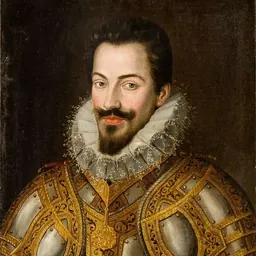
Contemporaries
People whose lives overlapped Ahmad al-Mansur's





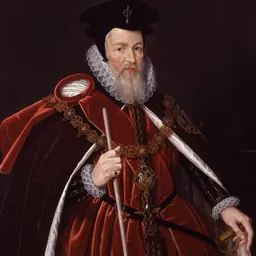
Frequently asked questions
Who was Ahmad al-Mansur?
Moroccan Sultan of the Saadi dynasty (1549-1603) (r.1578-1603)
When was Ahmad al-Mansur born?
Ahmad al-Mansur was born in 1549 in Fez.
When did Ahmad al-Mansur die?
Ahmad al-Mansur died on 25 August 1603 in Fez.
What was Ahmad al-Mansur's occupation?
Ahmad al-Mansur was a monarch, poet, writer and military leader.
Sources & further reading
Cite this page
APA: Biography.guide. (2026). Ahmad al-Mansur. https://biography.guide/ahmad-al-mansur/
MLA: "Ahmad al-Mansur." Biography.guide, https://biography.guide/ahmad-al-mansur/.
Chicago: "Ahmad al-Mansur." Biography.guide. https://biography.guide/ahmad-al-mansur/.
Data last updated: 2026-09-22 · Spot an error? Report a correction.
Portrait: Wikimedia Commons · author & licence
Page generated 2026-09-27 05:02 UTC