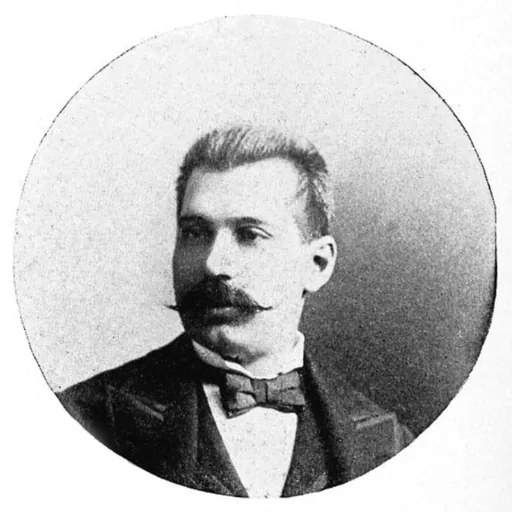
About Carlo Curti
Lived 1859 – 1922 (aged 63). Carlo Curti was an Italian composer, conductor, mandolinist, violinist and music teacher.
Carlo Curti (6 May 1859 – 8 May 1922), also known as Carlos Curti, was an Italian musician, composer and bandleader. He moved to the United States during his mid-teen years, where he popularized the mandolin in American music. He is credited by musicologist Paul Sparks with starting a national "grass-roots mandolin orchestra craze" that lasted from 1880 until the 1920s.
He also contributed to Mexican society in 1884 by creating one of Mexico's oldest orchestras, the Mexican Typical Orchestra. The orchestra under his leadership represented Mexico at the New Orleans Cotton Exhibition. As with his Spanish Students, Curti dressed his Mexican band in costumes, choosing the charro cowboy outfit. The patriotic value of having Mexico represented on the international stage gave a boost to mariachi bands (which had normally been repressed by social elites); the mariachis began using charro outfits as Curti's orchestra had done, expressing pride in being Mexican. Curti's Orquestra Típica Mexicana has been called the "predecessor of the Mariachi bands."
He was an orchestra leader, composer, educator at the Conservatorio Nacional de Música (Mexican National Conservatory of Music), xylophonist, violinist, mandolinist and author of a mandolin method. He directed the orchestra at the New York's Waldorf-Astoria hotel in his later career.
Also known as a composer of zarzuelas and dance music, among his most noted tunes are "La Tipica" and "Flower of Mexico". His brother was harpist Giovanni (Juan or John) Curti, who also was a member of his orchestra. About five years after he arrived in the United States (c.1875), Curti saw the opportunity to imitate one of the great acts of his day, the Estudiantina Figaro, also known as the Estudiantina Figueroa or "Spanish Students" troupe, a costumed, dancing, bandurria-playing group from Spain that was touring in the United States (as well as the United Kingdom and parts of South America in the early 1880s). Curti had experience in show business, working with a small traveling opera, along with his brother John. They left an impression on the people who saw them, and the mandolin, rather than the bandurria became established in the United States and Europe.
Flute. Anastasio Meneses. Harp. Juan Curti. Salterios. Maria Encarnación García and Mariano Aburto. Garcia played a 99 string Salterio that resembled a dulcimer. First Bandolóns. Andrés Díaz de la Vega. Pedro Zariñana, Mariano Pagani y Apolonio Domínguez. Bandolóns were shaped like a cittern or bouzouki with 18 strings (6 courses of 3 strings). Second Bandolóns. Vidal Ordaz, Vicente Solís y José Borbolla. Guitars. Pantaleón Dávila and Pedro Dávila. Violins. Antonio Figueroa, Jose Molina, and Enrique Palacios. Viola: Buenaventura Herrera. Cellos. Rafale Galindo and Eduardo Gabrielli. Xylophone. Carlos Curti.
Advertisement for the Mexican Typical orchestra from the Los Angeles Herald, January 21, 1886.
First concert The orchestra debuted Saturday night September 20, 1884 at a private concert, held at the Conservatory Orchestra's Theatre and alternated in the concert with the Conservatory Orchestra. The Mexican Typical Orchestra played the following five works during the third part of programming: The president wanted to bring order and stability and modernity to Mexico, and music was one of the tools he used. The "Aires Nacionales Mexicanos" (Mexican National Tunes) put together by Curti along with ethnic instruments like the salterio impressed the General.
Last years After fourteen years in Mexico, Curti returned to New York in 1897. At the beginning of the 1900s, he was conductor of the Waldorf–Astoria Orchestra for several years. He also formed another group called "Orquesta Mexicana Curti" with whom made recordings for Columbia Records in 1905, 1906 and 1912. His later life was marked by tragic events: he suffered financial difficulties and his wife Carmen shot herself on January 28, 1914, after he had lost his job at the Waldorf-Astoria. My Irish Home. Words by Joe A. Burgess. (August, 1892) La Tipica. Polka. (1895) Florera. Polka. (1891) Nueva Espana. (1894) Una boda en Santa Lucia. (1894) La patria. Military march. (1895) Merci. Gavotte. (1896) El Gondolero. Waltz, (1896) Serenate. (1897) Siempre alegre. Polka, (1897) Il n'y a pas de quoi. Welcome. Schottische. (1897) La cuarta plana. (1899) Los de abajo. (1899) El novio de Tacha. (1900) Benedictina, en "La cuarta plana". Gavota. (1901) Bolero, en "La cuarta plana". (1901) Diablito. Polka. (1901) Nemrod, rey de Babilonia. Operetta. Sala Wagner, (1901) Saravia, danza en la zarzuela La cuarta plana. (1901) Tango, danza en la zarzuela "La cuarta plana". (1901) Under the Bamboo Tree. Mandolin duo. Arranged by Carlo Curti (1902) While the Convent Bells Were Wringing. Mandolin duo. Arranged by Carlo Curti (1902) including: Saravia, Antonio Vargas, 1902 The flower of Mexico, Arthur Pryor's Band, 1904 Tipica polka, W. Eugene Page; D. F. Ramseyer, 1909 Blue ribbon, Conway's Band, 1914 La tipica, Trio Romano[ i.e., Cibelli's Neapolitan Orchestra], 1921 La cuarta plana, Banda de Zapadores, 1905 La cuarta plana, Trío Arriaga, 1905 Canción de la saravia, Esperanza Iris, 1906
Columbia Estudiantina Walzer by Waldteufel with the Columbia Orchestra, with Kastagnetten; La tipica polka by Carlo Curti with the Orquesta Espanola La Tipica, F Lahoz; Carlos Curti; Curti's Band.; Banda Española, 1910
Zonophone Flower of Mexico, Hager's Orchestra, 1906
Modern Among modern reinterpretations are: La Tipica, Los Alegres de Terán, 1961 La Tipica, Mariachi Vargas de Tecalitlán, 1963 La Tipica, Flaco Jiménez, 1988 La Tipica, Nashville Mandolin Ensemble, 1998 La Tipica, Terry Waldo, 2004 La Tipica, Milwaukee Mandolin Orchestra, 2007 Flower of Mexico, Milwaukee Mandolin Orchestra, 2015
Don’t just read it —
keep it.
Full-length biographies made to live with: read them, listen on the way to work, watch them tonight.
- E-book
- Audio
- Video
Instant download · yours to keep · every purchase keeps this site free
Important facts
People in Carlo Curti's life
Named in this biography and alive at the same time


Related people
Same field, nearest in time


Contemporaries
People whose lives overlapped Carlo Curti's


Frequently asked questions
Who was Carlo Curti?
Italian musician and bandleader (1859–1922)
When was Carlo Curti born?
Carlo Curti was born on 6 May 1859 in Gallicchio.
When did Carlo Curti die?
Carlo Curti died on 8 May 1922 in Mexico City.
What was Carlo Curti's occupation?
Carlo Curti was a composer, conductor, mandolinist, violinist and music teacher.
What nationality was Carlo Curti?
Carlo Curti was Italian.
Sources & further reading
Cite this page
APA: Biography.guide. (2026). Carlo Curti. https://biography.guide/carlo-curti/
MLA: "Carlo Curti." Biography.guide, https://biography.guide/carlo-curti/.
Chicago: "Carlo Curti." Biography.guide. https://biography.guide/carlo-curti/.
Data last updated: 2026-09-23 · Spot an error? Report a correction.
Portrait: Wikimedia Commons · author & licence
Page generated 2026-09-27 05:07 UTC