
About Carlo Azeglio Ciampi
Lived 1920 – 2016 (aged 95). Carlo Azeglio Ciampi was an Italian banker, economist and politician.
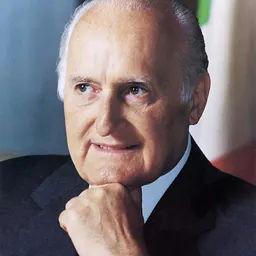
Carlo Azeglio Ciampi (; 9 December 1920 – 16 September 2016) was an Italian politician, statesman and banker who was the president of Italy from 1999 to 2006 and prime minister of Italy from 1993 to 1994.
A World War II veteran, Ciampi had fought for the Italian resistance movement after he evaded capture from the Wehrmacht in 1943. Afterwards, he became a prominent banker in the First Italian Republic, gradually rising in the ranks of the Bank of Italy before becoming its governor in 1979. In his tenure as governor, the Italian lira was devalued amid conflict with Prime Minister Bettino Craxi in the mid-1980s, and Italy withdrew from the European Monetary System in 1992. Besides his political career, he held numerous intergovernmental positions, including as Chairman of the Interim Committee of the International Monetary Fund from 1998 to 1999.
Following the Tangentopoli scandal that precipitated the collapse of the First Republic, Ciampi, who was politically independent, was asked to become Prime Minister by President Oscar Luigi Scalfaro in April 1993, which he accepted. His short tenure was mainly characterised by addressing political corruption uncovered by Tangentopoli, before Silvio Berlusconi's win in the 1994 election ushered in the Second Republic. He would then serve as Minister of the Treasury from 1996 to 1999 in the First Prodi and First D'Alema governments during the country's transition into the eurozone, for which he chose Leonardo da Vinci's Vitruvian Man for the design of the one euro coin.
He succeeded Scalfaro as President of Italy in the 1999 Italian presidential election, and held the office for seven years until his resignation in May 2006. His broad, unifying rhetoric and non–interventionist role as head of state meant he retained the role's largely ceremonial powers. However, his relationship with Berlusconi in the latter's second and third governments was often strained, publicly opposing Italian military involvement in the Iraq War in 2003 and opposing Berlusconi regarding the resignation of Minister of Foreign Affairs Renato Ruggiero in 2002. He enjoyed high approval ratings by the Italian public throughout his presidency and was well regarded in Italian politics, but chose not to run for re–election in 2006, and was succeeded by Giorgio Napolitano, whose interventionist approach shifted the role of the Presidency.
Following his resignation, he served as Senator until his death in 2016 at the age of 95, being the only living former Italian President and the oldest head of state from Europe and the second oldest in the world.
Biography Education Ciampi was born in Livorno to Pietro Ciampi, an optician, and his wife, Marie (née Masino). He received a B.A. in ancient Greek literature and classical philology in 1941 from the Scuola Normale Superiore di Pisa, one of the country's most prestigious universities, defending a thesis, entitled Favorino d'Arelate e la consolazione Περὶ φυγῆς, under the direction of the Hellenist Augusto Mancini. He had also studied literature in Leipzig University from 1940-1941 and would receive an honorary doctorate from Leipzig University in 2001. In 1941, he was called to military duty in Albania as a lieutenant. On 8 September 1943, on the date of the armistice with the Allies, he refused to remain in the Fascist Italian Social Republic, and took refuge in Abruzzo, in Scanno. He subsequently managed to pass the lines and reach Bari, where he joined the Partito d'Azione and thus the Italian resistance movement. In 1946 he married Franca Pilla. That same year, he obtained a B.A. in law from the University of Pisa and began working at the Banca d'Italia. He also joined the CGIL (Trade Union), which he left in 1980.
Bank of Italy In 1960, he was called to work in the central administration of the Bank of Italy, where he became Secretary General in 1973, Vice Director General in 1976, and Director General in 1978. In October 1979, he was nominated Governor of the Bank of Italy and President of the national Bureau de Change, positions he filled until 1993.
Political career Ciampi was the first non-parliamentarian prime minister of Italy in more than 100 years. From April 1993 to May 1994 he oversaw a technical government. Later, as treasury minister from 1996 to May 1999 in the governments of Romano Prodi and Massimo D'Alema, he was credited with adopting the euro currency. He chose the Italian design for the 1-euro coin, whereas all others were left to a television vote among some candidates the ministry had prepared. Ciampi chose the Vitruvian Man of Leonardo da Vinci, on the symbolic grounds that it represented man as a measure of all things, and in particular of the coin: in this perspective, money was at the service of man, instead of its opposite. The design also fitted very well on the bimetallic material of the coin.
According to the Italian weekly Famiglia Cristiana, in 1993 Ciampi was a member of the regular Masonic Lodge "Hermes" of Livorno, which was affiliated with the Grand Orient of Italy and linked to the Rito Filosofico Italiano.
President (1999–2006)
Ciampi meets U.S. President George W. Bush at the Quirinale Palace, 7 April 2005 Ciampi was elected with a broad majority, and was the second president ever to be elected at the first ballot (when there is a requirement of a two-thirds majority) in a joint session of the Chamber of Deputies, the Italian Senate and representatives of the Regions. He usually refrained from intervening directly in the political debate while serving as president. He often addressed general issues, without mentioning their connection to the current political debate, in order to state his opinion without being too intrusive. His interventions frequently stressed the need for all parties to respect the Constitution and observe the proprieties of political debate. He was generally held in high regard by all political forces represented in the parliament.
The possibility of persuading Ciampi to stand for a second term as president by the election 2006 – the so-called Ciampi-bis – was widely discussed, despite his advancing age, but it was officially dismissed by Ciampi himself on 3 May 2006: "None of the past nine presidents of the Republic has been re-elected. I think this has become a meaningful rule. It is better not to infringe it". Ciampi, whose mandate was due to expire on the 18th, resigned on the 15th. His successor, Giorgio Napolitano, took the oath on the same day.
As head of state of the host country, he officially declared the 2006 Winter Olympics open on 10 February 2006. As president, Ciampi was not considered to be close to the positions of the Vatican and the Catholic Church, in a sort of alternate after the devout Oscar Luigi Scalfaro. He often praised patriotism, not always a common feeling because of its abuse by the Italian Fascist regime.
Death He died in Rome on 16 September 2016 at the age of 95. His funeral was officiated at the Church of San Saturnino in Rome on 19 September by Archbishop Vincenzo Paglia. A national day of mourning was proclaimed on the same day and flags were flown at half-mast. 2001: – Knight Grand Cross of the Royal Norwegian Order of St. Olav 2001: Medal of the Oriental Republic of Uruguay. 2001: – Grand Cross of the Grand Order of King Tomislav (19 October 2001) 2001: Honorary doctorate from the University of Leipzig Faculty of Economics 2002: – Grand Star of Honour for Services to the Republic of Austria 2002: – Grand Cross (or 1st Class) of the Order of the White Double Cross (Slovakia) 2002: – Grand Collar of the Order of Prince Henry (Portugal, 22 February 2002) 2002: – Grand Cross with Collar of the Order of Merit of the Hungarian Republic 2002: – Collar Pro Merito Melitensi of the Sovereign Military Order of Malta 2003: – Collar of the Order of the Star of Romania 2003: – Honorary Recipient of the Order of the Crown of the Realm (Malaysia) 2004: – Collar of the Order of the Cross of Terra Mariana (Estonia) 2004: – Commander Grand Cross with Chain of the Order of Three Stars (Latvia) (Malta, 19 May 2005) Honorary Member of the Xirka Ġieħ ir-Repubblika 2005: Charlemagne Prize 2005: – Grand Cross of the Order of Saint-Charles (Monaco, 13 December 2005) March 2005: honorary Doctor of Civil Law degree form the Oxford University – Grand Cross of the Order of the Southern Cross (Brazil) 2008: Honorary doctorate from the Economics Faculty of the University of Augsburg 15 June 2005: honorary doctorate by the of Paris.
Don’t just read it —
keep it.
Full-length biographies made to live with: read them, listen on the way to work, watch them tonight.
- E-book
- Audio
- Video
Instant download · yours to keep · every purchase keeps this site free
Important facts
Family & relationships
People in Carlo Azeglio Ciampi's life
Named in this biography and alive at the same time





Related people
Same field, nearest in time

Contemporaries
People whose lives overlapped Carlo Azeglio Ciampi's




Frequently asked questions
Who was Carlo Azeglio Ciampi?
President of Italy from 1999 to 2006
When was Carlo Azeglio Ciampi born?
Carlo Azeglio Ciampi was born on 9 December 1920 in Livorno.
When did Carlo Azeglio Ciampi die?
Carlo Azeglio Ciampi died on 16 September 2016 in Rome.
What was Carlo Azeglio Ciampi's occupation?
Carlo Azeglio Ciampi was a banker, economist and politician.
What nationality was Carlo Azeglio Ciampi?
Carlo Azeglio Ciampi was Italian.
Sources & further reading
· Wikipedia: Carlo Azeglio Ciampi
· DBpedia: Carlo Azeglio Ciampi
Cite this page
APA: Biography.guide. (2026). Carlo Azeglio Ciampi. https://biography.guide/carlo-azeglio-ciampi/
MLA: "Carlo Azeglio Ciampi." Biography.guide, https://biography.guide/carlo-azeglio-ciampi/.
Chicago: "Carlo Azeglio Ciampi." Biography.guide. https://biography.guide/carlo-azeglio-ciampi/.
Data last updated: 2026-09-20 · Spot an error? Report a correction.
Page generated 2026-09-27 05:25 UTC