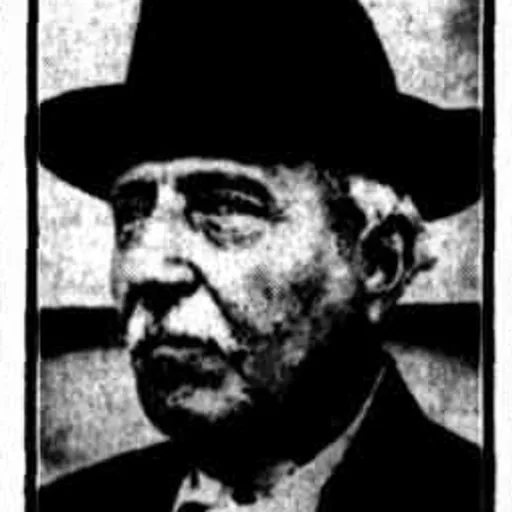
About Carlile Vernon
Born 1857. Carlile Vernon was a musician.
Charles Trussell aka Carlile Vernon, (1860, London, England – 1946, Bauple, Queensland, Australia ) was a prominent musician in brass bands (British style) both in Australia and New Zealand during the late nineteenth and early twentieth centuries. He served as band master of a number of bands in both countries and was a significant composer and arranger of brass band music. He also was an adjudicator at brass band contests. He is also believed to have written vocal music. in India. During this time he played euphonium and studied musical composition and harmony.
Australia In 1887, after 13 years service in the army, Trussell followed relatives to Australia and settled in Maryborough, before moving to Tasmania. Shortly thereafter he was appointed conductor of the Latrobe Brass (later Federal) Band. He also became conductor of the Deloraine Band, conducted a church choir, and later on entertained as part of a group called the Federal Minstrels. In 1895 he was married to Minnie Ada Biggins (b.1863 in Tasmania)
New Zealand In 1895, Trussell moved to New Zealand settling in Auckland where he was appointed band master of the Newton (later Auckland Battalion) Band. He also judged band contests, the first being the 1897 Goldfields Band Contest in Te Aroha. He was a prominent member of the North Island Brass Band Association. During this time, he played cricket for the St. Albans Cricket Club in Auckland.
By 1900, he had moved to Nelson and was band master of the Nelson Garrison Band. It was about this time he had composed the Alexandra Dance. In 1901 he composed the march Joys of Life for the national band contest held that year in New Plymouth.
In November 1903 Trussell moved back to the North Island, to Waihi. As band master of the Waihi Federal Band he improved the standard of the band to one of the best in the country.
During this time his compositional output increased, with several marches written each year (including Rimutaka (1905), Mount Egmont (1905), N. I. B. B. A. (1907)), arrangements of operatic selections for contests (including L’ Ebreo (1904) and La Traviata (1906)) and a fantasias Concordia (1903) and The Tournament (1906).
He also competed in lawn bowling competitions in the region.
In April 1907 Trussell hosted the prestigious Besses o' th' Barn Band from England as part of their world tour. Shortly after this, in May 1907, he and his wife were farewelled from Waihi where the town presented him with a marble clock in recognition of the contribution made to the town. Silver hair brushes were presented to his wife. In the press and in band circles, Trussell had become known as "the New Zealand March King".
Confusion has arisen about a later band master of the Waihi Federal Band. Between 1910 and 1914, and again in 1925, the band master was a Mr. T. Russell. It has been assumed that Trussell and Russell were in fact the same person with Trussell's name being a contraction of T. Russell used for composing purposes. It seems this is a misunderstanding and that Charles Trussell and T. Russell appear to be two different people, as both apparently were conducting different bands in different places at the same time. Mr. T. Russell, like Trussell, appears to have originally come from England, but when he returned in 1925, he is recorded as having come back from England. He also apparently returned to England due to ill health. Charles Trussell would have been both coming from and returning to Australia rather than England at this time.
Return to Australia In 1907 Trussell moved back to Australia, this time settling in Ipswich, Queensland. He was appointed conductor of the Ipswich Vice-Regal Band, a position he held until his retirement in 1923. His wife died aged 58 in 1925 after an illness.
He then moved to live near Bauple, Queensland. He continued playing with bands and was active composing and arranging (mostly contest pieces for brass bands) during this time receiving high praise for the quality of his music, especially his various selections from Verdi operas
Alexandra (Dance) c. 1899 Annexation (March) c. 1903 Aviator (March) c. 1914 Bridal Rose (Waltz) c. 1916 Capiscolus (March) c. 1896 A copy of this piece with Trussell's name stamped on it is held in the Kerepehi Brass Band Library. Concordia (Fantasia) c. 1903 Grand Junction (March) 1905 Dedicated to the Grand Junction Mine in Waihi Guy Fawkes (March) c. 1900 Gympie City (March) I Masnadieri (Selection) c. 1937 (by Verdi arr. C. Trussell) Il Bravo (Selection) (by Mercadante, arr. Trussell) c. 1910 Ingomar (March) c. 1910 La Mia Speranza (Fantasia) c. 1901 arr. Trussell) (Some publications spell Speranizo rather than Speranza) La Traviata (Selection) (Verdi arr. Trussell) 1906, Test Piece Waihi Band Contest., Luisa Miller (Selection) (by Verdi arr. Trussell) c. 1906, Used in 1920 for Brisbane contest Maritana (Selection) (by Wallace arr. Trussell) c. 1927 Martha Hill (March) 1905, Dedicated to the Martha Hill Mine, Waihi Mount Egmont(March) 1905, Composed as the A Grade Test March (quickstep) for the Hāwera Contest, 1906 N I B B A (North Island Brass Band Association) (March) c. 1907, Composed as the A Grade Test March (quickstep) for the New Plymouth Contest, 1908 Our Journal (Trio – cornet, tenor horn, trombone) Pagliacci (Selection) (Verdi arr. Trussell) c. 1920, written for the Bundaberg Contest 1920 used as the A Grade Test March (quickstep) for the Dunedin Contest, 1923 The Pateena Valse (Waltz) (piano), Pride of the North (March) c. 1914 Princess Royal (Gavotte) (March?) c. 1899 Possibly the same piece as Queen of the South. Queen of the South (Waltz) c. 1917, Possibly the same piece as Queen of the Earth. Reminisences of the Opera (Selection) (arr. Trussell) c. 1900 Rifle Volunteers (March) c. 1903 Rouge et Noir (Overture) c. 1918 Possibly same piece as Scotch Melodies St. Kilda (March) c. 1923 Tiberius (March) (composed as Carlile Vernon) Trombone Tutor (Method Book, published by John E. Dallas and Sons.) (written as Carlile Vernon) Victorine (Intermezzo?) (March?) c. 1903. stamped with C. Trussell. So this is likely to have been mistaken as a composition by Trussell. Volunteers Parade (Quick March) c. 1903 Wairarapa (March) c. 1926, Composed as the A Grade Test March (quickstep) for the Wellington Contest, 1927 Weel May the Boatie Row (March) c. 1901 With All My Heart (Cornet Solo) c. 1925
Don’t just read it —
keep it.
Full-length biographies made to live with: read them, listen on the way to work, watch them tonight.
- E-book
- Audio
- Video
Instant download · yours to keep · every purchase keeps this site free
Important facts
Related people
Same field, nearest in time



Frequently asked questions
Who was Carlile Vernon?
musician in Oceania (1860-1946)
When was Carlile Vernon born?
Carlile Vernon was born on 18 June 1857.
What was Carlile Vernon's occupation?
Carlile Vernon was a musician.
Sources & further reading
Cite this page
APA: Biography.guide. (2026). Carlile Vernon. https://biography.guide/carlile-vernon/
MLA: "Carlile Vernon." Biography.guide, https://biography.guide/carlile-vernon/.
Chicago: "Carlile Vernon." Biography.guide. https://biography.guide/carlile-vernon/.
Data last updated: 2026-09-22 · Spot an error? Report a correction.
Portrait: Wikimedia Commons · author & licence
Page generated 2026-09-27 05:02 UTC