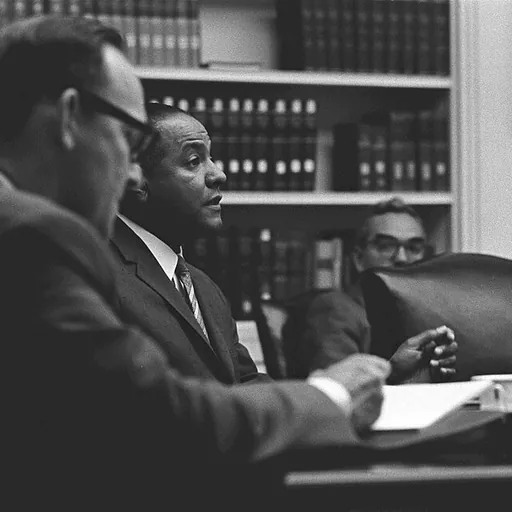
About Carl Rowan
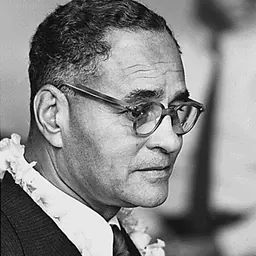
Lived 1925 – 2000 (aged 75). Carl Rowan was an American diplomat, author, writer and journalist.
Carl Thomas Rowan (August 11, 1925 – September 23, 2000) was an American journalist, author and government official whose columns were syndicated across the U.S. At one point, he was the highest ranking African American in the United States government.
Early life Carl Rowan was born in Ravenscroft, Tennessee, the son of Johnnie, a cook and cleaner, and Thomas Rowan, who stacked lumber. He was raised in McMinnville, Tennessee, during the Great Depression. Rowan was determined to get a good education. He graduated from the Bernard School in 1942, as class president and valedictorian. After graduating from high school, Rowan worked cleaning porches at a tuberculosis hospital in order to attend Tennessee State College in Nashville.
Journalism career He graduated from Oberlin College (1947) and was awarded a master's degree in journalism from the University of Minnesota (1948). He began his career in journalism writing for the African-American newspapers Minneapolis Spokesman and St. Paul Recorder (the Minnesota Spokesman-Recorder since 2000). He went on to be a copywriter for The Minneapolis Tribune (1948–50), and later became a staff writer (1950–61), reporting extensively on the Civil Rights Movement.
In a 1964 interview with Robert Penn Warren for the book Who Speaks for the Negro?, Rowan reflected on his reporting of the civil rights movement, as well as his opinions on the distinctions between the North and the South, prejudices and persecution, and African Americans' political power.
From 1966 to 1998, Rowan wrote a syndicated column for the Chicago Sun-Times and, from 1967 to 1996, was a panelist on a television program Agronsky & Company, later called Inside Washington; Rowan's demeanor presented the appearance of a fair opponent whose arguments were persuasive and well-balancedhe always came across as the voice of reason.
Montgomery bus boycott During the 1950s, Rowan covered the burgeoning civil rights movement in the South, including the 1955 Montgomery bus boycott in Alabama, resulting from Rosa Parks's refusal to relinquish her bus seat to a white passenger. As the only black reporter covering the story for a national newspaper, Rowan struck a special friendship with the boycott's leaders, including Martin Luther King Jr. These speaking tours were part of U.S. Cold War propaganda efforts which funded leading American figures lecturing abroad. Rowan was selected to speak in India because of their criticism of U.S. treatment of African Americans.
In 1961, Rowan was appointed Deputy Assistant Secretary of State by President John F. Kennedy. In serving as director of the USIA, Rowan became the first African American to hold a seat on the National Security Council and the highest level African American in the United States government.
Carl Rowan was a well-known and highly decorated journalist. His columns were published in more than one hundred newspapers across the United States. In 1968 he received the Elijah Parish Lovejoy Award as well as an honorary Doctor of Laws degree from Colby College. In 1997, he was awarded the Spingarn Medal from the NAACP. Rowan was a 1995 Pulitzer Prize finalist for his commentaries. He is the only journalist in history to win the Sigma Delta Chi medallion for journalistic excellence in three successive years. On January 9, 2001, United States Secretary of State Madeleine Albright dedicated the press briefing room at the State Department as the Carl T. Rowan Briefing room.
Rowan died in Washington on September 23, 2000, of heart and kidney ailments in the intensive care unit at Washington Hospital Center. Rowan was 75 and had diabetes prior to his death.
Rowan was survived by his wife, Vivien; the three children they shared: two sons and one daughter; and four grandchildren. Rowan’s two sons are Carl Jr., a lawyer; and Jeffrey, a clinical psychologist. His daughter, Barbara Rowan Jones, is a formal journalist like her father.
From People magazine: "When Rowan heard the police arrive, he stepped outside to let them in. It was then, he says, that he was confronted by "a tall man who was smoking something that I absolutely was sure was marijuana." Rowan says he repeatedly warned the intruder that he was armed and would shoot. "My first words were: 'Freeze! Stay where you are!' " says Rowan. "Then I said, 'I have a gun.' " Rowan says the man kept coming and that he finally felt forced to shoot in self-defense. He says he aimed at the intruder's feet but hit him in the wrist when the man lunged forward.
The intruder, teenager Benjamin Smith, 18, of Chevy Chase, Maryland, tells a different story. "I was in my underwear," he told a radio interviewer. "I just climbed out of the pool. It was pretty innocent. I never spoke with him. He just shot me and closed the door and went back hiding in his house. I mean, I guess I was trespassing. But that's no reason to shoot a person, is it? For swimming in their pool?"
Rowan was charged for firing a gun that he did not legally own. Rowan was arrested and tried. During the trial, he argued that he had the right to use whatever means necessary to protect himself and his family. He also said the pistol he used was exempt from the District's handgun prohibition law because it belonged to his older son, a former FBI agent. He was accused of hypocrisy, since Rowan was a strict gun control advocate. In a 1981 column, he advocated "a law that says anyone found in possession of a handgun except a legitimate officer of the law goes to jail—period." In 1985, he called for "A complete and universal federal ban on the sale, manufacture, importation and possession of handguns (except for authorized police and military personnel).
Rowan was tried but the jury was deadlocked; the judge declared a mistrial and he was never retried. In his autobiography, Rowan said he still favors gun control, but admits being vulnerable to a charge of hypocrisy.
Don’t just read it —
keep it.
Full-length biographies made to live with: read them, listen on the way to work, watch them tonight.
- E-book
- Audio
- Video
Instant download · yours to keep · every purchase keeps this site free
Important facts
People in Carl Rowan's life
Named in this biography and alive at the same time



Related people
Same field, nearest in time

Contemporaries
People whose lives overlapped Carl Rowan's



Frequently asked questions
Who was Carl Rowan?
American journalist (1925–2000)
When was Carl Rowan born?
Carl Rowan was born on 11 August 1925 in Ravenscroft.
When did Carl Rowan die?
Carl Rowan died on 23 September 2000 in Washington, D.C..
What was Carl Rowan's occupation?
Carl Rowan was a diplomat, author, writer and journalist.
What nationality was Carl Rowan?
Carl Rowan was American.
Sources & further reading
Cite this page
APA: Biography.guide. (2026). Carl Rowan. https://biography.guide/carl-rowan/
MLA: "Carl Rowan." Biography.guide, https://biography.guide/carl-rowan/.
Chicago: "Carl Rowan." Biography.guide. https://biography.guide/carl-rowan/.
Data last updated: 2026-09-20 · Spot an error? Report a correction.
Portrait: Wikimedia Commons · author & licence
Page generated 2026-09-27 04:57 UTC